On a rough horizontal surface, a body of mass $2 \,kg$ is given a velocity of $10 \,m/s$. If the coefficient of friction is $0.2$ and $g = 10\, m/{s^2}$, the body will stop after covering a distance of ........ $m$
Medium
Download our app for free and get started
(b)$S = \frac{{{u^2}}}{{2\mu g}} = \frac{{{{(10)}^2}}}{{2 \times 0.2 \times 10}} = 25\;m$

Download our appand get started for free
Experience the future of education. Simply download our apps or reach out to us for more information. Let's shape the future of learning together!No signup needed.*
Similar Questions
- 1A body is sliding down an inclined plane (angle of inclination $45^o$). If the coefficient of friction is $0.5$ and $g = 9.8\, m/s^2$. then the acceleration of the body downwards in $m/s^2$ isView Solution
- 2A $2 \mathrm{~kg}$ brick begins to slide over a surface which is inclined at an angle of $45^{\circ}$ with respect to horizontal axis. The co-efficient of static friction between their surfaces is:View Solution
- 3View SolutionA passenger inside a bus moving with uniform speed suddenly finds that a ball at rest, starts moving towards his left. It means that the bus now is
- 4A lift is moving downwards with an acceleration equal to acceleration due to gravity. $A$ body of mass $M$ kept on the floor of the lift is pulled horizontally. If the coefficient of friction is $\mu $, if the lift is moving upwards with a uniform velocity, then the frictional resistance offered by the body isView Solution
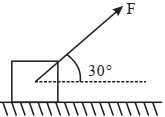
- 5As shown in the figure a block of mass $10\,kg$ lying on a horizontal surface is pulled by a force $F$ acting at an angle $30^{\circ}$, with horizontal. For $\mu_{ s }=0.25$, the block will just start to move for the value of $F..........\,N$ : $\left[\right.$ Given $\left.g =10\,ms ^{-2}\right]$View Solution
- 6A $1\,kg$ block is being pushed against a wall by a force $F = 75\,N$ as shown in the Figure. The coefficient of friction is $0.25.$ The magnitude of acceleration of the block is ........ $m/s^2$View Solution

- 7A stone of mass $0.25\; kg$ tied to the end of a string is whirled round in a circle of radius $1.5 \;m$ with a speed of $40\; rev./min$ in a hortzontal plane. What is the tenston in the string? What is the maximum speed in $m/s $ with which the stone can be whirled around if the string can withstand a maximum tension of $200\; N ?$View Solution
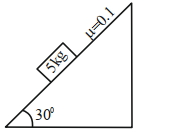
- 8A block of mass $5 \mathrm{~kg}$ is placed on a rough inclined surface as shown in the figure.If $\vec{F}_1$ is the force required to just move the block up the inclined plane and $\vec{F}_2$ is the force required to just prevent the block from sliding down, then the value of $\left|\vec{F}_1\right|-\left|\vec{F}_2\right|$ is : [Use $g=10 \mathrm{~m} / \mathrm{s}^2$ ]View Solution
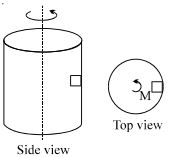
- 9A hollow vertical cylinder of radius $R$ is rotated with angular velocity $\omega$ about an axis through its center. What is the minimum coefficient of static friction necessary to keep the mass $M$ suspended on the inside of the cylinder as it rotates?View Solution
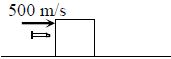
- 10A bullet of mass $20\, g$ travelling horizontally with a speed of $500 \,m/s$ passes through a wooden block of mass $10.0 \,kg$ initially at rest on a surface. The bullet emerges with a speed of $100\, m/s$ and the block slides $20 \,cm$ on the surface before coming to rest, the coefficient of friction between the block and the surface. $(g = 10\, m/s^2)$View Solution