On all the six surfaces of a unit cube, equal tensile force of $F$ is applied. The increase in length of each side will be ($Y =$ Young's modulus, $\sigma $= Poission's ratio)
Medium
Download our app for free and get started
(c) Tensile strain on each face$ = \frac{F}{Y}$
Lateral strain due to the other two forces acting on perpendicular faces$ = \frac{{ - 2\sigma F}}{Y}$
Total increase in length $ = (1 - 2\sigma )\frac{F}{Y}$

Download our appand get started for free
Experience the future of education. Simply download our apps or reach out to us for more information. Let's shape the future of learning together!No signup needed.*
Similar Questions
- 1A wire of length $L$ is hanging from a fixed support. The length changes to $L _{1}$ and $L _{2}$ when masses $1 \,kg$ and $2 \,kg$ are suspended respectively from its free end. Then the value of $L$ is equal to ..................View Solution
- 2The diameter of a brass rod is 4 mm and Young's modulus of brass is $9 \times {10^{10}}\,N/{m^2}$. The force required to stretch by $0.1\%$ of its length isView Solution
- 3If a load of $9$ $kg$ is suspended on a wire, the increase in length is $4.5\, mm$. The force constant of the wire isView Solution
- 4A copper wire of length $1.0\, m$ and a steel wire of length $0.5\, m$ having equal cross-sectional areas are joined end to end. The composite wire is stretched by a certain load which stretches the copper wire by $1\, mm$. If the Young's modulii of copper and steel are respectively $1.0\times10^{11}\, Nm^{-2}$ and $2.0\times10^{11}\, Nm^{- 2}$, the total extension of the composite wire is ........ $mm$View Solution
- 5View SolutionIn suspended type moving coil galvanometer, quartz suspension is used because
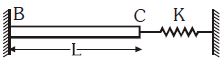
- 6A rod $BC$ of negligible mass fixed at end $B$ and connected to a spring at its natural length having spring constant $K = 10^4\ N/m$ at end $C$, as shown in figure. For the rod $BC$ length $L = 4\ m$, area of cross-section $A = 4 × 10^{-4}\ m^2$, Young's modulus $Y = 10^{11} \ N/m^2$ and coefficient of linear expansion $\alpha = 2.2 × 10^{-4} K^{-1}.$ If the rod $BC$ is cooled from temperature $100^oC$ to $0^oC,$ then find the decrease in length of rod in centimeter.(closest to the integer)View Solution
- 7View SolutionHook's law defines
- 8The Young's modulus of a wire is $y$. If the energy per unit volume is $E$, then the strain will beView Solution
- 9Two wires of copper having the length in the ratio $4 : 1$ and their radii ratio as $1 : 4$ are stretched by the same force. The ratio of longitudinal strain in the two will beView Solution
- 10A steel wire is $1 \,m$ long and $1 \,mm ^2$ in area of cross$-$section. If it takes $200 \,N$ to stretch this wire by $1 \,mm$, how much force will be required to stretch a wire of the same material as well as diameter from its normal length of $10 \,m$ to a length of $1002 \,cm$ is $........ N$View Solution