If a load of $9$ $kg$ is suspended on a wire, the increase in length is $4.5\, mm$. The force constant of the wire is
Easy
Download our app for free and get started
(b) $F = Kx \Rightarrow K = \frac{F}{x} = \frac{{9 \times 9.8}}{{4.5 \times {{10}^{ - 3}}}} = 1.96 \times {10^4}N/m$

Download our appand get started for free
Experience the future of education. Simply download our apps or reach out to us for more information. Let's shape the future of learning together!No signup needed.*
Similar Questions
- 1The Young's modulus of a rubber string $8\, cm$ long and density $1.5\,kg/{m^3}$ is $5 \times {10^8}\,N/{m^2}$, is suspended on the ceiling in a room. The increase in length due to its own weight will beView Solution
- 2A wire extends by $1 mm$ when a force is applied. Double the force is applied to another wire of same material and length but half the radius of cross-section. The elongation of the wire in mm will be ........View Solution
- 3A rubber cord catapult has cross-sectional area $25\,m{m^2}$ and initial length of rubber cord is $10\,cm.$ It is stretched to $5\,cm.$ and then released to project a missile of mass $5gm.$ Taking ${Y_{rubber}} = 5 \times {10^8}N/{m^2}$ velocity of projected missile is ......... $ms^{-1}$View Solution
- 4Compressibility per unit atm. pressure of water is $'\sigma '$ and if due to pressure $P$ there is decrement in volume $V$, find change is volumeView Solution
- 5A steel wire of length $3.2 m \left( Y _{ S }=2.0 \times 10^{11}\,Nm ^{-2}\right)$ and a copper wire of length $4.4\,M$ $\left( Y _{ C }=1.1 \times 10^{11}\,Nm ^{-2}\right)$, both of radius $1.4\,mm$ are connected end to end. When stretched by a load, the net elongation is found to be $1.4\,mm$. The load applied, in Newton, will be. (Given $\pi=\frac{22}{7}$)View Solution
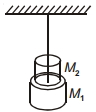
- 6The length of wire, when $M_1$ is hung from it, is $I_1$ and is $I_2$ with both $M_1$ and $M_2$ hanging. The natural length of wire is ........View Solution
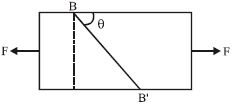
- 7A bar of cross-sectional area $A$ is subjected two equal and opposite tensile forces at its ends as shown in figure. Consider a plane $BB'$ making an angle $\theta $ with the length The ratio of tensile stress to the shearing stress on the plane $BB'$ isView Solution
- 8The ratio of the lengths of two wires $A$ and $B$ of same material is $1 : 2$ and the ratio of their diameter is $2 : 1.$ They are stretched by the same force, then the ratio of increase in length will beView Solution
- 9View SolutionWhich of the following is the graph showing stress-strain variation for elastomers?
- 10If the temperature of a wire of length $2 \,m$ and area of cross-section $1 \,cm ^2$ is increased from $0^{\circ} C$ to $80^{\circ} C$ and is not allowed to increase in length, then force required for it is ............$N$ $\left\{Y=10^{10} \,N / m ^2, \alpha=10^{\left.-6 /{ }^{\circ} C \right\}}\right.$View Solution