Question
On an open ground, a motorist follows a track that turns to his left by an angle of $60^{\circ}$ after every 500 m . Starting from a given turn, specify the displacement of the motorist at the third, sixth and eighth turn. Compare the magnitude of the displacement with the total path length covered by the motorist in each case.
Answer


Image
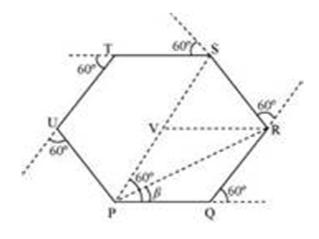
The path followed by the motorist is a regular hexagon with side 500 m , as shown in the given figure.
Let the motorist start from point P . The motorist takes the third turn at S .
Magnitude of displacement $= PS = PV + VS =500+500=1000 m(\because P V=Q R, V S=S R)$
Total path length, $d _1=P Q+Q R+R S=500+500+500=1500 m$
The motorist take the sixth turn at point P , which is the starting point
$\therefore$ Magnitude of displacement $=0$
Total path length, $d _2= PQ + QR + RS + ST + TU + UP$
$
d_2=500+500+500+500+500=3000 m
$
The motorist takes the eight turn at point R
$\therefore$ Magnitude of displacement $= PR$
$
\begin{aligned}
& P R=\sqrt{P Q^2+Q R^2+2(P Q) \cdot(Q R) \cos 60^{\circ}} \\
& P R=\sqrt{500^2+500^2+\left(2 \times 500 \times 500 \times \cos 60^{\circ}\right)} \\
& P R=\sqrt{250000+250000+\left(500000 \times \frac{1}{2}\right)} \\
& P R=866.03 m \\
& \beta=\tan ^{-1}\left(\frac{500 \sin 60^{\circ}}{500+500 \cos 60^{\circ}}\right)=30^{\circ}
\end{aligned}
$
Therefore, the magnitude of displacement is 866.03 m at an angle of $30^{\circ}$ with PR.
Total path length $=$ Circumference of the hexagon $+ PQ + QR$
Total path length $=6 \times 500+500+500=4000 m$
The magnitude of displacement and the total path length corresponding to the required turns is shown in the given table
TurnMagnitude of displacement (m)Total path length (m)
Third10001500
Sixth03000
Eighth$866.03 ; 30^{\circ}$4000

Need a full question paper?

Generate a complete, print-ready paper with questions like this in minutes — across 16+ boards, with answer keys.

Start Generating Free

Similar questions

Suppose the smaller pulley of the previous problem has its radius $5.0cm$ and moment of inertia $0.10kg-m^2$. Find the tension in the part of the string joining the pulleys.
A particle of mass m is projected from origin O with speed u at an angle with positive x-axis. Find the angular momentum of particle at any time t about O before the particle strikes the ground again.
A spring having with a spring constant $1200 N m ^{-1}$ is mounted on a horizontal table as shown in Fig. A mass of 3 kg is attached to the free end of the spring. The mass is then pulled sideways to a distance of 2.0 cm and released.
Image

Take the position of mass when the spring is unstreched as $x=0$, and the direction from left to right as the positive direction of $x$-axis. Give $x$ as a function of time $t$ for the oscillating mass if at the moment we start the stopwatch $(t=0)$, the mass is
a. at the mean position,
b. at the maximum stretched position, and
c. at the maximum compressed position.
In what way do these functions for SHM differ from each other, in frequency, in amplitude or the initial phase?
The magnetic field B and the magnetic intensity H in material are found to be 1.6T and 1000A/m reepectively. Calculate the relative permeability $\mu_\text{r}$ and the susceptibility x of the material.
The figure shows a cylindrical container containing oxygen $(\gamma=1.4)$ and closed by a $50 kg$ frictionless piston. The area of cross section is $100 \mathrm{~cm}^2$, atmospheric pressure is 100 kPa and g is $10 \mathrm{~m}-\mathrm{s}^{-2}$. The cylinder is slowly heated for some time. Find the amount of heat supplied to the gas if the piston moves out through a distance of $20 cm$ .
A wave travels along the positive x-direction with a speed of 20m/s. The amplitude of the wave is 0.20cm and the wavelength 2.0cm.
  1. Write a suitable wave equation which describes this wave.
  2. What is the displacement and velocity of the particle at x = 2.0cm at time t = 0 according to the wave equation written? Can you get different values of this quantity if the wave equation is written in a different fashion?
Specific heat capacity of argon at constant pressure is $0.125$ cal/ g/ k and at constant volume is $0.075$ cal/ g/ k. Calculate the density of argon at STP. Given $J = 4.18 J/ cal$ and the normal pressure = $1.01 \times 10^5 Nm^{-2}$.
Obtain equations of motion for constant acceleration using method of calculus.
The heavier block in an Atwood machine has a mass twice that of the lighter one. The tension in the string is 16.0N when the system is set into motion. Find the decrease in the gravitational potential energy during the first second after the system is released from rest.
Describe the following :
(i) Velocity gradient (ii) Coefficient of viscosity (iii) Application of viscosity.