Suppose the smaller pulley of the previous problem has its radius $5.0cm$ and moment of inertia $0.10kg-m^2$. Find the tension in the part of the string joining the pulleys.
Download our app for free and get started
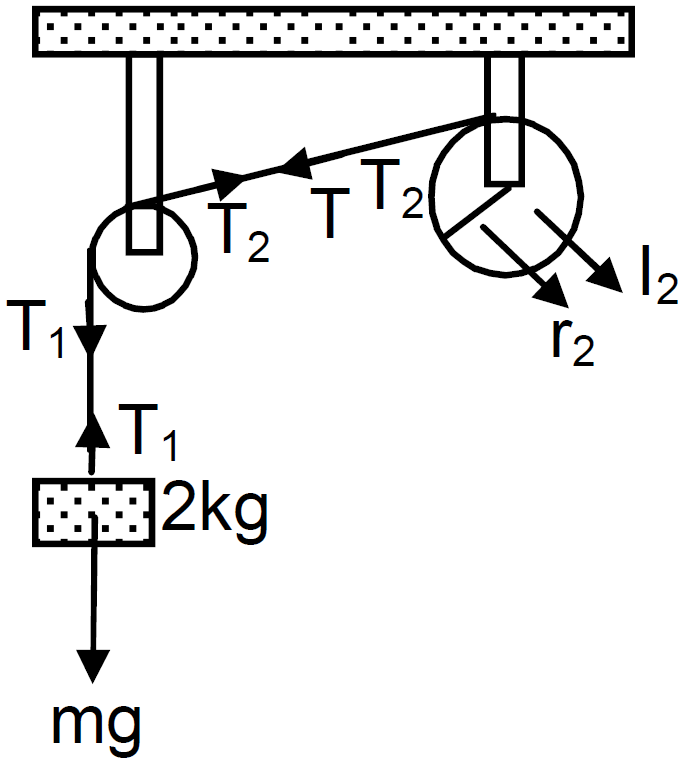
$m = 2kg, i_1 = 0.10kg-m^2, r_1 = 5cm = 0.05m$
$i_2 = 0.20kg-m^2, r_2 = 10cm = 0.1m$
Therefore $\text{mg}-\text{T}_1=\text{ma}\ \dots(1)$
$\big(\text{T}_1-\text{T}_2\big)\text{r}_1=\text{l}_1\alpha\ \dots(2)$
$\text{T}_2\text{r}_2=\text{l}_2\alpha\ \dots(3)$
Substituting the value of $T_2$ in the equation (2), we get
$\Rightarrow\Big(\text{t}_1-\frac{\text{l}_2\alpha}{\text{r}_1}\Big)\text{r}_2=\text{l}_1\alpha$
$\Rightarrow\Big(\text{T}_1-\frac{\text{l}_2\text{a}}{\text{r}_1^2}\Big)=\frac{\text{l}_1\text{a}}{\text{r}_2^2}$
$\Rightarrow\text{T}_1\Big[\Big(\frac{\text{l}_1}{\text{r}_1^2}\Big)+\Big(\frac{\text{l}_2}{\text{r}_2^2}\Big)\Big]\text{a}$
Substituting the value of $T_1$ in the equation (1), we get
$\Rightarrow\text{mg}-\Big[\Big(\frac{\text{l}_1}{\text{r}_1^2}\Big)+\Big(\frac{\text{l}_2}{\text{r}_2^2}\Big)\Big]\text{a}=\text{ma}$
$\Rightarrow\frac{\text{mg}}{\Big[\Big(\frac{l_1}{\text{r}_1^2}\Big)+\Big(\frac{l_2}{\text{r}_2^2}\Big)\Big]+\text{m}}=\text{a}$
$\Rightarrow\text{a}=\frac{2\times9.8}{\Big(\frac{0.1}{0.0025}\Big)+\Big(\frac{0.2}{0.01}\Big)+2}=0.316\text{m/s}^2$
$\Rightarrow\text{T}_2=\frac{\text{l}_2\text{a}}{\text{r}_2^2}=\frac{0.20\times0.316}{0.01}=6.32\text{N}$

Download our appand get started for free
Experience the future of education. Simply download our apps or reach out to us for more information. Let's shape the future of learning together!No signup needed.*
Similar Questions
- 1A uniform sphere of mass m and radius R is placed on a rough horizontal surface. The sphere is struck horizontally at a height h from the floor. Match the following:View Solution
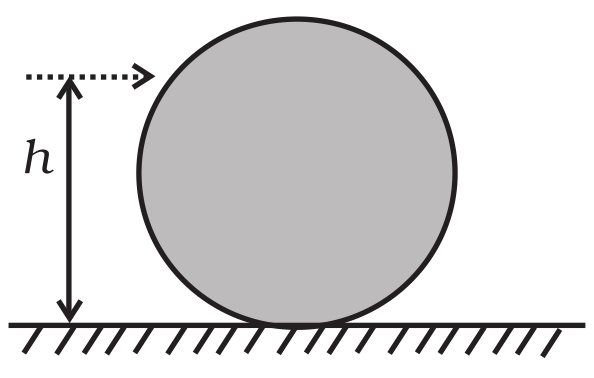
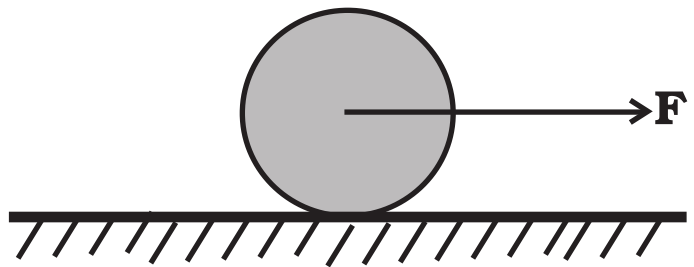
a. $\text{h}=\frac{\text{R}}{2}$ i. Sphere rolls without slipping with a constant velocity and no loss of energy. b. $\text{h}=\text{R}$ ii. Sphere spins clockwise, loses energy by friction. c. $\text{h}=\frac{3\text{R}}{2}$ iii. Sphere spins anti-clockwise, loses energy by friction. d. $\text{h}=\frac{7\text{R}}{5}$ iv. Sphere has only a translational motion, looses energy by friction. - 2A uniform disc of radius R, is resting on a table on its rim.The coefficient of friction between disc and table is $\mu.$Now the disc is pulled with a force F as shown in the figure. What is the maximum value of F for which the disc rolls without slipping?View Solution
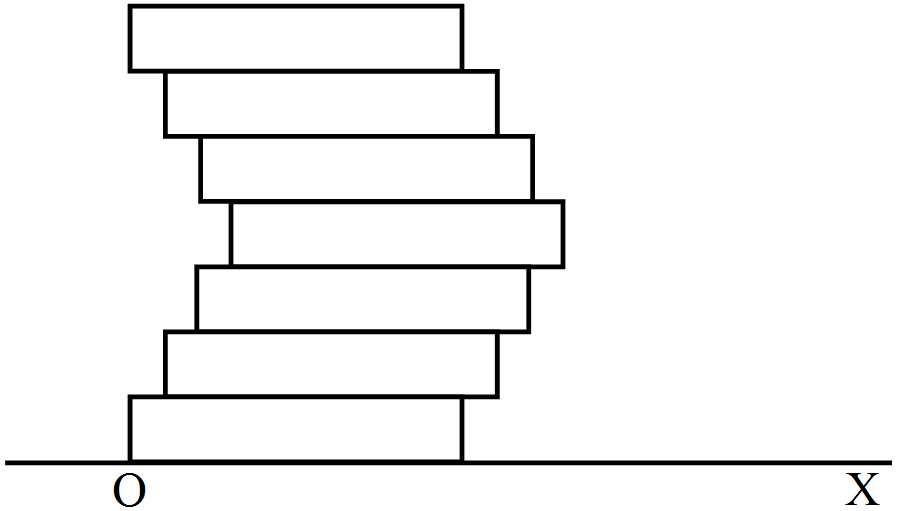
- 3Seven homogeneous bricks, each of length L, are arranged as shown in figure. Each brick is displaced with respect to the one in contact by $\frac{\text{L}}{10}.$ Find the x-coordinate of the centre of mass relative to the origin shown.View Solution
- 4A uniform square plate S(side c) and a uniform rectangular plate R(sides b, a) have identical areas and masses:View Solution
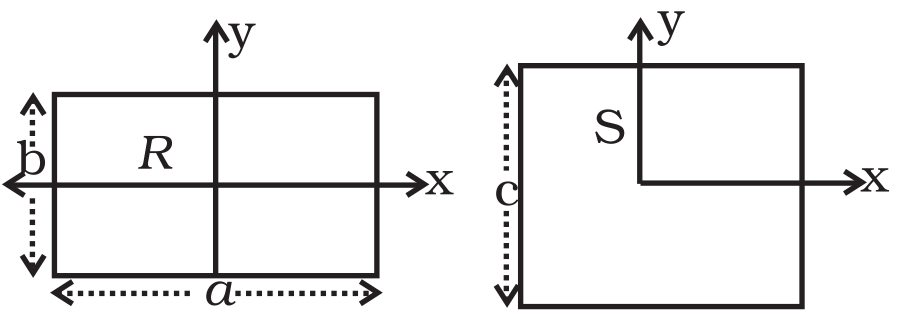
Show that:- $\frac{\text{I}_\text{xR}}{\text{I}_\text{xS}}<1$
- $\frac{\text{I}_\text{ys}}{\text{I}_\text{ys}}>1$
- $\frac{\text{I}_{2\text{R}}}{\text{I}_{2\text{s}}}>1$
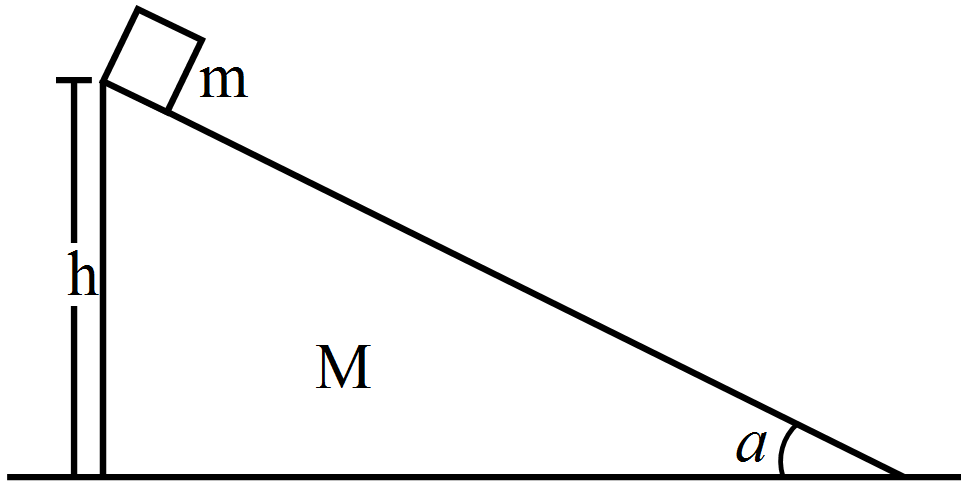
- 5View SolutionA block of mass m is placed on a triangular block of mass M, which in turn is placed on a horizontal surface as shown in figure. Assuming frictionless surfaces find the velocity of the triangular block when the smaller block reaches the bottom end.
- 6View SolutionDefine radius of gyration and give the physical significance of moment of inertia.
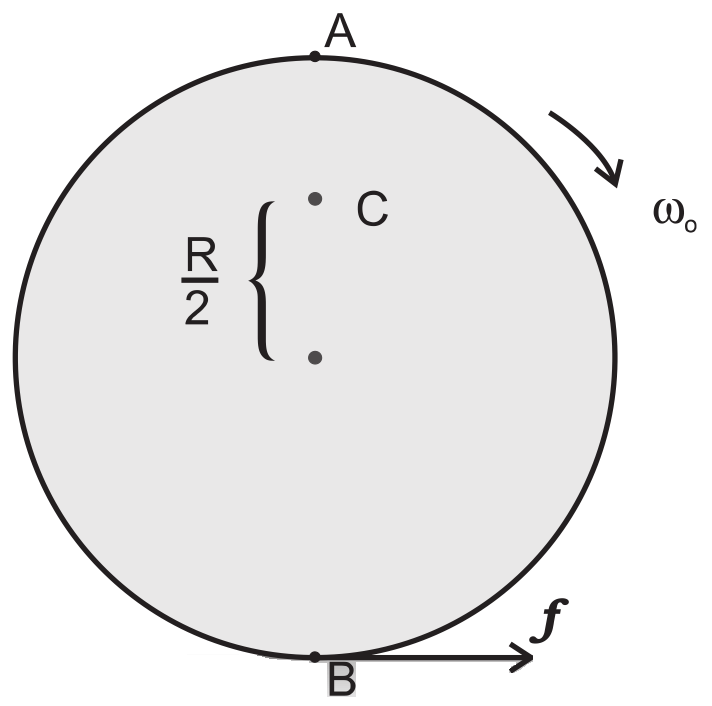
- 7A disc rotating about its axis with angular speed $\omega_0$ is placed lightly (without any translational push) on a perfectly frictionless table. The radius of the disc is R. What are the linear velocities of the points A, B and C on the disc shown in will the disc roll in the direction indicated?View Solution
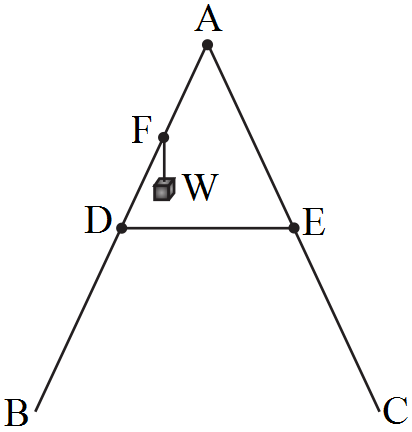
- 8As shown in the two sides of a step ladder BA and CA are 1.6m long and hinged at A. A rope DE, 0.5m is tied half way up. A weight 40kg is suspended from a point F, 1.2m from B along the ladder BA. Assuming the floor to be frictionless and neglecting the weight of the ladder, find the tension in the rope and forces exerted by the floor on the ladder. (Take $g = 9.8m/s^2$) (Hint: Consider the equilibrium of each side of the ladder separately).View Solution
- 9A cylinder of mass $5kg$ and radius $30cm$ and free to rotate about its axis, receives an angular impulse of $3kgm^2 s^{-1}$ followed by a similar impulse after every $4$ seconds. What is the angular speed of the cylinder $30s$ after the initial impulse? The cylinder is at rest initially.View Solution
- 10View SolutionDiscuss the rolling motion of a cylinder on an inclined plane.