On applying a stress of $20 \times {10^8}N/{m^2}$ the length of a perfectly elastic wire is doubled. Its Young’s modulus will be
Medium


Download our appand get started for free
Experience the future of education. Simply download our apps or reach out to us for more information. Let's shape the future of learning together!No signup needed.*
Similar Questions
- 1A substance breaks down by a stress of $10^6 N/m^2$. If the density of the material of the wire is $3×10^3 kg/m^3$, then the length of the wire of the substance which will break under its own weight when suspended vertically, is ......... $m$View Solution
- 2If the interatomic spacing in a steel wire is $3.0Å$ and ${Y_{steel}}$= $20 \times {10^{10}}N/{m^2}$ then force constant isView Solution
- 3The length of wire becomes $l_1$ and $l_2$ when $100\,N$ and $120\,N$ tensions are applied respectively. If $10l_2=11l_1$, the natural length of wire will be $\frac{1}{x} l_1$. Here the value of $x$ is ........View Solution
- 4The Young's modulus of the material of a wire is $6 \times {10^{12}}\,N/{m^2}$ and there is no transverse strain in it, then its modulus of rigidity will beView Solution
- 5The bulk modulus of rubber is $9.1 \times 10^8\,N/m^2$. To what depth a rubber ball be taken in a lake so that its volume is decreased by $0.1\%$ ? ....... $m$View Solution
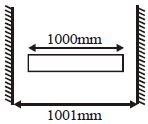
- 6$A$ rod of length $1000\, mm$ and coefficient of linear expansion $a = 10^{-4}$ per degree is placed symmetrically between fixed walls separated by $1001\, mm$. The Young’s modulus of the rod is $10^{11} N/m^2$. If the temperature is increased by $20^o C$, then the stress developed in the rod is ........... $MPa$View Solution
- 7A solid sphere of radius $r$ made of a soft material of bulk modulus $K$ is surrounded by a liquid in a cylindrical container. A massless piston of area $a$ floats on the surface of the liquid, covering entire crosssection of cylindrical container. When a mass $m$ is placed on the surface of the piston to compress the liquid, the fractional decrement in the radius of the sphere, $\left( {\frac{{dr}}{r}} \right)$ isView Solution
- 8When load of $5\,kg$ is hung on a wire then extension of $3\,m$ takes place, then work done will be ....... $joule$View Solution
- 9View SolutionA stretched rubber has
- 10If $x$ longitudinal strain is produced in a wire of Young's modulus $y,$ then energy stored in the material of the wire per unit volume isView Solution