MCQ
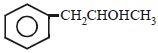
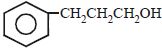
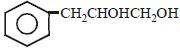
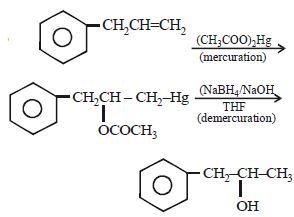
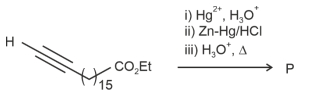
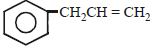
on mercuration and demercuration produces
  • B

  • C

  • D
    none of these

Answer

Correct option: A.

a

Need a full question paper?

Generate a complete, print-ready paper with questions like this in minutes — across 16+ boards, with answer keys.

Start Generating Free

Similar questions

Match the organic compounds in column $-I$ with the Lassaigne's test results in column $-II$ appropriately
Column $-I$ Column $-II$
$(A)$ Aniline $(i)$ Red colour with $FeCl_3$
$(B)$ Benzene sulfonic acid $(ii)$ Violet colour with sodium nitroprusside
$(C)$ Thiourea $(iii)$ Blue colour with hot and acidic solution of $FeSO_ 4$
Select incorrect order of electronegativity of element
In the following reaction sequence, the major product $P$ is formed.  Glycerol reacts completely with excess $P$ in the presence of an acid catalyst to form $Q$. Reaction of $Q$ with excess $NaOH$ followed by the treatment with $CaCl _2$ yields $Ca$-soap $R$, quantitatively. Starting with one mole of $Q$, the amount of $R$ produced in gram is. . . . [Given, atomic weight: $H =1, C =12, N =14, O =16, Na =23, Cl =35, Ca =40$ ]
Yellow ammonium sulphide can separate:
  ${(C{H_3})_2}C = \mathop {CH}\limits_{\mathop {|\,\,\,\,\,\,\,}\limits_{C{H_3}} } \mathop {\xrightarrow{{{\text{Catalyst}}}}}\limits_{{H_2}} $  Optical isomers
Which of the following pairs of species have unpaired electrons in antibonding Molecular Orbital
In a reaction $A + B$ $\rightleftharpoons$ $C + D$, the concentrations of $A$, $B$, $C$ and $D$ (in moles/litre) are $0.5$, $0.8$, $0.4$ and $1.0$ respectively. The equilibrium constant is
A solution which maintains constant $\ce{pH}$ when small amounts of acid or alkali are added is known as $ .........$
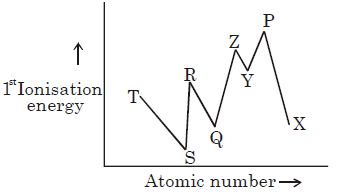
In given graph which represents an alkali metal with least atomic number (Period number $= 3$ )
A metal used in storage batteries is