On observing light from three different stars $P, Q$ and $R$, it was found that intensity of violet colour is maximum in the spectrum of $P$, the intensity of green colour is maximum in the spectrum of $R$ and the intensity of red colour is maximum in the spectrum of $Q$. If $T_P, T_Q$ and $T_R$ are the respective absolute temperatures of $P, Q$ and $R$, then it can be concluded from the above observations that
AIPMT 2015, Medium
Download our app for free and get started
According to $Wein's$ displacement law
${\lambda _m}T = constant$ $...(i)$
For star $P,$ instensity of violet colour is maximum
For star $Q,$ instensity of red colour is maximum.
For star $R,$ intensity of green colour is maximum.
$Also,{\lambda _r} > {\lambda _g} > {\lambda _v}$
Using equation $(i)$, ${T_r} < {T_g} < {T_v}$
${T_Q} < {T_R} < {T_P}$

Download our appand get started for free
Experience the future of education. Simply download our apps or reach out to us for more information. Let's shape the future of learning together!No signup needed.*
Similar Questions
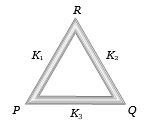
- 1hree rods of same dimensions are arranged as shown in figure they have thermal conductivities ${K_1},{K_2}$ and${K_3}$ The points $P$ and $Q$ are maintained at different temperatures for the heat to flow at the same rate along $PRQ$ and $PQ$ then which of the following option is correctView Solution
- 2View SolutionFollowing graph shows the correct variation in intensity of heat radiations by black body and frequency at a fixed temperature
- 3A metal ball of surface area $200\;c{m^2}$ and temperature ${527^o}C$ is surrounded by a vessel at ${27^o}C$. If the emissivity of the metal is $0.4$ , then the rate of loss of heat from the ball is .......... $joules $ approx. $(\sigma = 5.67 \times {10^{ - 8}}J/{m^2}\; - s - {k^4})$View Solution
- 4A black body at $200 K$ is found to exit maximum energy at a wavelength of $14\mu m$. When its temperature is raised to $1000K$ , the wavelength at which maximum energy is emitted isView Solution
- 5An incandescent bulb has a thin filament of tungsten that is heated to high temperature by passing an electric current. The hot filament emits black-body radiation. The filament is observed to break up at random locations after a sufficiently long time of operation due to non-uniform evaporation of tungsten from the filament. If the bulb is powered at constant voltage, which of the following statement($s$) is(are) true?View Solution
($A$) The temperature distribution over the filament is uniform
($B$) The resistance over small sections of the filament decreases with time
($C$) The filament emits more light at higher band of frequencies before it breaks up
($D$) The filament consumes less electrical power towards the end of the life of the bulb
- 6The ratio of thermal conductivity of two rods of different material is $5 : 4$ . The two rods of same area of cross-section and same thermal resistance will have the lengths in the ratioView Solution
- 7A certain stellar body has radius $50 \,R_{s}$ and temperature $2 \,T_{s}$ and is at a distance of $2 \times 10^{10} \,AU$ from the earth. Here, $AU$ refers to the earth-sun distance and $R_{s}$ and $T_{s}$ refer to the sun's radius and temperature, respectively. Take, both star and sun to be ideal black bodies. The ratio of the power received on earth from the stellar body as compared to that received from the sun is close toView Solution
- 8View SolutionWhich of the following is more closed to a black body?
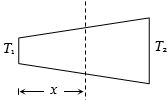
- 9Radius of a conductor increases uniformly from left end to right end as shown in fig.Material of the conductor is isotropic and its curved surface is thermally isolated from surrounding. Its ends are maintained at temperatures $T_1$ and $T_2$ ($T_1$ > $T_2$): If, in steady state, heat flow rate is equal to $H$ , then which of the following graphs is correctView Solution
- 10Assuming the sun to have a spherical outer surface of radius $r$, radiating like a black body at temperature $t^o C$, the power received by a unit surface, (normal to the incident rays) at a distance $R$ from the centre of the sun isView Solution
where $\sigma$ is the Stefan's constant.