Following graph shows the correct variation in intensity of heat radiations by black body and frequency at a fixed temperature
Medium
Download our app for free and get started
(c)According to Wein's law ${\lambda _m} \propto \frac{1}{T}$==> ${\nu _m} \propto T$. As the temperature of body increases, frequency corresponding to maximum energy in radiation ($V_m$) increases this is shown in graph $(c)$ .

Download our appand get started for free
Experience the future of education. Simply download our apps or reach out to us for more information. Let's shape the future of learning together!No signup needed.*
Similar Questions
- 1A partition wall has two layers $A$ and $B$ in contact, each made of a different material. They have the same thickness but the thermal conductivity of layer $A$ is twice that of layer $B$. If the steady state temperature difference across the wall is $60K$, then the corresponding difference across the layer $A$ is ....... $K$View Solution
- 2Two spherical bodies $\mathrm{A}$ (radius $6 \mathrm{~cm}$ ) and $\mathrm{B}$ (radius $18 \mathrm{~cm}$ ) are at temperature $\mathrm{T}_1$ and $\mathrm{T}_2$, respectively. The maximum intensity in the emission spectrum of $\mathrm{A}$ is at $500 \mathrm{~nm}$ and in that of $\mathrm{B}$ is at $1500 \mathrm{~nm}$. Considering them to be black bodies, what will be the ratio of the rate of total energy radiated by $A$ to that of $B$ ?View Solution
- 3If temperature of $Sun =6000\, K ,$ radius of Sun is $7.2 \times 10^{5}\, Km$ radius of Earth $=6000 \,Km \&$ distance between earth and $Sum =15 \times 10^{7}\, Km .$ Find intensity of light on Earth.View Solution
- 4View SolutionOn heating one end of a rod, the temperature of whole rod will be uniform when
- 5View SolutionIn rainy season, on a clear night the black seat of a bicycle becomes wet because
- 6$Assertion :$ A brass tumbler feels much colder than a wooden tray on a chilly day.View Solution
$Reason :$ The thermal conductivity of brass is more than the thermal conductivity of wood.
- 7Four rods of identical cross-sectional area and made from the same metal form the sides of square. The temperature of two diagonally opposite points and $T$ and $\sqrt 2 $ $T$ respective in the steady state. Assuming that only heat conduction takes place, what will be the temperature difference between other two pointsView Solution
- 8The temperature gradient in a rod of $0.5 m$ long is ${80^o}C/m$. If the temperature of hotter end of the rod is ${30^o}C$, then the temperature of the cooler end is ...... $^oC$View Solution
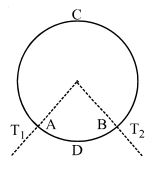
- 9Aring consisting of two parts $ADB$ and $ACB$ of same conductivity $k$ carries an amount of heat $H$. The $ADB$ part is now replaced with another metal keeping the temperatures $T_1$ and $T_2$ constant. The heat carried increases to $2H$. What $ACB$ should be the conductivity of the new$ADB$ part? Given $\frac{{ACB}}{{ADB}}= 3$View Solution
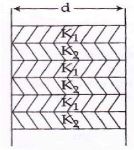
- 10A wall consists of alternating blocks of length $d$ and coefficient of thermal conductivity $K_{1}$ and $K_{2}$ respectively as shown in figure. The cross sectional area of the blocks are the same. The equivalent coefficient of thermal conductivity of the wall between left and right isView Solution