MCQ
One astronomical unit is a distance equal to ...... $m$
  • A
    $9.46 \times 10^{15}$
  • $1.496 \times 10^{11}$
  • C
    $3 \times 10^8$
  • D
    $3.08 \times 10^{16}$

Answer

Correct option: B.
$1.496 \times 10^{11}$
b
(b)

One astronomical unit is the average distance between earth and sun

$1 \text { astronomical unit }( AU )=1.496 \times 10^{11} \,m$

Need a full question paper?

Generate a complete, print-ready paper with questions like this in minutes — across 16+ boards, with answer keys.

Start Generating Free

Similar questions

On a frictionless horizontal plane, a bob of mass $m=0.1 kg$ is attached to a spring with natural length $l_0=0.1 m$. The spring constant is $k_1=0.009 Nm ^{-1}$ when the length of the spring $I > l_0$ and is $k_2=0.016 Nm ^{-1}$ when $ I < l_0$. Initially the bob is released from $l=0.15 m$. Assume that Hooke's law remains valid throughout the motion. If the time period of the full oscillation is $T=(n \pi) s$, then the integer closest to $n$ is. . . . .
Identify the pair of physical quantities which have different dimensions 
A ball is thrown vertically upward with a velocity of $19.6 m / s$. In how many seconds will the ball reach its maximum height?
At a height $0.4\, m$ from the ground, the velocity of a projectile in vector form is $\vec v = \left( {6\hat i + 2\hat j} \right)\,m/{s}$. The angle of projection is ...... $^o$ $(g = 10\, m/s^2)$ 
$50 \,cal$ of heat is required to raise the temperature of $1$ mole of an ideal gas from $20^{\circ} C$ to $25^{\circ} C$, while the pressure of the gas is kept constant. The amount of heat required to raise the temperature of the same gas through same temperature range at constant volume is ........ $cal$ $(R=2 \,cal / mol -K )$
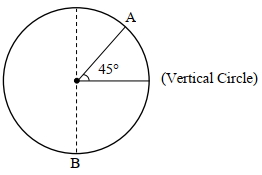
A body of $\mathrm{m} \mathrm{kg}$ slides from rest along the curve of vertical circle from point $A$ to $B$ in friction less path. The velocity of the body at $B$ is:

(given, $\mathrm{R}=14 \mathrm{~m}, \mathrm{~g}=10 \mathrm{~m} / \mathrm{s}^2$ and $\sqrt{2}=1.4$ )
A particle is in uniform circular motion, then its velocity is perpendicular to
An ideal gas undergoes isothermal process from some initial state i to final state f. Choose the correct alternatives.
A sample of gas at temperature $\mathrm{T}$ is adiabatically expanded to double its volume. Adiabatic constant for the gas is $\gamma=3 / 2$. The work done by the gas in the process is : $(\mu=1 \mathrm{~mole})$
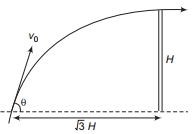
A projectile is thrown at an angle $\theta$ such that it is just able to cross a vertical wall at its highest point as shown in the figure.The angle $\theta$ at which the projectile is thrown is given by