One end of a slack wire (Young's modulus $Y$, length $L$ and cross-sectional area $A$ ) is clamped to a rigid wall and the other end to a block (mass $m$ ), which rests on a smooth horizontal plane. The block is set in motion with a speed $v$. What is the maximum distance, then the block will travel after the wire becomes taut?
KVPY 2015, Diffcult


Download our appand get started for free
Experience the future of education. Simply download our apps or reach out to us for more information. Let's shape the future of learning together!No signup needed.*
Similar Questions
- 1View SolutionThe longitudinal strain is only possible in
- 2A substance breaks down by a stress of $10^6 N/m^2$. If the density of the material of the wire is $3×10^3 kg/m^3$, then the length of the wire of the substance which will break under its own weight when suspended vertically, is ......... $m$View Solution
- 3A steel wire of diameter $2 \,mm$ has a breaking strength of $4 \times 10^5 \,N.$ the breaking force $......... \times 10^5 \,N$ of similar steel wire of diameter $1.5 \,mm$ ?View Solution
- 4If $x$ longitudinal strain is produced in a wire of Young's modulus $y,$ then energy stored in the material of the wire per unit volume isView Solution
- 5If a load of $9$ $kg$ is suspended on a wire, the increase in length is $4.5\, mm$. The force constant of the wire isView Solution
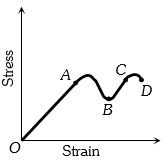
- 6View SolutionA graph is shown between stress and strain for a metal. The part in which Hooke's law holds good is
- 7Two wires of copper having the length in the ratio $4 : 1$ and their radii ratio as $1 : 4$ are stretched by the same force. The ratio of longitudinal strain in the two will beView Solution
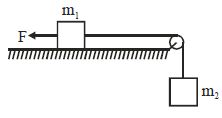
- 8Consider the situation shown in figure. The force $F$ is equal to the $m_2g/2.$ If the area of cross-section of the string is $A$ and its Young's modulus $Y$, find the strain developed in it. The string is light and there is no friction anywhereView Solution
- 9How much force is required to produce an increase of $0.2\%$ in the length of a brass wire of diameter $0.6\, mm$ (Young’s modulus for brass = $0.9 \times {10^{11}}N/{m^2}$)View Solution
- 10View SolutionHook's law defines