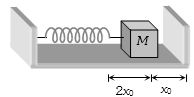
One end of a spring of force constant k is fixed to a vertical wall and the other to a block of mass m resting on a smooth horizontal surface. There is another wall at a distance ${x_0}$ from the black. The spring is then compressed by $2{x_0}$ and released. The time taken to strike the wall is
Diffcult
Download our app for free and get started
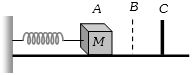
(c) The total time from $A$ to $C$
${t_{Ac}} = {t_{AB}} + {t_{BC}}$
$ = (T/4) + {t_{BC}}$
where $T =$ time period of oscillation of spring mass system
${t_{BC}}$ can be obtained from, $BC = AB\sin (2\pi /T)\,{t_{BC}}$
Putting $\frac{{BC}}{{AB}} = \frac{1}{2}$ we obtain ${t_{BC}} = \frac{T}{{12}}$
==> ${t_{AC}} = \frac{T}{4} + \frac{T}{{12}} = \frac{{2\pi }}{3}\sqrt {\frac{m}{k}} $.
${t_{Ac}} = {t_{AB}} + {t_{BC}}$
$ = (T/4) + {t_{BC}}$
where $T =$ time period of oscillation of spring mass system
${t_{BC}}$ can be obtained from, $BC = AB\sin (2\pi /T)\,{t_{BC}}$
Putting $\frac{{BC}}{{AB}} = \frac{1}{2}$ we obtain ${t_{BC}} = \frac{T}{{12}}$
==> ${t_{AC}} = \frac{T}{4} + \frac{T}{{12}} = \frac{{2\pi }}{3}\sqrt {\frac{m}{k}} $.

Download our appand get started for free
Experience the future of education. Simply download our apps or reach out to us for more information. Let's shape the future of learning together!No signup needed.*
Similar Questions
- 1A particle undergoing simple harmonic motion has time dependent displacement given by $x(t)\, = \,A\,\sin \,\frac{{\pi t}}{{90}}$. The ratio of kinetic to potential energy $o$ the particle at $t=210\,s$ will beView Solution
- 2The variation of kinetic energy $(KE)$ of a particle executing simple harmonic motion with the displacement $(x)$ starting from mean position to extreme position $(A)$ is given byView Solution
- 3A ring of diameter $2m$ oscillates as a compound pendulum about a horizontal axis passing through a point at its rim. It oscillates such that its centre move in a plane which is perpendicular to the plane of the ring. The equivalent length of the simple pendulum is .... $m$View Solution
- 4A body executing simple harmonic motion has a maximum acceleration equal to $ 24\,metres/se{c^2} $ and maximum velocity equal to $ 16\;metres/sec $. The amplitude of the simple harmonic motion isView Solution
- 5The time period of a mass suspended from a spring is $T$. If the spring is cut into four equal parts and the same mass is suspended from one of the parts, then the new time period will beView Solution
- 6Two particles undergo $SHM$ along parallel lines with the same time period $(T)$ and equal amplitudes. At a particular instant, one particle is at its extreme position while the other is at its mean position. They move in the same direction. They will cross each other after a further timeView Solution
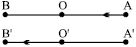
- 7A spring has a certain mass suspended from it and its period for vertical oscillation is $T$. The spring is now cut into two equal halves and the same mass is suspended from one of the halves. The period of vertical oscillation is nowView Solution
- 8View SolutionResonance is an example of
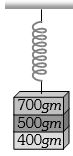
- 9Three masses $700g, 500g$, and $400g$ are suspended at the end of a spring a shown and are in equilibrium. When the $700g$ mass is removed, the system oscillates with a period of $3$ seconds, when the $500 \,gm$ mass is also removed, it will oscillate with a period of ...... $s$View Solution
- 10Two bodies $M$ and $N $ of equal masses are suspended from two separate massless springs of force constants $k_1$ and $k_2$ respectively. If the two bodies oscillate vertically such that their maximum velocities are equal, the ratio of the amplitude $M$ to that of $N$ isView Solution