Two bodies $M$ and $N $ of equal masses are suspended from two separate massless springs of force constants $k_1$ and $k_2$ respectively. If the two bodies oscillate vertically such that their maximum velocities are equal, the ratio of the amplitude $M$ to that of $N$ is
AIEEE 2003,IIT 1988, Medium
Download our app for free and get started
(d) Maximum velocity $ = a\omega = a\sqrt {\frac{k}{m}} $
Given that ${a_1}\sqrt {\frac{{{K_1}}}{m}} = {a_2}\sqrt {\frac{{{K_2}}}{m}} $
==> $\frac{{{a_1}}}{{{a_2}}} = \sqrt {\frac{{{K_2}}}{{{K_1}}}} $

Download our appand get started for free
Experience the future of education. Simply download our apps or reach out to us for more information. Let's shape the future of learning together!No signup needed.*
Similar Questions
- 1A particle of mass $m$ oscillates with simple harmonic motion between points ${x_1}$ and ${x_2}$, the equilibrium position being $O$. Its potential energy is plotted. It will be as given below in the graphView Solution
- 2The equation of a simple harmonic motion is $X = 0.34\cos (3000t + 0.74)$ where $X$ and $t$ are in $mm$ and $sec$. The frequency of motion isView Solution
- 3A bead of mass $m$ is attached to the mid-point of a tant, weightless string of length $l$ and placed on a frictionless horizontal table.Under a small transverse displacement $x$, as shown in above figure. If the tension in the string is $T$, then the frequency of oscillation isView Solution
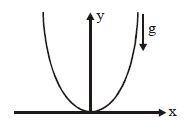
- 4A particle of mass $5 × 10^{-5}\ kg$ is placed at lowest point of smooth parabola $x^2 = 40y$ ( $x$ and $y$ in $m$ ). If it is displaced slightly such that it is constrained to move along parabola, angular frequency of oscillation (in $rad/s$) will be approximately:-View Solution
- 5A rectangular block of mass $5\,kg$ attached to a horizontal spiral spring executes simple harmonic motion of amplitude $1\,m$ and time period $3.14\,s$. The maximum force exerted by spring on block is $.......N$.View Solution
- 6Four simple harmonic vibrations:View Solution
${y_1} = 8\,\cos\, \omega t;\,{y_2} = 4\,\cos \,\left( {\omega t + \frac{\pi }{2}} \right)$ ;
${y_3} = 2\cos \,\left( {\omega t + \pi } \right);\,{y_4} = \,\cos \,\left( {\omega t + \frac{{3\pi }}{2}} \right)$ ,
are superposed on each other. The resulting amplitude and phase are respectively;
- 7A body is executing simple harmonic motion with frequency $'n',$ the frequency of its potential energy is :View Solution
- 8A particle is performing simple harmonic motion with amplitude A and angular velocity ${\omega }$. The ratio of maximum velocity to maximum acceleration isView Solution
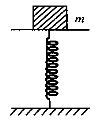
- 9A mass of $2.0\, kg$ is put on a flat pan attached to a vertical spring fixed on the ground as shown in the figure. The mass of the spring and the pan is negligible. When pressed slightly and released the mass executes a simple harmonic motion. The spring constant is $200\, N/m.$ What should be the minimum amplitude of the motion so that the mass gets detached from the pan (take $g = 10 m/s^2$).View Solution
- 10Function $x$ = $A sin^2 wt + B cos^2 wt + C sin wt \ cos wt$ does not represents $SHM$ for this conditionView Solution