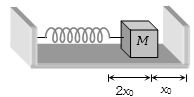
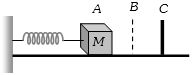
One end of a spring of force constant k is fixed to a vertical wall and the other to a block of mass m resting on a smooth horizontal surface. There is another wall at a distance ${x_0}$ from the black. The spring is then compressed by $2{x_0}$ and released. The time taken to strike the wall is
Diffcult


Download our appand get started for free
Experience the future of education. Simply download our apps or reach out to us for more information. Let's shape the future of learning together!No signup needed.*
Similar Questions
- 1A $5\, kg$ collar is attached to a spring of spring constant $500\, Nm^{-1}$. It slides without friction over a horizontal rod. The collar is displaced from its equillibrium position by $10\, cm$ and released. The time period of oscillation isView Solution
- 2View SolutionThe graph between velocity and position for a damped oscillation will be
- 3The potential energy of a particle of mass $4\,kg$ in motion along the $x$-axis is given by $U =4(1-\cos 4 x )\,J$. The time period of the particle for small oscillation $(\sin \theta \simeq \theta)$ is $\left(\frac{\pi}{ K }\right)\,s$. The value of $K$ is .......View Solution
- 4A particle excutes $SHM$ on a straight line path. The amplitude of oscillation is $2\,cm$. When the displacement of the particle from the mean position is $1\,cm$, the numerical value of magnitude of acceleration is equal to the numerical value of magnitude of velocity. The frequency of $SHM$ is (in $second^{-1}$)View Solution
- 5The equation of an $S.H.M.$ with amplitude $A$ and angular frequency $\omega$ in which all the distances are measured from one extreme position and time is taken to be zero at the other extreme position is ...View Solution
- 6A particle executing simple harmonic motion with amplitude of $0.1 \,m$. At a certain instant when its displacement is $0.02 \,m$, its acceleration is $0.5 \,m/s^2$. The maximum velocity of the particle is (in $m/s$)View Solution
- 7A solid cylinder of density $\rho_0$, cross-section area $A$ and length $l$ floats in a liquid of density $\rho\left( >\rho_0\right)$ with its axis vertical, as shown. If it is slightly displaced downward and released, the time period will be .......View Solution
- 8The amplitude of a particle executing $SHM$ is $3\,cm$. The displacement at which its kinetic energy will be $25 \%$ more than the potential energy is: $.............cm$.View Solution
- 9Two $SHM$ are represented by equations, $y_1 = 6\cos \left( {6\pi t + \frac{\pi }{6}} \right)\,,{y_2} = 3\left( {\sqrt 3 \sin 3\pi t + \cos 3\pi t} \right)$View Solution
- 10The particle executing simple harmonic motion has a kinetic energy $K_0cos^2 \omega t$. The maximum values of the potential energy and the total energy are respectivelyView Solution