The ratio of Young's modulus of the material of two wires is $2 : 3.$ If the same stress is applied on both, then the ratio of elastic energy per unit volume will be
Medium


Download our appand get started for free
Experience the future of education. Simply download our apps or reach out to us for more information. Let's shape the future of learning together!No signup needed.*
Similar Questions
- 1A material has Poisson's ratio $0.5$. If a uniform rod of it suffers a longitudinal strain of $3 \times 10^{-3}$, what will be percentage increase in volume is .......... $\%$View Solution
- 2When a force is applied on a wire of uniform cross-sectional area $3 \times {10^{ - 6}}\,{m^2}$ and length $4m$, the increase in length is $1\, mm.$ Energy stored in it will be $(Y = 2 \times {10^{11}}\,N/{m^2})$View Solution
- 3When a certain weight is suspended from a long uniform wire, its length increases by one cm. If the same weight is suspended from another wire of the same material and length but having a diameter half of the first one then the increase in length will be ........ $cm$View Solution
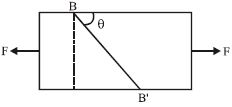
- 4A bar of cross-sectional area $A$ is subjected two equal and opposite tensile forces at its ends as shown in figure. Consider a plane $BB'$ making an angle $\theta $ with the length The ratio of tensile stress to the shearing stress on the plane $BB'$ isView Solution
- 5View SolutionWhen compared with solids and liquids, the gases have
- 6View SolutionThe only elastic modulus that applies to fluids is
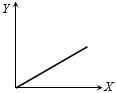
- 7A student plots a graph from his reading on the determination of Young’s modulus of a metal wire but forgets to label. The quantities on $X$ and $Y$ axes may be respectively.View Solution
- 8In $CGS$ system, the Young's modulus of a steel wire is $2 \times {10^{12}}$. To double the length of a wire of unit cross-section area, the force required isView Solution
- 9A steel wire of lm long and $1\,m{m^2}$ cross section area is hang from rigid end. When weight of $1\,kg$ is hung from it then change in length will be given ..... $mm$ $(Y = 2 \times {10^{11}}N/{m^2})$View Solution
- 10The area of cross-section of a wire of length $1.1$ metre is $1$ $mm^2$. It is loaded with $1 \,kg.$ If Young's modulus of copper is $1.1 \times {10^{11}}\,N/{m^2}$, then the increase in length will be ......... $mm$ (If $g = 10\,m/{s^2})$View Solution