Question
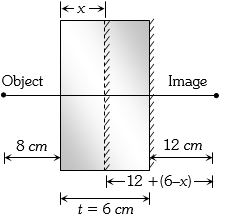
One face of a rectangular glass plate $6 \,cm$ thick is silvered. An object held $8\, cm$ in front of the first face, forms an image $12\, cm$ behind the silvered face. The refractive index of the glass is

Answer

(c) Let $ x$ be the apparent position of the silvered surface.

According to property of plane mirror

$x + 8 = 12 + 6 -x  \Rightarrow x = 5 cm$

Also $\mu = \frac{t}{x}$$ \Rightarrow $$\mu = \frac{6}{5} = 1.2$
Need a full question paper?

Generate a complete, print-ready paper with questions like this in minutes — across 16+ boards, with answer keys.
Start Generating Free

Similar questions

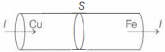
Two rods of copper and iron with the same cross-sectional area are joined at $S$ and a steady current $I$ flows through the rods as shown in the figure. Choose the most appropriate representation of charges accumulated near the junction $S$.
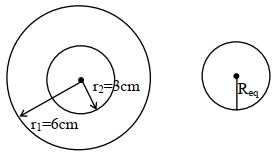
A soap bubble of radius $3\, {cm}$ is formed inside the another soap bubble of radius $6\, {cm}$. The radius of an equivalent soap bubble which has the same excess pressure as inside the smaller bubble with respect to the atmospheric pressure is .......... ${cm}$ 
If black wire of platinum is heated, then its colour first appear red, then yellow and finally white. It can be understood on the basis of
A spring balance is graduated on sea level. If a body is weighed with this balance at consecutively increasing heights from earth's surface, the weight indicated by the balance
If $V$ denotes the potential difference across the plates of a capacitor of capacitance $C$, the dimensions of $C{V^2}$are
Velocity of light in glass whose refractive index with respect to air is $1.5$ is $2 \times 10^8 m/s$ and in certain liquid the velocity of light found to be $2.5 \times 10^8 m/s$. The refractive index of the liquid with respect to air is
A spring is stretched by $5 \,\mathrm{~cm}$ by a force $10 \,\mathrm{~N}$. The time period of the oscillations when a mass of $2 \,\mathrm{~kg}$ is suspended by it is :(in $s$)
The maximum velocity of electrons emitted from a metal surface is $V$. When frequency of light falling on it is $f$. The maximum velocity when frequency becomes $4f$ is
For non-conductors, the energy gap is
A solid cylinder of density $\rho_0$, cross-section area $A$ and length $l$ floats in a liquid of density $\rho\left( >\rho_0\right)$ with its axis vertical, as shown. If it is slightly displaced downward and released, the time period will be .......