MCQ
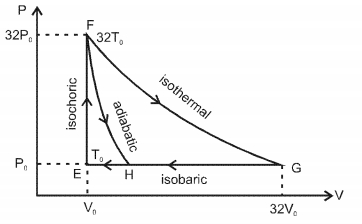
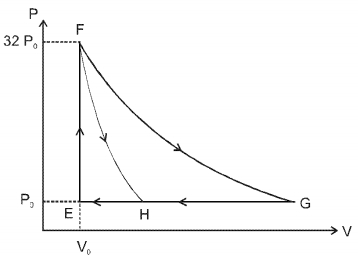
One mole of a monatomic ideal gas is taken along two cyclic processes $E \rightarrow F \rightarrow G \rightarrow E$ and $E \rightarrow F \rightarrow H \rightarrow$ E as shown in the $PV$ diagram. The processes involved are purely isochoric, isobaric, isothermal or adiabatic. $Image$

Match the paths in List $I$ with the magnitudes of the work done in List $II$ and select the correct answer using the codes given below the lists.

List $I$ List $I$
$P.$ $\quad G \rightarrow E$ $1.$ $\quad 160 P_0 V_0 \ln 2$
$Q.$ $\quad G \rightarrow H$ $2.$ $\quad 36 P _0 V _0$
$R.$ $\quad F \rightarrow H$ $3.$ $\quad 24 P _0 V _0$
$S.$ $\quad F \rightarrow G$ $4.$ $\quad 31 P_0 V_0$

Codes: $ \quad  \quad P \quad Q \quad R \quad S $ 
  • $\quad 4 \quad 3 \quad 2 \quad 1 $
  • B
    $\quad 4 \quad 3 \quad 1 \quad 2 $
  • C
    $\quad 3 \quad 1 \quad 2 \quad 4 $
  • D
    $\quad 1 \quad 3 \quad 2 \quad 4 $

Answer

Correct option: A.
$\quad 4 \quad 3 \quad 2 \quad 1 $
a
In $F \rightarrow G$ work done in isothermal proces is $n R T \ln \left(\frac{V_f}{V_i}\right)=32 P_0 V_0 \ln \left(\frac{32 V_0}{V_0}\right)$

$=32 P_0 V_0 \ln 2^5=160 P_0 V_0 \ln 2 $

$\ln G \rightarrow E, \Delta W=P_0 \Delta V=P_0\left(31 V_0\right)=31 P_0 V_0$

In $G \rightarrow H$ work done is less than $31 P_0 V_0$ i.e., $24 P_0 V_0$

In $F \rightarrow H$ work done is $36 P _0 V _0$

Need a full question paper?

Generate a complete, print-ready paper with questions like this in minutes — across 16+ boards, with answer keys.

Start Generating Free

Similar questions

Radius of an air bubble at the bottom of the lake is $r$  and it becomes $ 2r $ when the air bubbles rises to the top surface of the lake. If $P $ $cm$  of water be the atmospheric pressure, then the depth of the lake is
A closed hollow insulated cylinder is filled with gas at ${0^o}C$ and also contains an insulated piston of negligible weight and negligible thickness at the middle point. The gas on one side of the piston is heated to ${100^o}C.$ If the piston moves $5\,cm,$ the length of the hollow cylinder is ..... $cm$
A vernier callipers has $20$ divisions on the vernier scale, which coincides with $19^{\text {th }}$ division on the main scale. The least count of the instrument is $0.1 \mathrm{~mm}$. One main scale division is equal to $. . .  . . ..$ $\mathrm{mm}$
The decimal equivalent of $\frac {1}{20} $ upto three significant figures is
A ball is thrown from a point with a speed ${v_o}$ at an angle of projection $\theta $. From the same point and at the same instant a person starts running with a constant speed ${v_o}/2$ to catch the ball. Will the person be able to catch the ball? If yes, what should be the angle of projection
Force acts for $20\,s$ on a body of mass $20\,kg$, starting from rest, after which the force ceases and then body describes $50\,m$ in the next $10\,s$. The value of force will be $..........\,N$
A small disc is on the top of a hemisphere of radius $R$. What is the smallest horizontal velocity v that should be given to the disc for it to leave the hemisphere and not slide down it ? [There is no friction]
A thin hollow cylinder open at both ends:

$(i)$ Slides without rotating

$(ii)$ Rolls without slipping, with the same speed

A rod of mass $M$ and length $l$ is at rest on plane horizontal smooth surface. A particle of same mass $M$ strike one end with velocity $u$ perpendicular to rod, elastically. Now just after collision what is the kinetic energy of upper half part of rod.
A small object placed on a rotating horizontal turn table just slips when it is placed at a distance $4\, cm$ from the axis of rotation. If the angular velocity of the turn-table is doubled, the object slips when its distance from the axis of rotation is