One mole of an ideal monoatomic gas is heated at a constant pressure of one atmosphere from ${0^o}C$ to ${100^o}C$. Then the change in the internal energy is
Medium
Download our app for free and get started
(c) Change in internal energy is always equal to the heat supplied at constant volume.
i.e. $\Delta U = {(\Delta Q)_V} = \mu {C_V}\Delta T.$
For monoatomic gas ${C_V} = \frac{3}{2}R$
==> $\Delta U = \mu \,\left( {\frac{3}{2}R} \right)\Delta T = 1 \times \frac{3}{2} \times 8.31 \times (100 - 0)$
$ = 12.48 \times {10^2}J$
i.e. $\Delta U = {(\Delta Q)_V} = \mu {C_V}\Delta T.$
For monoatomic gas ${C_V} = \frac{3}{2}R$
==> $\Delta U = \mu \,\left( {\frac{3}{2}R} \right)\Delta T = 1 \times \frac{3}{2} \times 8.31 \times (100 - 0)$
$ = 12.48 \times {10^2}J$

Download our appand get started for free
Experience the future of education. Simply download our apps or reach out to us for more information. Let's shape the future of learning together!No signup needed.*
Similar Questions
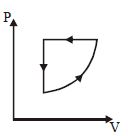
- 1For one complete cycle of a thermodynamic processes on a gas as shown in $P-V$ diagram. Which is trueView Solution
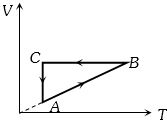
- 2A cyclic process $ABCA$ is shown in the $V-T $ diagram. Process on the $P-V$ diagram isView Solution
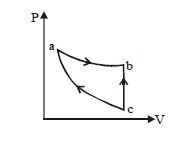
- 3An ideal gas expands isothermally along $ab$ and does $600\,J$ of work. During the processView Solution
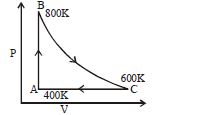
- 4One mole of diatomic ideal gas undergoes a cyclic process $ABC$ as shown in figure. The process $BC$ is adiabatic. The temperatures at $A, B$ and $C$ are $400\,K, 800\,K$ and $600\,K$ respectively. Choose the correct statementView Solution
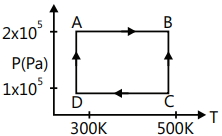
- 5Two moles of helium gas are taken over the cycle $ABCDA$, as shown in the $P-T$ diagram. The net work done on the gas in the cycle $ABCDA$ is ...... $R$View Solution
- 6View SolutionThe temperature of an ideal gas is kept constant as it expands. The gas does external work. During this process, the internal energy of the gas
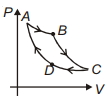
- 7Carnot cycle is plotted in $P-V$ graph. Which portion represents an isothermal expansion?View Solution
- 8One mole of an ideal gas $(\gamma = 1.4)$ is adiabatically compressed so that its temperature rises from $27\,^oC$ to $35\,^oC$. The change in the internal energy of the gas is .... $J$ (given $R = 8.3 \,J/mole/K$)View Solution
- 9Consider one mole of helium gas enclosed in a container at initial pressure $P_1$ and volume $V_1$. It expands isothermally to volume $4 V_1$. After this, the gas expands adiabatically and its volume becomes $32 V_1$. The work done by the gas during isothermal and adiabatic expansion processes are $W_{\text {iso }}$ and $W_{\text {adia, }}$ respectively. If the ratio $\frac{W_{\text {iso }}}{W_{\text {adia }}}=f \ln 2$, then $f$ is. . . . . . . .View Solution
- 10View SolutionWhich of the following is not thermodynamical function