MCQ
One watt is equal to __________?
- AOne kilowatt per second.
- BOne kilo joule per second.
- COne joule per second.
- DOne joule per minute.
Explanation:
Watt is the SI unit of power.
$\text{Power}=\frac{\text{Work done}}{\text{time}}$.
The SI unit of work done is the same as energy, that is, joule and that of time is seconds. Therefore, one watt is equal to one joule per second.
Generate a complete, print-ready paper with questions like this in minutes — across 16+ boards, with answer keys.
The resistance of an ideal ammeter is
|
(a) Infinite |
(b) Very high |
(c) Small |
(d) Zero |
How many NAND gates are used to form an AND gate
|
(a) 1 |
(b) 2 |
(c) 3 |
(d) 4 |
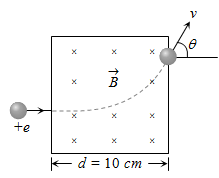
A proton accelerated by a potential difference 500 KV moves though a transverse magnetic field of 0.51T as shown in figure. The angle θ through which the proton deviates from the initial direction of its motion is
|
(a) 15° |
(b) 30° |
(c) 45° |
(d) 60° |
Two plates are 2 cm apart, a potential difference of 10 volt is applied between them, the electric field between the plates is
|
(a) 20 N/C |
(b) 500 N/C |
(c) 5 N/C |
(d) 250 N/C |
If the operating potential of an X-ray tube is 50 kV, the velocity of X-rays coming out of it is
|
(a) 4 |
(b) 3 |
(c) |
(d) 3 m/s |
In a spherical condenser radius of the outer sphere is R. The different in the radii of outer and inner sphere in x. Its capacity is proportional to
|
(a) |
(b) |
(c) |
(d) |


