Question
✓
Answer
i. Let $E_1$ and $E_2$ denotes the events that Ankit and Vinod will respectively qualify the exam.
$\begin{array}{l}P\left(E_1 \cup E_2\right)= P \left( E _1\right)+ P \left( E _2\right)- P \left( E _1 \cap E _2\right) \\ =0.05+0.10-0.02=0.13\end{array}$
iii. Let $E_1$ and $E_2$ denotes the events that Ankit and Vinod will respectively qualify the exam.
$\begin{array}{l}=P\left(E_1^{\prime} \cap E_2^{\prime}\right)=P\left(\left(E_1 \cup E_2\right)^{\prime}\right) \\ =1- P \left(E_1 \cup E_2\right)=1-0.13=0.87\end{array}$
OR
Let $E_1$ and $E_2$ denotes the events that Ankit and Vinod will respectively qualify the exam.
The probability that Vinod will not qualify the exam.
Probability that only one of them will qualify the exam $= P \left(\left( E _1- E _2\right) \cup\left( E _2- E _1\right)\right)$
$\begin{array}{l}=P\left(E_1-E_2\right)+P\left(E_2-E_1\right) \\ =P\left(E_1 \cup E_2\right)-P\left(E_1 \cap E_2\right) \\ =0.13-0.02=0.11\end{array}$
$\begin{array}{l}P\left(E_1 \cup E_2\right)= P \left( E _1\right)+ P \left( E _2\right)- P \left( E _1 \cap E _2\right) \\ =0.05+0.10-0.02=0.13\end{array}$
iii. Let $E_1$ and $E_2$ denotes the events that Ankit and Vinod will respectively qualify the exam.
$\begin{array}{l}=P\left(E_1^{\prime} \cap E_2^{\prime}\right)=P\left(\left(E_1 \cup E_2\right)^{\prime}\right) \\ =1- P \left(E_1 \cup E_2\right)=1-0.13=0.87\end{array}$
OR
Let $E_1$ and $E_2$ denotes the events that Ankit and Vinod will respectively qualify the exam.
The probability that Vinod will not qualify the exam.
Probability that only one of them will qualify the exam $= P \left(\left( E _1- E _2\right) \cup\left( E _2- E _1\right)\right)$
$\begin{array}{l}=P\left(E_1-E_2\right)+P\left(E_2-E_1\right) \\ =P\left(E_1 \cup E_2\right)-P\left(E_1 \cap E_2\right) \\ =0.13-0.02=0.11\end{array}$
Need a full question paper?
Generate a complete, print-ready paper with questions like this in minutes — across 16+ boards, with answer keys.
Explore more
Similar questions
→→→→→→
The school organised a farewell party for 100 students and school management decided three types of drinks will be distributed in farewell party ie. Milk (M), Coffee (C) and Tea (T). Organiser reported that 10 students had all the three drinks M, C, T. 20 students had M and C; 30 students had C and T; 25 students had M and T. 12 students.had M only; 5 students had C only; 8 students had T only.
Based on the above information, answer the following questions.
Based on the above information, answer the following questions.
- The number of students who did not take any drink, is
- 20
- 30
- 10
- 25
- The number of students who prefer Milk is
- 47
- 45
- 53
- 50
- The number of students who prefer Coffee is
- 47
- 53
- 45
- 50
- The number of students who prefer Tea is
- 51
- 53
- 50
- 47
- The number of students who prefer Milk and Coffee but not tea is
- 12
- 10
- 15
- 20
A manufacturing company produces certain goods. The company manager used to make a data record on daily basis about the cost and revenue of these goods separately. The cost and revenue function of a product are given by $C(x)=20 x+4000$ and $R(x)=60 x+2000$, respectively, where $x$ is the number of goods produced and sold.
Based on above information, answer the following questions.
(i) How many goods must be sold to realise some profit?
(a) $\mathrm{x}<\mathbf{5 0}$
(b) $x>50$
(c) $x \geq 50$
(d) $\mathbf{x} \leq \mathbf{5 0}$
(ii) If the cost and revenue functions of a product are given by $C(x)=3 x+400$ and $R(x)=$ $5 x+20$ respectively, where $x$ is the number of items produced by the manufacturer, then how many items must be sold to realise some profit?
(a) $x \leq 190$
(b) $x \geq 190$
(c) $x<190$
(d) $x>190$
(iii) Let $\mathbf{x}$ and $\mathbf{b}$ are real numbers. If $\mathbf{b} > \mathbf{0}$ and $\mathbf{x}< \mathbf{b}$, then
(a) $x$ is always positive
(b) $\mathbf{X}$ is always negative
(c) $\mathrm{x}$ is real number
(d) None of these
(iv) The solution set of $\mathbf{3}-\mathbf{5}<\mathrm{x}+\mathbf{7}$, when $\mathrm{x}$ is a whole number is given by
(a) $\{0,1,2,3,4,5\}$
(b) $(-\infty, 6)$
(c) $[0,5]$
(d) None of these
(v) Graph of inequality $x>2$ on the number line is represented by
(a)
(b)
(c)
(d) None of the above
→Based on above information, answer the following questions.
(i) How many goods must be sold to realise some profit?
(a) $\mathrm{x}<\mathbf{5 0}$
(b) $x>50$
(c) $x \geq 50$
(d) $\mathbf{x} \leq \mathbf{5 0}$
(ii) If the cost and revenue functions of a product are given by $C(x)=3 x+400$ and $R(x)=$ $5 x+20$ respectively, where $x$ is the number of items produced by the manufacturer, then how many items must be sold to realise some profit?
(a) $x \leq 190$
(b) $x \geq 190$
(c) $x<190$
(d) $x>190$
(iii) Let $\mathbf{x}$ and $\mathbf{b}$ are real numbers. If $\mathbf{b} > \mathbf{0}$ and $\mathbf{x}< \mathbf{b}$, then
(a) $x$ is always positive
(b) $\mathbf{X}$ is always negative
(c) $\mathrm{x}$ is real number
(d) None of these
(iv) The solution set of $\mathbf{3}-\mathbf{5}<\mathrm{x}+\mathbf{7}$, when $\mathrm{x}$ is a whole number is given by
(a) $\{0,1,2,3,4,5\}$
(b) $(-\infty, 6)$
(c) $[0,5]$
(d) None of these
(v) Graph of inequality $x>2$ on the number line is represented by
(a)
(b)
(c)
(d) None of the above
In a library, 25 students read physics, chemistry and mathematics books. It was found that 15 students read mathematics, 12 students read physics while 11 students read chemistry. 5 students read both mathematics and chemistry, 9 students read physics and mathematics. 4 students read physics and chemistry and 3 students read all three subject books.
- The number of students who reading only chemistry is:
- 5
- 4
- 2
- 1
- The number of students who reading only mathematics is:
- 4
- 3
- 5
- 11
- The number of students who reading only one of the subjects is:
- 5
- 11
- 8
- 6
- The number of students who reading atleast one of the subject is:
- 20
- 22
- 23
- 21
- The number of students who reading none of the subject is:
- 2
- 4
- 3
- 5
In an University, out of 100 students 15 students offered Mathematics only, 12 students offered Statistics only, 8 students offered only Physics, 40 students offered Physics and Mathematics, 20 students offered Physics and Statistics, 10 students offered Mathematics and Statistics, 65 students offered Physics.
Based on the above information answer the following questions.
Based on the above information answer the following questions.
- The number of students who offered all the three subjects is:
- 4
- 3
- 2
- 5
- The number of students who offered Mathematics is:
- 62
- 65
- 55
- 60
- The number of students who offered statistics is:
- 31
- 35
- 39
- 34
- The number of students who offered mathematics and statistics but not physics is:
- 7
- 6
- 5
- 4
- The number of students who did not offer any of the above three subjects is:
- 4
- 1
- 5
- 3
Five students Ajay, Shyam, Yojana, Rahul and Akansha are sitting in a playground in a line.
Based on the above information, answer the following questions.
(i) Total number of ways of sitting arrangement of five students is
(a) 120 (b) 60 (c) 24 (d) None of these
(ii) Total number of arrangement of sitting, if Ajay and Yojana sit together, is
(a) 60 (b) 48 (c) 72 (d) 120
(iii) Total number of arrangement 'Yojana and Rahul sitting at extreme position' is
(a) 24 (b) 36 (c) 48 (d) 12
(iv) Total number of arrangement, if shyam is sitting in the middle, is
(a) 24 (b) 12 (c) 6 (d) 36
(v) Total number of arrangement sitting Yojana and Rahul not sit together, is
(a) 72 (b) 120 (c) 60 (d) 144
Based on the above information, answer the following questions.
(i) Total number of ways of sitting arrangement of five students is
(a) 120 (b) 60 (c) 24 (d) None of these
(ii) Total number of arrangement of sitting, if Ajay and Yojana sit together, is
(a) 60 (b) 48 (c) 72 (d) 120
(iii) Total number of arrangement 'Yojana and Rahul sitting at extreme position' is
(a) 24 (b) 36 (c) 48 (d) 12
(iv) Total number of arrangement, if shyam is sitting in the middle, is
(a) 24 (b) 12 (c) 6 (d) 36
(v) Total number of arrangement sitting Yojana and Rahul not sit together, is
(a) 72 (b) 120 (c) 60 (d) 144
Ordered Pairs The ordered pair of two elements a and 3 is denoted by (a, b) : a is first element (or first component) and d is second element (or second component). Two ordered pairs are equal if their corresponding elements are equal. ie. (a, b) = (c, d)
→⇒ a = c and b = d
Cartesian Product of Two Sets For two non-empty sets A and B, the cartesian product A . B is the set of all ordered pairs of elements from sets Aand B. In symbolic form, it can be written as
$\text{A}\cdot\text{B}=\{(\text{a},\text{b}):\text{a}\in\text{A},\text{b}\in\text{B}\}$
Based on the above topics, answer the following questions.
If (a - 3, 6 + 7) = (3, 7), then the value of aand d are:
6, 0
3, 7
7, 0
3, -7
If (x + 6, y - 2) = (0, 6), then the value of x and y are:
6, 8
-6, -8
-6, 8
6, -8
If (x + 2, 4) = (5, 2x + y), then the value of x and y are:
-3, 2
3, 2
-3, -2
Let A and B be two sets such that A . B consists of 6 elements. If three elements of A . B are (1, 4), (2, 6) and (3, 6), then
(A . B) = (B . A)
$(\text{A}\cdot\text{B})\neq(\text{B}\cdot\text{A})$
A . B = {(1, 4), (1, 6), (2, 4)}
None of the above
If m(A . B) = 45, then n(A) cannot be
15
17
5
9
To find the limits of trigonometric functions, we use the following theorems
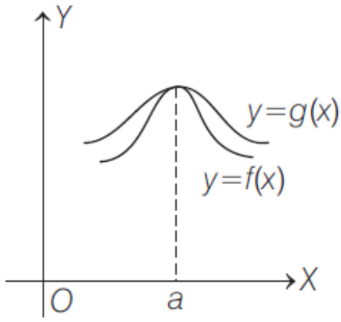
Theorem 1: Let $f$ and $g$ be two real valued functions with the same domain such that $f(x) \leq g(x)$ for all $x$ in the domain of definition. For some real number $a$, if both $\lim _{x \rightarrow a} f(x)$ and $\lim _{x \rightarrow a} g(x)$ exist, then
$
\lim _{x \rightarrow a} f(x) \leq \lim _{x \rightarrow a} g(x) .
$
This is shown in the figure
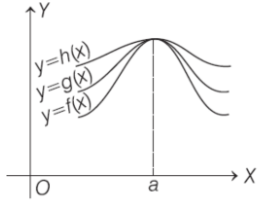
Theorem 2 (Sandwich theorem) : Let $f, g$ and $h$ be real functions such that $f(x) \leq g(x) \leq h(x)$ for all $x$ in the common domain of definition. For some real number $a$, if $\lim _{x \rightarrow a} f(x)=l=\lim _{x \rightarrow a} h(x)$, then $\lim _{x \rightarrow a} g(x)=l$.
This is shown in the figure
Theorem 3 : Three important limits are
(i) $\lim _{x \rightarrow 0} \frac{\sin x}{x}=1$
(ii) $\lim _{x \rightarrow 0} \frac{\frac{x}{1-\cos x}}{x}=0$
(iii) $\lim _{x \rightarrow 0} \frac{\tan ^x x}{x}=1$
Based on above information, answer the following questions.
(i) $\lim _{x \rightarrow 0} \frac{\sin 3 x}{5 x}$ is equal to
(a) $\frac{1}{5}$ (b) $\frac{2}{5}$ (c) $\frac{3}{5}$ (d) $\frac{4}{5}$
(ii) $\lim _{\theta \rightarrow b} \frac{\tan (\theta-b)}{\theta-b}$ is equal to
(a) 0 (b) 1 (c) 2 (d) 3
(iii) $\lim _{x \rightarrow 0} \frac{\tan 2 x-\sin 2 x}{x^3}$ is equal to
(a) 4 (b) 3 (c) 2 (d) 1
(iv) $\lim _{x \rightarrow 0} \frac{2 \sin x-\sin 2 x}{x^3}$ is equal to
(a) 0 (b) 1 (c) 2 (d) 3
(v) $\lim _{x \rightarrow \frac{\pi}{4}} \frac{\sin x-\cos x}{x-\frac{\pi}{4}}$ is equal to
(a) $\sqrt{2}$ (b) 3 (c) 1 (d) $\sqrt{3}$
→→Theorem 1: Let $f$ and $g$ be two real valued functions with the same domain such that $f(x) \leq g(x)$ for all $x$ in the domain of definition. For some real number $a$, if both $\lim _{x \rightarrow a} f(x)$ and $\lim _{x \rightarrow a} g(x)$ exist, then
$
\lim _{x \rightarrow a} f(x) \leq \lim _{x \rightarrow a} g(x) .
$
This is shown in the figure
Theorem 2 (Sandwich theorem) : Let $f, g$ and $h$ be real functions such that $f(x) \leq g(x) \leq h(x)$ for all $x$ in the common domain of definition. For some real number $a$, if $\lim _{x \rightarrow a} f(x)=l=\lim _{x \rightarrow a} h(x)$, then $\lim _{x \rightarrow a} g(x)=l$.
This is shown in the figure
Theorem 3 : Three important limits are
(i) $\lim _{x \rightarrow 0} \frac{\sin x}{x}=1$
(ii) $\lim _{x \rightarrow 0} \frac{\frac{x}{1-\cos x}}{x}=0$
(iii) $\lim _{x \rightarrow 0} \frac{\tan ^x x}{x}=1$
Based on above information, answer the following questions.
(i) $\lim _{x \rightarrow 0} \frac{\sin 3 x}{5 x}$ is equal to
(a) $\frac{1}{5}$ (b) $\frac{2}{5}$ (c) $\frac{3}{5}$ (d) $\frac{4}{5}$
(ii) $\lim _{\theta \rightarrow b} \frac{\tan (\theta-b)}{\theta-b}$ is equal to
(a) 0 (b) 1 (c) 2 (d) 3
(iii) $\lim _{x \rightarrow 0} \frac{\tan 2 x-\sin 2 x}{x^3}$ is equal to
(a) 4 (b) 3 (c) 2 (d) 1
(iv) $\lim _{x \rightarrow 0} \frac{2 \sin x-\sin 2 x}{x^3}$ is equal to
(a) 0 (b) 1 (c) 2 (d) 3
(v) $\lim _{x \rightarrow \frac{\pi}{4}} \frac{\sin x-\cos x}{x-\frac{\pi}{4}}$ is equal to
(a) $\sqrt{2}$ (b) 3 (c) 1 (d) $\sqrt{3}$