Question
Outcrossing and Crossbreeding.

Answer

OutcrossingCrossbreeding
1. Breeding of animals of the same breed but having no common ancestors for 4 to 6 generations is known as outcrossing.1. Breeding of superior male of one breed with superior female of another breed is known as crossbreeding.
2. Progeny is known as outeross. 2. Progeny is known as hybrid.
3. New breeds are not developed by outcrossing.3. New breeds or hybrids are formed by crossbreeding.
4. An outcross helps to overcome inbreeding depression.4. Hybrids are subjected to inbreeding and new stable breeds are developed by crossbreeding.

Need a full question paper?

Generate a complete, print-ready paper with questions like this in minutes — across 16+ boards, with answer keys.

Start Generating Free

Similar questions

Column i

Column ii

Q.1. 21 trisomy

(a) Turner’s syndrome

Q.2. X-monosomy

(b) Klinefelter’s syndrome

Q.3. Holandric traits

(c) Down’s syndrome

Q.4. Feminized male

(d) Hypertrichosis

Read the following and answer any four questions from (i) to (v) given below:
ABO blood groups in human beings are controlled by the gene. The gene I has three alleles. $I^A, I^B$ and $i$. Since there are three different alleles six different genotypes are possible. If two persons with 'AB' blood group marry and have sufficient large number of children, there children could be classified as 'A: blood group : 'AB' blood group : B blood group in $1 : 2 : 1$ ratio. Modern technique of protein electrophoresis reveals presence of both 'A and 'B' type proteins in 'AB' blood group individuals.
  1. How many types of phenotypes can occur in ABO blood group?
  1. Six
  2. Two
  3. Three
  4. Four
  1. ABO blood grouping in human beings cites the example of.
  1. Incomplete dominance.
  2. Co-dominance.
  3. Multiple allelism.
  4. both (b) an (c).
  1. The presence of both 'X and 'B' type proteins in 'AB' blood group individuals is an example of.
  1. Partial dominance.
  2. Incomplete dominance.
  3. Co-dominanc.
  4. complete dominance.
  1. If a man of A blood group marries a woman of AB blood group. Which type of progeny indicates that man is heterozygous?
  1. O
  2. B
  3. A
  4. AB
  1. Complete the given table regarding different possibilities and their corresponding blood groups.
Genotypes
Blood group
$I^AI^B$
$(I)$
$I^B i, (II)$
$B$
$(III)$
$O$
$I^A I^A, (IV)$
$I^A$
 
 
(I)
(II)
(III)
(IV)
(a)
O
$I^B I^B$
$I^B i$
$I^A i$
(b)
AB
$I^A i$
$I^A I^B$
$IBi$
(c)
AB
$I^B I^B$
$ii$
$I^A i$
(d)
O
$I^A I^A$
$ii$
$I^A i$
Read the following and answer any four questions from (i) to (v) given below:
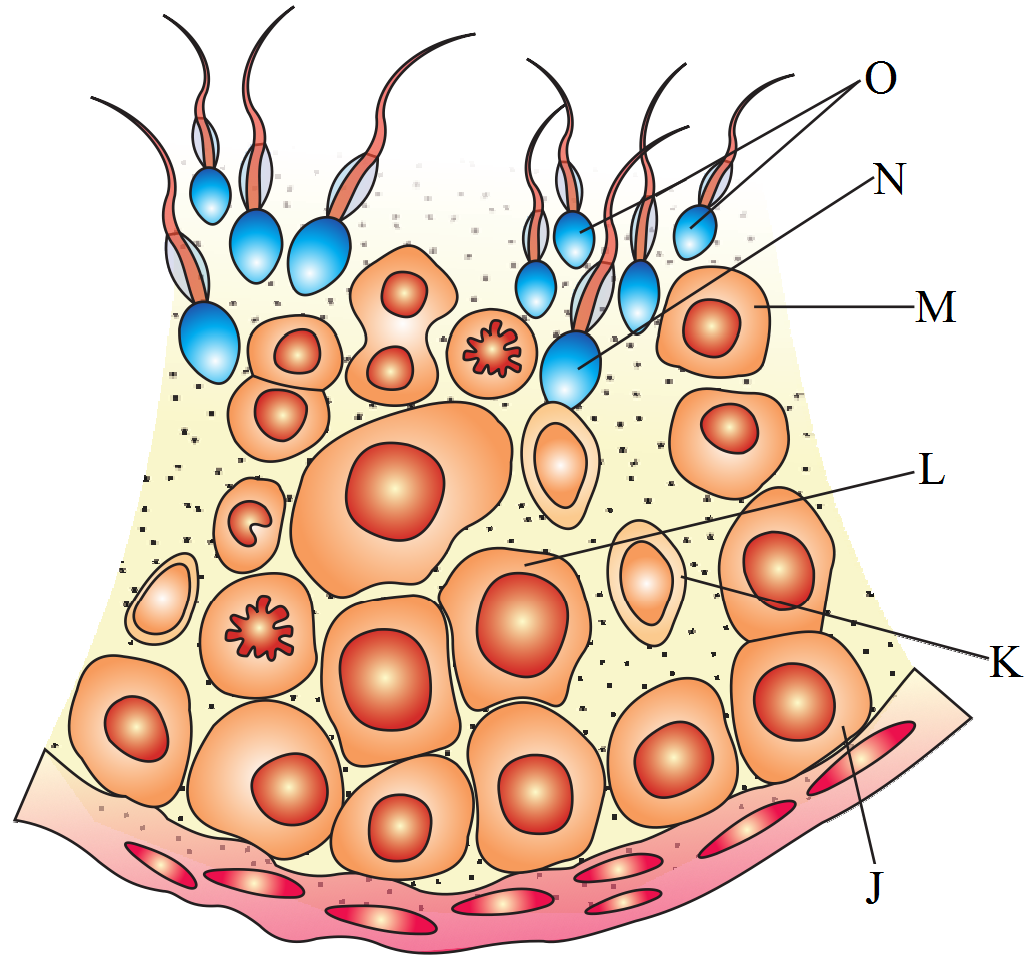
Each testicular globule of testis contains one to three highly coiled seminiferous tubules. Wall of each seminiferous tubule is formed of single layered germinal epithelium. Majority of cells in this epithelium are cuboidal, called male germ cells. Study the transverse section of part of seminiferous tubule and answer the following questions.
  1. What is the characteristic of K?
  1. K is spermatogonium which grows into primary spermatocyte.
  2. K is Sertoli cell which provides nutrition to spermatids.
  3. K is secondary spermatocyte which undergo meiosis II to form spermatid.
  4. K is spermatid being converted into sperm.
  1. Which of the following cell undergo reduction division to form secondary spermatocyte?
  1. J
  2. M
  3. L
  4. K
  1. How many among the following have 46 chromosomes?
  1. 2
  2. 4
  3. 5
  4. 3
  1. Select an option that correctly identifies different labels.
  1. L- Primary spermatocyte, N - Spermatozoa, M - Secondary spermatocyte.
  2. J - Spermatogonium, K - Sertoli cell, O - Spermatozoa.
  3. L- Primary spermatocyte, M - Secondary spermatocyte, N - Spermatozoa.
  4. J - Spermatogonium, K - Primary spermatocyte, N - Spermatid.
  1. Which hormone initiates spermatogenesis at puberty?
  1. FSH
  2. ICSH
  3. ABP
  4. GnRH
Distinguish between: Hypohydrophily – Epihydrophily
Read the following and answer any four questions from (i) to (v) given below:
The Kakapo is the world's largest and heaviest parrot, found only in New Zealand. It is unusual in that it is nocturnal, flightless and ground-dwelling. It is an excellent climber of trees, has strong legs that allow it to "jog" several kilometres in a single trip, and has mossy green plumage mottled with brown and yellow. The Kakapo is also critically endangered as of now, there were only few known living individuals left.
  1. Which could be the possible reason for Kakapo to be well-adapted to its environment prior to the arrival of humans in New Zealand?
  1. Kakapo was active only in the night when its potential predators would not be out for hunting.
  2. The Kakapo would likely be well-camouflaged among the forest foliage due to its greenish plumage.
  3. It was able to effectively hunt for food in the night.
  4. All of these.
  1. When humans started to settle in New Zealand, they took with them non-native animals, including mammals such as cats, dogs and stoats. By which of the following ways, human settlement likely contributed to a near decimation of Kakapo populations in New Zealand?
  1. Habitat destruction.
  2. Alien species invasion.
  3. Pollution.
  4. Both (a) and (b).
  1. All known survived Kakapo have been relocated by the New Zealand government to three predator-free islands, where they are monitored year round by staffs and volunteers to ensure that the birds are safe, healthy and well-fed. The extremely low population of Kakapo is a hurdle to the species becoming viable in the long term, despite such dedicated conservation efforts. This is because.
  1. The small population results in very small gene pool.
  2. There would be very Ii mited genetic diversity among the resulting offspring.
  3. Of reduced capacity of the species to adapt and survive changes in the environment.
  4. All of these.
  1. The reasons behind conserving biodiversity have been grouped into which of the following categories?
  1. Narrowly utilitarian.
  2. Broadly utilitarian.
  3. Ethical.
  4. All of these.
  1. One of the ex situ conservation methods for endangered species is:
  1. Wildlife sanctuaries.
  2. Biosphere reserves.
  3. Cryopreservation.
  4. National parks.
Distinguish between: Blastula and Gastrula ### Give two differences between blastula and gastrula.
Read the following and answer any four questions from (i) to (v) given below:
Excessive exploitation of species, whether a plant or animal reduces the size of its population so it becomes vulnerable to extinction. Such as Dodo and passenger pigeon have become extinct due to over exploitation by humans. Thus the world is facing accelerated rates of species extinctions, largely due to human interference.
  1. Which of the following cause of biodiversity loss is not included in evil quartet?
  1. Coextinction.
  2. Pollution.
  3. Alien species invasion.
  4. Habitat loss and fragmentation.
  1. Identify the species that have become extinct due to over exploitation.
  1. Stellar sea cow.
  2. Yucca moth.
  3. Blatta orientalis.
  4. Nile Perch.
  1. Factors which make species susceptible to extinction are:
  1. Large population size.
  2. Lack of genetic variability.
  3. Ower status of trophic level.
  4. Ability to switch over to ahem ate foods.
  1. Assertion: Pollution reduces species biodiversity.
Reason: Spill over of oil in sea causes death of several marine animals.
  1. Both assertion and reason are true and reason is the correct explanation of assertion.
  2. Both assertion and reason are true but reason is not the correct explanation of assertion.
  3. Assertion is true but reason is false.
  4. Both assertion and reason are false.
  1. ________ is the first major cause of species extinction.
  1. Coextinction.
  2. Over exploitation.
  3. Habitat destruction.
  4. Alien species invasion.
Distinguish between: DNA in prokaryotic and eukaryotic cells.
Read the following and answer any four questions from (i) to (v) given below:
Green manuring is the fanning practice where a leguminous plant which has derived enough benefits from its association with appropriate species of Rhizobium, is ploughed into the field soil and then a non-legume is sown and allowed to get benefitted from the already present nitrogen fixer. Some legumes, such as, Crotolaria juncea, Sesbania rostrata, Lencaena leucocephala, etc. are used as green manure. Rhizobia, that fix atmospheric nitrogen in the form of nitrate, live in the roots ofleguminous plants. These nutrients are used by non-leguminous plants through the practice of green manuring.
  1. Green manures mainly provide nutrient enriched in:
  1. Magnesium.
  2. Sulphur.
  3. Nitrogen.
  4. Both (a) and (b).
  1. Which of the following plants is used as green manure in crop fields?
  1. Saccharum.
  2. Dichanthium.
  3. Phyllonthus.
  4. Crotolaria.
  1. Green manure plants belong to the Family:
  1. Lamiaceae.
  2. Papilionaceae.
  3. Liliaceae.
  4. Poaceae.
  1. Due to excess use of chemical fertilisers rich in nitrate, ________ disease occurred in children.
  1. Jaundice.
  2. Septicemia.
  3. Methemoglobinemia.
  4. Botulism.
  1. A green manure is:
  1. Rice.
  2. Maize.
  3. Sorghum.
  4. Sesbania.
Valves in heartLocation
(1) Bicuspid/Mitral valve(a) Opening of inferior vena cava
(2) Tricuspid valve(b) Opening of coronary sinus
(3) Eustachian valve(c) Left atrioventricular aperture
(4) Thebesian valve(d) Right atrioventricular aperture