Particles having positive charges occasionally come with high velocity from the sky towards the earth. On account of the magnetic field of earth, they would be deflected towards the
Easy


Download our appand get started for free
Experience the future of education. Simply download our apps or reach out to us for more information. Let's shape the future of learning together!No signup needed.*
Similar Questions
- 1A proton is projected with a velocity $10^7\, m/s$, at right angles to a uniform magnetic field of induction $100\, mT$. The time (in second) taken by the proton to traverse $90^o$ arc is $(m_p = 1.65\times10^{-27}\, kg$ and $q_p = 1.6\times10^{-19}\, C)$View Solution
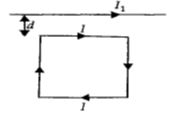
- 2A square loop, carrying a steady current $I,$ is placed in a horizontal plane near a long straight conductor carrying a steady current $I_1$ at a distance $d$ from the conductor as shown in figure. The loop will experienceView Solution
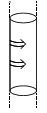
- 3A hollow cylinder having infinite length and carrying uniform current per unit length $\lambda$ along the circumference as shown. Magnetic field inside the cylinder isView Solution
- 4If a particle of charge ${10^{ - 12}}\,coulomb$ moving along the $\hat x - $ direction with a velocity ${10^5}\,m/s$ experiences a force of ${10^{ - 10}}\,newton$ in $\hat y - $ direction due to magnetic field, then the minimum magnetic field isView Solution
- 5View SolutionIf the direction of the initial velocity of the charged particle is neither along nor perpendicular to that of the magnetic field, then the orbit will be
- 6A particle of mass $m,$ charge $Q$ and kinetic energy $K$ enters a transverse uniform magnetic field of induction $B.$ After $3$ $seconds$ the kinetic energy of the particle will be .......$K$View Solution
- 7In hydrogen atom, the electron is making $6.6 \times {10^{15}}\,rev/\sec $ around the nucleus in an orbit of radius $0.528\, \mathop A\limits^o $. The magnetic moment $(A - {m^2})$ will beView Solution
- 8View SolutionTesla is a unit for measuring
- 9An electron is revolving round a proton, producing a magnetic field of $16\, weber/m^2$ in a circular orbit of radius $1\,\mathop A\limits^o $. It’s angular velocity will beView Solution
- 10Two concentric circular coils of ten turns each are situated in the same plane. Their radii are $20$ and $40\, cm$ and they carry respectively $0.2$ and $0.3$ $ampere$ current in opposite direction. The magnetic field in $weber/{m^2}$ at the centre isView Solution