MCQ
Path length does not depend on $...........$
  • A
    Initial point
  • B
    Final point
  • C
    Path taken
  • Coordinate system

Answer

Correct option: D.
Coordinate system
The path length depends on the final and initial point. It also depends on the path taken. But it does not depend on the coordinate system. The coordinate system merely defines thee path and does not affect its total length.

Need a full question paper?

Generate a complete, print-ready paper with questions like this in minutes — across 16+ boards, with answer keys.
Start Generating Free

Similar questions

The physical quantity that has the same dimensional formula as pressure is :
A rod of length $L$ with sides fully insulated is of a material whose thermal conductivity varies with $\alpha$ temperature as $ K= \frac{\alpha }{T}$, where $\alpha$ is a constant. The ends of the rod are kept at temperature $T_1$ and $T_2$. The temperature $T$ at $x,$ where $x$ is the distance from the end whose temperature is $T_1$ is 
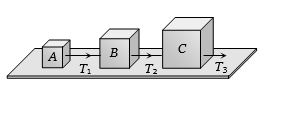
Three blocks $A, B$ and $C $ weighing $1, 8$ and $27\, kg$ respectively are connected as shown in the figure with an inextensible string and are moving on a smooth surface. ${T_3}$ is equal to $36\, N$. Then ${T_2}$ is ........ $N$
Two gases of equal mass are in thermal equilibrium. If ${P_a},\,{P_b}$ and ${V_a}$ and ${V_b}$ are their respective pressures and volumes, then which relation is true
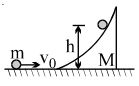
A particle of mass $m$ moving horizontally with $v_0$ strikes $a$ smooth wedge of mass $M$, as shown in figure. After collision, the ball starts moving up the inclined face of the wedge and rises to $a$ height $h$. Choose the correct statement(s) related to particle $m$ 
When a force of constant magnitude and a fixed direction acts on a moving object, then its path is
If water is flowing in a pipe with speed $2 \,m / s$ then its kinetic energy per unit volume is ........... $J ^2 m ^3$
A ball $P$ is dropped vertically and another ball Q is thrown horizontally with the same velocities from the same height and at the same time. If air resistance is neglected, then
A rubber ball is dropped from a height of $5 \,m$ on a planet where the acceleration due to gravity is not known. On bouncing, it rises to $1.8\, m$. The ball loses its velocity on bouncing by a factor of
From a $200m$ high tower, one ball is thrown upwards with speed of $10m/ s$ and another is thrown vertically downwards at the same speed simultaneously. The time difference of their reaching the ground will be nearest to: