Question
✓
Answer
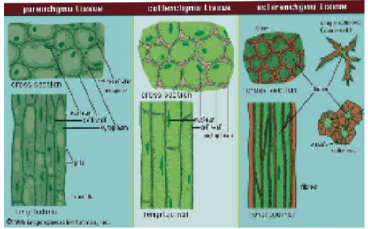
i. Sclerenchyma, Lignin is a chemical substance present in the cell wall of plant that acts as cement and hardens it.
ii. Due to presence of a chemical substance called suberin.
iii. The parenchyma tissue is present in the cortex of roots and sclerenchyma tissue is present in the veins of the leaves.
OR
Collenchyma tissue in plants provides them flexibility.
ii. Due to presence of a chemical substance called suberin.
iii. The parenchyma tissue is present in the cortex of roots and sclerenchyma tissue is present in the veins of the leaves.
OR
Collenchyma tissue in plants provides them flexibility.
Need a full question paper?
Generate a complete, print-ready paper with questions like this in minutes — across 16+ boards, with answer keys.
Explore more
Similar questions
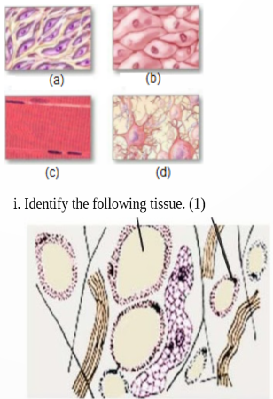
The covering or protective tissues in the animal body are epithelial tissues. Epithelium covers most organs and cavities within the body. External and Internal covering of the body and organs are all made of epithelial tissue.Epithelial tissue cells are tightly packed and form a continuous sheet. They have only a small or almost no intercellular spaces.it plays an important role in regulating the exchange of materials between the body and the external environment and also between different parts of the body.
Simple squamous epithelial cells are extremely thin and flat and form a delicate lining. The oesophagus and the lining of the mouth are also covered with squamous epithelium. The skin, which protects the body, is also made of squamous epithelium.
Where absorption and secretion occur, as in the inner lining of the intestine, tall epithelial cells are present. This columnar (meaning ‘pillar-like’) epithelium facilitates movement across the epithelial barrier. In the respiratory tract, the columnar epithelial tissue also has cilia, which are hair-like projections on the outer surfaces of epithelial cells. These cilia can move, and their movement pushes the mucus forward to clear it. This type of epithelium is thus ciliated columnar epithelium.
Cuboidal epithelium (with cube-shaped cells) forms the lining of kidney tubules and ducts of salivary glands, where it provides mechanical support. Epithelial cells often acquire additional specialisation as gland cells, which can secrete substances at the epithelial surface. Sometimes a portion of the epithelial tissue folds inward, and a multicellular gland is formed. This is glandular epithelium.
(1) The ciliated columnar epithelium is present in
$(a)$ Respiratory tract
$(b)$ Bile duct and oesophagus
$(c)$ Fallopian tube and urethra
$(d)$ Eustachian tube and stomach lining
(2) The cuboidal epithelium is present in
$(a)$ Bronchioles
$(b)$ Bile duct and oesophagus
$(c)$ Fallopian tube and urethra
$(d)$ Kidney tubules ducts of salivary glands
(3) External and Internal covering of the body and organs are all made of ________
$(a)$ Skin Tissue
$(b)$ Epithelial Tissue
$(c)$ Nerves Tissue
$(d)$ Connective Tissue
(4) How are cells arranged in epithelial tissue?
$(a)$ Loosely packed
$(b)$ Closely packed
$(c)$ Arranged in discontinuous form
$(d)$ Both $a$ and $c$
(5) Enlist the types of Epithelial Tissue?
→Simple squamous epithelial cells are extremely thin and flat and form a delicate lining. The oesophagus and the lining of the mouth are also covered with squamous epithelium. The skin, which protects the body, is also made of squamous epithelium.
Where absorption and secretion occur, as in the inner lining of the intestine, tall epithelial cells are present. This columnar (meaning ‘pillar-like’) epithelium facilitates movement across the epithelial barrier. In the respiratory tract, the columnar epithelial tissue also has cilia, which are hair-like projections on the outer surfaces of epithelial cells. These cilia can move, and their movement pushes the mucus forward to clear it. This type of epithelium is thus ciliated columnar epithelium.
Cuboidal epithelium (with cube-shaped cells) forms the lining of kidney tubules and ducts of salivary glands, where it provides mechanical support. Epithelial cells often acquire additional specialisation as gland cells, which can secrete substances at the epithelial surface. Sometimes a portion of the epithelial tissue folds inward, and a multicellular gland is formed. This is glandular epithelium.
(1) The ciliated columnar epithelium is present in
$(a)$ Respiratory tract
$(b)$ Bile duct and oesophagus
$(c)$ Fallopian tube and urethra
$(d)$ Eustachian tube and stomach lining
(2) The cuboidal epithelium is present in
$(a)$ Bronchioles
$(b)$ Bile duct and oesophagus
$(c)$ Fallopian tube and urethra
$(d)$ Kidney tubules ducts of salivary glands
(3) External and Internal covering of the body and organs are all made of ________
$(a)$ Skin Tissue
$(b)$ Epithelial Tissue
$(c)$ Nerves Tissue
$(d)$ Connective Tissue
(4) How are cells arranged in epithelial tissue?
$(a)$ Loosely packed
$(b)$ Closely packed
$(c)$ Arranged in discontinuous form
$(d)$ Both $a$ and $c$
(5) Enlist the types of Epithelial Tissue?
Read the following text carefully and answer the questions that follow:
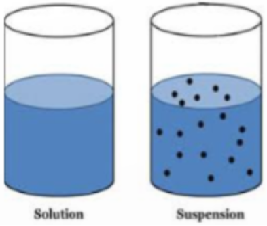
Homogeneous mixtures are regarded as solutions or true solutions. Heterogeneous mixtures are of two types. These are suspensions and colloidal solutions. These differ in the size of the particles responsible for the difference in their properties. In a suspension, the particle size is more than $10^{-5} cm$ whereas in a colloidal solution, it ranges between $10^{-5} cm$ to $10^{-7} cm$. The two phases which constitute colloidal solutions, are dispersed phase and dispersion medium. Based upon their nature, the colloidal solutions are classified into eight types. The mixture of the nonreacting gases is always homogeneous irrespective of their nature. Therefore, it is not a colloidal solution.
i. Scattering of light occurs when a beam of light is passed through Blood. Why?
ii. What is Tyndall effect?
iii. What is called colloidal solution?
OR
Give an example of colloidal solution and identified their dispersed phase and dispersion medium?
→→Homogeneous mixtures are regarded as solutions or true solutions. Heterogeneous mixtures are of two types. These are suspensions and colloidal solutions. These differ in the size of the particles responsible for the difference in their properties. In a suspension, the particle size is more than $10^{-5} cm$ whereas in a colloidal solution, it ranges between $10^{-5} cm$ to $10^{-7} cm$. The two phases which constitute colloidal solutions, are dispersed phase and dispersion medium. Based upon their nature, the colloidal solutions are classified into eight types. The mixture of the nonreacting gases is always homogeneous irrespective of their nature. Therefore, it is not a colloidal solution.
i. Scattering of light occurs when a beam of light is passed through Blood. Why?
ii. What is Tyndall effect?
iii. What is called colloidal solution?
OR
Give an example of colloidal solution and identified their dispersed phase and dispersion medium?
- The distance between two consecutivecompressions $(C)$ or two consecutiverarefactions $(R)$ is called the wavelength.The wavelength is usually represented by λ (Greek letter lambda). Its $SI$ unit is meter $(m)$.
•If we can count the number of the compressions or rarefactions that cross us per unit time, we will get the frequency of the sound wave. It is usually represented by υ (Greek letter, nu). $SI$ unit is hertz (symbol, Hz).
•The time taken for one complete oscillation is called the time period of the sound wave. It is represented by the symbol T. Its $SI$ unit is second $(s)$.Frequency and time period are related asfollows: $υ=1/\lambda $
•The speed of sound is defined as the distance which a point on a wave, such as a compression or a rarefaction, travels per unit time.
$v= \lambda /T = υ\lambda $
(i) SI unit of wavelength
$(a)$ m
$(b)$ Hertz
$(c)$ m/s
$(d)$ None of these
(ii)SI unit of Frequency
$(a)$ m
$(b)$ Hertz
$(c)$ m/s
$(d)$ None of these
(iii) Relation between frequency and time is given by
$(a)$ frequency and time are directly proportional
$(b)$ frequency and time are inversely proportional
$(c)$ There is no relation between them
$(d)$ None of these
$(iv)$ Define speed of sound. Give its formula in terms of wavelength and frequency
$(v)$ Define wavelength frequency and time period of longitudinal wave
The force acting on an object perpendicular to the surface is called thrust. When you stand on loose sand, the force, that is, the weight of your body is acting on an area equal to area of your feet. When you lie down then the same force acts on an area equalto the contact area of your whole body, which is larger than the area of your feet. Thus, the effects of forces of the same magnitude on different areas are different. In the above cases, thrust is the same. But effects are different. Therefore the effect of thrust depends on the area on which it acts. The effect of thrust on sand is larger while standing than while lying. The thrust on unit area is called pressure.Pressure=thrust/area. SI unit of pressure as $N/m^2$ or Pascal.
(i) SI unit of thrust is
$(a)$ m/s
$(b)$ $m/s^2$
$(c)$ Newton$(N)$
$(d)$ None of these
(ii) We have two different areas A and B. where A>B. Then relation between pressure on $A(P_A)$ and pressure on $B (P_B)$ is
$(a)$ $P_{A>}P_B$
$(b)$ $P_{B>}P_A$
$(c)$ $P_{A=}P_A$
$(d)$ None of these
(iii)SI unit of pressure is
$(a)$ $N/m^2$
$(b)$ Pascal.
$(c)$ Both $a$ and $b$
$(d)$ None of these
(iv) The effects of forces of the same magnitude on different areas are different. True or false
$(a)$ True
$(b)$ False
$(c)$ None of these
$(v)$ Define pressure.
→(i) SI unit of thrust is
$(a)$ m/s
$(b)$ $m/s^2$
$(c)$ Newton$(N)$
$(d)$ None of these
(ii) We have two different areas A and B. where A>B. Then relation between pressure on $A(P_A)$ and pressure on $B (P_B)$ is
$(a)$ $P_{A>}P_B$
$(b)$ $P_{B>}P_A$
$(c)$ $P_{A=}P_A$
$(d)$ None of these
(iii)SI unit of pressure is
$(a)$ $N/m^2$
$(b)$ Pascal.
$(c)$ Both $a$ and $b$
$(d)$ None of these
(iv) The effects of forces of the same magnitude on different areas are different. True or false
$(a)$ True
$(b)$ False
$(c)$ None of these
$(v)$ Define pressure.
You must have observed that the rate of evaporation increases with–
In an open vessel, the liquid keeps on evaporating. The particles of liquid absorb energy from the surrounding to regain the energy lost during evaporation. This absorption of energy from the surroundings makes the surroundings cold. What happens when you pour some acetone (nail polish remover)$ on your palm? The particles gain energy from your palm or surroundings and evaporate causing the palm to feel cool. After a hot sunny day, people sprinkle water on the roof or open ground because the large latent heat of vaporization of water helps to cool the hot surface.
$i.)$ Evaporation is surface phenomenon. True or false
$a.)$ True
$b.)$ False
$c.)$ None of these
$ii.)$ As temperature increases the rate of evaporation is
$a.)$ increases
$b.)$ decreases
$c.)$ remains constant
$d.)$ None of these
$iii.)$ The rate of evaporation increases with
$a.)$ Increase in wind speed
$b.)$ Decrease in wind speed
$c.)$ Does not have any effect from wind speed
$d.)$ None of these
$iv.)$ What happens when you pour some acetone (nail polish remover) on your palm?
$v.)$ We are able to sip hot tea from saucer than from cup. Why?
→- an increase of surface area:
- We know that evaporation is a surface phenomenon. If the surface area is increased, the rate of evaporation increases. For example, while putting clothes for drying up we spread them out.
- an increase of temperature:
In an open vessel, the liquid keeps on evaporating. The particles of liquid absorb energy from the surrounding to regain the energy lost during evaporation. This absorption of energy from the surroundings makes the surroundings cold. What happens when you pour some acetone (nail polish remover)$ on your palm? The particles gain energy from your palm or surroundings and evaporate causing the palm to feel cool. After a hot sunny day, people sprinkle water on the roof or open ground because the large latent heat of vaporization of water helps to cool the hot surface.
$i.)$ Evaporation is surface phenomenon. True or false
$a.)$ True
$b.)$ False
$c.)$ None of these
$ii.)$ As temperature increases the rate of evaporation is
$a.)$ increases
$b.)$ decreases
$c.)$ remains constant
$d.)$ None of these
$iii.)$ The rate of evaporation increases with
$a.)$ Increase in wind speed
$b.)$ Decrease in wind speed
$c.)$ Does not have any effect from wind speed
$d.)$ None of these
$iv.)$ What happens when you pour some acetone (nail polish remover) on your palm?
$v.)$ We are able to sip hot tea from saucer than from cup. Why?
In the given below activity, on heating the solution, water evaporates, and we get back the ink dye in the watch glass. The different substance has a different boiling point. We use this property to separate the components of the mixture. Here, the boiling point of ink is much higher than that of water. On heating the ink solution, water evaporates while ink dye remains in the china dish.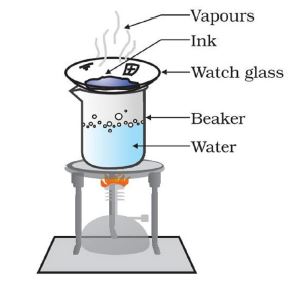
$(i)$ Name the process shown in the diagram.
$(ii)$ Which type of substance can be separated by this method ?
$(a)$ Any solvent from its non-volatile solute.
$(b)$ The volatile solvent from its non-volatile solute.
$(c)$ The non-volatile solvent from its non-volatile solute.
$(d)$ The volatile solvent from its volatile solute.
$(iii)$ What can we interpret about the nature of ink ?
$(iv)$ Name the component which gets evaporated.
$(a)$ Heating leads to the evaporation of water.
$(b)$ Heating leads to the evaporation of dyes.
$(c)$ Heating leads to the filtration of water.
$(d)$ Heating leads to the distillation of dyes.
$(v)$ Define the process shown in the diagram
$(a)$ It is the process of conversion of a liquid into its vapours.
$(b)$ It is a process of separating insoluble component by filtering the solution
$(c)$ It is a process that separates a pure solid in the form of its crystals
$(d)$ It is a technique to separate two miscible liquids
→$(i)$ Name the process shown in the diagram.
| $(a)$ Boiling | $(b)$ Filtration | $(c)$ Crystallisation | $(d)$ Distillation |
$(a)$ Any solvent from its non-volatile solute.
$(b)$ The volatile solvent from its non-volatile solute.
$(c)$ The non-volatile solvent from its non-volatile solute.
$(d)$ The volatile solvent from its volatile solute.
$(iii)$ What can we interpret about the nature of ink ?
| $(a)$ We cannot separate components of ink | $(b)$ Ink is not a mixture |
| $(c)$ Ink is pure substance | $(d)$ Ink is a mixture of dyes in water. |
$(a)$ Heating leads to the evaporation of water.
$(b)$ Heating leads to the evaporation of dyes.
$(c)$ Heating leads to the filtration of water.
$(d)$ Heating leads to the distillation of dyes.
$(v)$ Define the process shown in the diagram
$(a)$ It is the process of conversion of a liquid into its vapours.
$(b)$ It is a process of separating insoluble component by filtering the solution
$(c)$ It is a process that separates a pure solid in the form of its crystals
$(d)$ It is a technique to separate two miscible liquids
Three mixtures $A, B$ and $C$ are obtained by stirring three different solids in water taken in separate beakers. When mixture $A$ is allowed to stand for some time, then its particles settle at the bottom of the beaker. When a beam of light is passed through mixture $A$ in a dark room, the path of light becomes visible when observed from the side of the beaker. When mixture $B$ is allowed to stand for a considerable time, even then its particles do not settle down. Mixture $B$, however, scatters the beam of light just like mixture $A$. The particles of mixture $C$ do not settle down on keeping and it also does not scatter a beam of light passing through it.
→- What are the mixtures like $A$ known as?
- What are the mixtures like $B$ known as?
- What are the mixtures like $C$ known as?
- Name the phenomenon exhibited by $A$ and $B$ which occurs on passing a beam of light through them.
- Name one mixture each which is like $(i) A (ii) B$, and $(iii) C.$
A moving object can do work. An object moving faster can do more work than an identical object moving relatively slow. A moving bullet, blowing wind, a rotating wheel, a speeding stone can do work. How does a bullet pierce the target? How does the wind move the blades of a windmill? Objects in motion possess energy. We call this energy kinetic energy.Thus, the kinetic energy possessed by an object of mass, m and moving with a uniform velocity, $v$ is
$\mathrm{KE}=1 / 2 \times \mathrm{mv}^2$
The energy possessed by an object is thus measured in terms of its capacity of doing work. The unit of energy is, therefore, the same as that of work, that is, joule $(J)$.
(i) Energy possessed by body which is in motion is called
$(a)$ Potential energy
$(b)$ Kinetic energy
$(c)$ Nuclear energy
$(d)$ None of these
(ii) Which of the following has same unit?
$(a)$ Potential energy and Force
$(b)$ Kinetic energy and work
$(c)$ Both $a$ and $b$
$(d)$ None of these
(iii) Kinetic energy depends
$(a)$ Inversely on velocity of body
$(b)$ Directly on square of velocity of body
$(c)$ Directly on velocity of body
$(d)$ None of these
(iv) Define kinetic energy of body. Give its SI unit
(v) Is kinetic energy scalar or vector? Justify your answer
→$\mathrm{KE}=1 / 2 \times \mathrm{mv}^2$
The energy possessed by an object is thus measured in terms of its capacity of doing work. The unit of energy is, therefore, the same as that of work, that is, joule $(J)$.
(i) Energy possessed by body which is in motion is called
$(a)$ Potential energy
$(b)$ Kinetic energy
$(c)$ Nuclear energy
$(d)$ None of these
(ii) Which of the following has same unit?
$(a)$ Potential energy and Force
$(b)$ Kinetic energy and work
$(c)$ Both $a$ and $b$
$(d)$ None of these
(iii) Kinetic energy depends
$(a)$ Inversely on velocity of body
$(b)$ Directly on square of velocity of body
$(c)$ Directly on velocity of body
$(d)$ None of these
(iv) Define kinetic energy of body. Give its SI unit
(v) Is kinetic energy scalar or vector? Justify your answer