Question
The force acting on an object perpendicular to the surface is called thrust. When you stand on loose sand, the force, that is, the weight of your body is acting on an area equal to area of your feet. When you lie down then the same force acts on an area equalto the contact area of your whole body, which is larger than the area of your feet. Thus, the effects of forces of the same magnitude on different areas are different. In the above cases, thrust is the same. But effects are different. Therefore the effect of thrust depends on the area on which it acts. The effect of thrust on sand is larger while standing than while lying. The thrust on unit area is called pressure.Pressure=thrust/area. SI unit of pressure as $N/m^2$ or Pascal.
(i) SI unit of thrust is
$(a)$ m/s
$(b)$ $m/s^2$
$(c)$ Newton$(N)$
$(d)$ None of these
(ii) We have two different areas A and B. where A>B. Then relation between pressure on $A(P_A)$ and pressure on $B (P_B)$ is
$(a)$ $P_{A>}P_B$
$(b)$ $P_{B>}P_A$
$(c)$ $P_{A=}P_A$
$(d)$ None of these
(iii)SI unit of pressure is
$(a)$ $N/m^2$
$(b)$ Pascal.
$(c)$ Both $a$ and $b$
$(d)$ None of these
(iv) The effects of forces of the same magnitude on different areas are different. True or false
$(a)$ True
$(b)$ False
$(c)$ None of these
$(v)$ Define pressure.
Answer

$(i)$ $c$
$(ii)$ $b$
$(iii)$ $c$
$(iv)$ $a$
$(v)$ pressure is defined as thrust or perpendicular force acting per unit area

Need a full question paper?

Generate a complete, print-ready paper with questions like this in minutes — across 16+ boards, with answer keys.

Start Generating Free

Similar questions

Read the following text carefully and answer the questions that follow:
Homogeneous mixtures are regarded as solutions or true solutions. Heterogeneous mixtures are of two types. These are suspensions and colloidal solutions. These differ in the size of the particles responsible for the difference in their properties. In a suspension, the particle size is more than $10^{-5} cm$ whereas in a colloidal solution, it ranges between $10^{-5} cm$ to $10^{-7} cm$. The two phases which constitute colloidal solutions, are dispersed phase and dispersion medium. Based upon their nature, the colloidal solutions are classified into eight types. The mixture of the nonreacting gases is always homogeneous irrespective of their nature. Therefore, it is not a colloidal solution.
i. Scattering of light occurs when a beam of light is passed through Blood. Why?
ii. What is Tyndall effect?
iii. What is called colloidal solution?
OR
Give an example of colloidal solution and identified their dispersed phase and dispersion medium?
There are three liquids $A, B$ and $C$, all having different densities and different boiling points. Liquids $A$ and $C$ are organic in nature whereas liquid $B$ is considered to be inorganic. When liquids $A$ and $B$ are put together in a container, they form a single layer. On the other hand, when liquids $B$ and $C$ are mixed, they form two separate layers:
$a.$ Which process will you use to separate a mixture of $A$ and $B$ ?
$b.$ Which method will you use to separate a mixture of $B$ and $C$ ?
$c.$ Name the liquids which would behave like $(i) a (ii) B$ and $(iii) C .$
A violin and a flute may both be played the same time in an orchestra. Bothsounds travel through the same medium,that is, air and arrive at our ear at the sametime. Both sounds travel at the same speedirrespective of the source. But the soundswe receive are different. This is due to thedifferent characteristics associated with thesound. Pitch is one of the characteristics.How the brain interprets the frequency ofan emitted sound is called its pitch. The fasterthe vibration of the source, the higher is the frequency and the higher is the pitch. The magnitude of the maximumdisturbance in the medium on either side ofthe mean value is called the amplitude of thewave. It is usually represented by the letter $(A)$.The loudness or softness of a sound isdetermined basically by its amplitude. Theamplitude of the sound wave depends uponthe force with which an object is made tovibrate. If we strike a table lightly, we hear asoft sound because we produce a sound waveof less energy (amplitude).
The quality or timber of sound is thatcharacteristic which enables us to distinguishone sound from another having the same pitchand loudness. The sound which is morepleasant is said to be of a rich quality. A sound of single frequency is called a tone. The sound which is produced due to a mixture of several frequencies is called a note and is pleasant to listen to. Noise is unpleasant to the ear! Music is pleasant to hear and is of rich quality.
(i) Pitch of sound is higher when
$(a)$ Vibration of source of sound is higher
$(b)$ Vibration of source of sound is Lower
$(c)$ Independent of vibration of source of sound
$(d)$ None of these
(ii) Loudness and softness of sound depends upon
$(a)$ Frequency of sound
$(b)$ Amplitude of sound
$(c)$ Wavelength of sound
$(d)$ None of these
(iii) Sound of single frequency is called
$(a)$ Note
$(b)$ Tone
$(c)$ Noise
$(d)$ None of these
(iv)If we strike a table lightly, we hear asoft sound. If we hit the tablehard we hear a louder sound up to large distance. Why?
(v) Determine which of the following has higher pitch railway horn or guitar?


Neils Bohr got the Nobel Prize for his work on the structure of atom in $1922$. Among Professor Bohr’s numerous writings, three appearing as books are: $(i)$ The Theory of Spectra and Atomic Constitution, $(ii)$ Atomic Theory and, $(iii)$ The Description of Nature.
In order to overcome the objections raised against Rutherford’s model of the atom, Neil’s Bohr put forward the following postulates about the model of an atom:
  • Only certain special orbits known as discrete orbits of electrons, are allowed inside the atom.
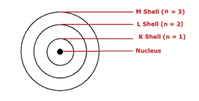
  • While revolving in discrete orbits the electrons do not radiate energy. These orbits or shells are called energy levels. Energy levels in an atom are shown in Fig. A few energy levels in an atom These orbits or shells are represented by the letters $K,L,M,N,…$ or the numbers, $n=1,2,3,4,….$
$(1)$ The orbits or shells are represented by
$(a)$ Letters
$(b)$ Numbers
$(c)$ Both a & b
$(d)$ Special symbols
$(2)$ These orbits or shells are called
$(a)$ Energy levels
$(b)$ Discrete orbit
$(c)$ Atomic levels
$(d)$ None of the above
$(3)$ Which of the following book is written by Professor Bohr’s
$(a)$ The Theory of Spectra and Atomic Constitution
$(b)$ Atomic Theory
$(c)$ The Description of Nature
$(d)$ All of the above
$(4)$ Identify the correct statement
Statement $1 –$ The orbits or shells are represented by letters only.
Statement $2 –$ The orbits or shells are represented by numbers only.
Statement $3 –$ While revolving in discrete orbits the electrons do not radiate energy.
Statement $4 –$ Certain special orbits known as discrete orbits of electrons.
$(a)$ Both $1 \& 2$
$(b)$ Both $3 \& 4$
$(c)$ Only $3$
$(d)$ All of the above
$(5)$ Write the postulate of Neil’s Bohr model of an atom?
Read the following text carefully and answer the questions that follow:
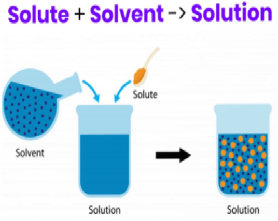
A solution of a solid in a liquid such as water can be prepared by adding it slowly to water with constant stirring at a certain temperature $($room temperature$)$. If the addition process is continued, a stage is ultimately reached in the dissolution process when no more of the solid dissolves. Rather it starts setlling at the bottom of the container such as a glass beaker. The solution at this stage is said to be saturated. The solubility of a solute is always expressed with respect to the saturated solution. It may be defined as the maximum amount of the solute that can be dissolved in $100 g$ of the solvent to form a saturated solution at a given temperature. Please remember that the role of temperature is very important. If temperature is increased, the solution becomes unsaturated. In case the temperature is decreased, the solution becomes supersaturated. As a result, crust of the solute gets deposited on the surface.
$i.$ What do mean by the term Solubility?
$ii. 20 g$ of a solute are dissolved in 500 g of the solvent. The solubility of the solute is:
$iii.$ When a saturated solution becomes unsaturated?
OR
What do you mean by concentration of solution?
We know that the earth attracts every object with a certain force and this force depends on the mass $(m)$ of the object and the acceleration due to the gravity $(g)$. The weight of an object is the force with which it is attracted towards the earth. Mathematically $W = m\ x\ g$
Where, $W$= weight of object
$m$= mass of object
$g$= acceleration due to the gravitational force
As the weight of an object is the force with which it is attracted towards the earth, the SI unit of weight is the same as that of force, that is, Newton $(N)$. The weight is a force acting vertically downwards; it has both magnitude and direction. We have learnt that the value of g is constant at a given place. Therefore at a given place, the weight of an object is directly proportional to the mass, say $m$, of the object, that is, $W$ αm. It is due to this reason that at a given place, we can use the weight of an object as a measure of its mass. Answer the following questions.
(i) Unit of acceleration due to the gravity (g) is
$(a)$ m/s
$(b)$ $m/s^2$
$(c)$ Newton$(N)$
$(d)$ None of these
(ii) Direction of weight of any object is
$(a)$ Always towards centre of earth
$(b)$ Always away from centre of earth
$(c)$ Weight don’t have direction
$(d)$ None of these
(iii) Which of the following has same unit
$(a)$ Mass and weight
$(b)$ Weight and force
$(c)$ Velocity and acceleration
$(d)$ None of these
(iv) Whether weight is scalar quantity or vector quantity? Justify your answer.
(v) Differentiate between mass and weight.
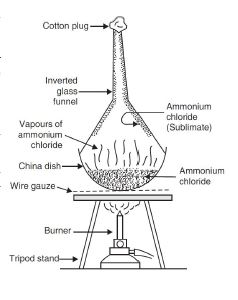
We take some ammonium chloride in a china dish and place the china dish on a tripod stand (see Figure). The china dish is covered with an inverted glass funnel. A loose cotton plug is put in the upper, open end of the funnel to prevent the ammonium chloride vapours from escaping into the atmosphere. The china dish is heated by using a burner. On heating, ammonium chloride changes into white vapours. These vapours rise up and get converted into solid ammonium chloride on coming in contact with the cold, inner walls of the funnel (see Figure). In this way, ammonium chloride collects on the inner sides of the funnel in the form of a sublimate and can be removed
$(i)$ What name is given to the phenomenon which takes place?
$(a)$ condensation $(b)$ evaporation $(c)$ sublimation $(d)$ vaporisation
$(ii)$ One of the following does not undergo sublimation. This one is :
$(a)$ iodine $(b)$ sodium chloride $(c)$ ammonium chloride $(d)$ camphor
$(iii)$ The conversion of a solid into vapours without passing through the liquid state is called :
$(a)$ vaporisation $(b)$ fusion $(c)$ sublimation $(d)$ freezing
$(iv)$ When heat is constantly supplied by a burner to boiling water, then the temperature of water during vaporisation :
$(a)$ rises very slowly $(b)$ rises rapidly until steam is produced
$(c)$ first rises and then becomes constant $(d)$ does not rise at all
$(v)$ During summer days, water kept in an earthen pot (pitcher) becomes cool because of the phenomenon of :
$(a)$ diffusion $(b)$ transpiration $(c)$ osmosis $(d)$ evaporation
Muscular tissue consists of elongated cells, also called muscle fibres. This tissue is responsible for movement in our body. Muscles contain special proteins called contractile proteins, which contract and relax to cause movementWe can move some muscles by conscious will. Such muscles are called voluntary muscles. These muscles are also called skeletal muscles as they are mostly attached to bones and help in body movement. Under the microscope, these muscles show alternate light and dark bands or striations, hence they are also called striated muscles. The cells of this tissue are long, cylindrical, unbranched and multinucleate.
The movement of food in the alimentary canal or the contraction and relaxation of blood vessels are involuntary movements. We can’t control these muscle movement. The Smooth muscles or involuntary muscles control such movements. They are also found in the iris of the eye, in ureters and in the bronchi of the lungs. The cells are long with pointed ends (spindle-shaped) and uninucleate. They are also called unstriated muscles.
The muscles of the heart show rhythmic contraction and relaxation throughout life. These involuntary muscles are called cardiac. Heart muscle cells are cylindrical, branched and uninucleate.
(1) Which of the following muscle tissue are voluntary in nature?
$(a)$ Cardiac muscle
$(b)$ Smooth muscle
$(c)$ auto rhythmic muscle
$(d)$ None of the above
(2) The muscles whose contraction is under our control are known as
$(a)$ Voluntary muscles
$(b)$ Involuntary movements
$(c)$ Cardiac muscle
$(d)$ Unstrained muscle
(3) The smooth muscle are found in the
$(a)$ Iris of eye
$(b)$ Uterus
$(c)$ Bronchi of lungs
$(d)$ All of above
(4) Give the characteristic of striated muscles.
(5) Give the characteristic of unstriated muscles.