MCQ
Photoelectric effect was successfully explained first by:
- APlanck
- BHallwash
- CHertz
- DEinsterin
Explanation:
Photoelectric effect was successfully explained first by Einstein.
Generate a complete, print-ready paper with questions like this in minutes — across 16+ boards, with answer keys.
While tuning in a certain broadcast station with a receiver, we are actually
|
(a) Varying the local oscillator frequency |
|
(b) Varying the frequency of the radio signal to be picked up |
|
(c) Tuning the antenna |
|
(d) None of these |
$\lambda\geq\lambda_0$
$\lambda\geq2\lambda_0$
$\lambda\leq\lambda_0$
$\lambda<\frac{\lambda_ 0}{2}.$
The sensitiveness of a moving coil galvanometer can be increased by decreasing
|
(a) The number of turns in the coil |
|
(b) The area of the coil |
|
(c) The magnetic field |
|
(d) The couple per unit twist of the suspension |
Same current i = 2A is flowing in a wire frame as shown in figure. The frame is a combination of two equilateral triangles ACD and CDE of side 1m. It is placed in uniform magnetic field B = 4T acting perpendicular to the plane of frame. The magnitude of magnetic force acting on the frame is
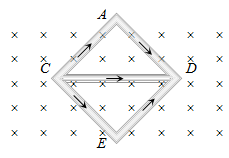
|
(a) 24 N |
(b) Zero |
(c) 16 N |
(d) 8 N |
The relation between Faraday constant (F), chemical equivalent (E) and electrochemical equivalent (Z) is
|
(a) F = EZ |
(b) |
(c) |
(d) |


