Question
Plot the corresponding reference circle for each of the following simple harmonic motions. Indicate the initial (t = 0) position of the particle, the radius of the circle, and the angular speed of the rotating particle. For simplicity, the sense of rotation may be fixed to be anticlockwise in every case: (x is in cm and t is in s).

$\text{x}=-2\sin\Big(3\text{t}+\frac{\pi}{3}\Big)$
Answer

$\text{x}=-2\sin\Big(3\text{t}+\frac{\pi}{3}\Big)=+2\cos\Big(3\text{t}+\frac{\pi}{3}+\frac{\pi}{2}\Big)$

$=2\cos\Big(3\text{t}+\frac{5\pi}{6}\Big)$

If this equation is compared with the standard SHM equation $\text{x}=\text{A}\cos\bigg(\Big(\frac{2\pi}{\text{T}}\Big)\text{t}+\phi\bigg),$ then we get:

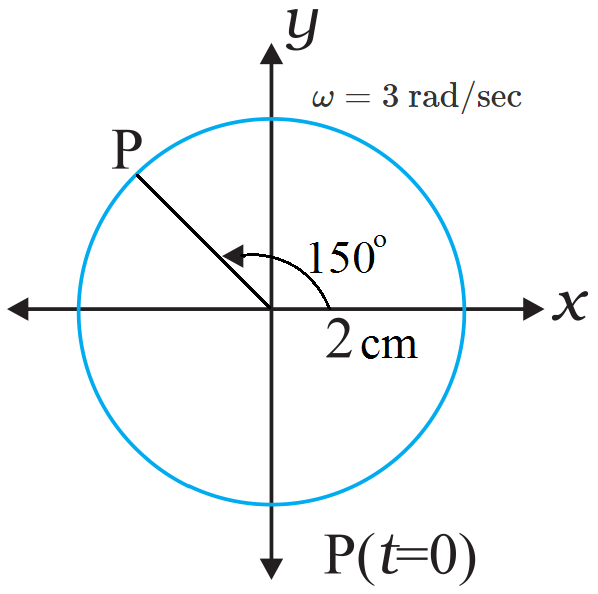
Amplitude, A = 2cm

Phase angle, $\phi=\frac{5\pi}{6}=150^\circ$

Angular velocity, $\omega=\frac{2\pi}{\text{T}}=3\text{rad/sec.}$

The motion of the particle can be plotted as shown in the following figure.

Need a full question paper?

Generate a complete, print-ready paper with questions like this in minutes — across 16+ boards, with answer keys.

Start Generating Free

Similar questions

The length, breadth and thickness of a block of metal were measured with the help of a Vernier Callipers. The measurements are:
$\text{l}=(5.250\pm0.001)\text{cm}$
$\text{b}=(3.450\pm0.001)\text{cm}$
$\text{t}=(1.740\pm0.001)\text{cm}$
Find the percentage error in volume of the block.
The temperature of 3kg krypton gas is raised from -29°C to 89°C.

  1. If this is done at constant volume, compute the heat added, the work done, and the change in internal energy.
  2. Repeat if the heating process is at constant pressure.

For Kr$\text{C}_\upsilon=0.0357\text{cal/gm}^\circ\text{C}$ and $\text{C}_\text{P}=0.0595\text{cal/gm}^\circ\text{C.}$

The first excited energy of a He+ ion is the same as the ground state energy of hydrogen. Is it always true that one of the energies of any hydrogen-like ion will be the same as the ground state energy of a hydrogen atom?
Show that terminal velocity V of a spherical object of radius r, density $\rho$ falling vertically through a viscous fluid of density $\sigma$ and coefficient of viscosity n is given by:

$\text{V}=\frac29\frac{(\rho-\sigma)\text{r}^2\text{g}}{\eta}$

A small error in the measurement of the quantity having the highest power (in a given formula) will contribute maximum percentage error in the value of the physical quantity to whom it is related. Explain why?
Give examples of a one-dimensional motion where:
The particle moving along positive x-direction comes to rest periodically and moves forward.
A jet airplane travelling at the speed of 500 km h–1 ejects its products of combustion at the speed of 1500km h–1 relative to the jet plane. What is the speed of the latter with respect to an observer on the ground?
Explain clearly, with examples, the distinction between:
Magnitude of average velocity over an interval of time, and the average speed over the same interval. [Average speed of a particle over an interval of time is defined as the total path length divided by the time interval]. Show in both (a) and (b) that the second quantity is either greater than or equal to the first. When is the equality sign true? [For simplicity, consider one-dimensional motion only]
A man weighing 60kg is sitting in a lift which is moving vertically with an acceleration of 2ms-2. Prove that the reaction on the base of the lift is greater when it is ascending than when it is descending. (Given g = 9.8ms-2).