MCQ
Positive rays consists of
  • A
    Electrons
  • B
    Neutrons
  • Positive ions
  • D
    Electro magnetic waves

Answer

Correct option: C.
Positive ions
Positive rays consist of positive ions.

Need a full question paper?

Generate a complete, print-ready paper with questions like this in minutes — across 16+ boards, with answer keys.
Start Generating Free

Similar questions

Which of the following figures correctly shows the phase relation between the input signal and the output signal of triode amplifier
Two capillary tubes of same diameter are put vertically one each in two liquids whose relative densities are 0.8 and 0.6 and surface tensions are 60 and $50 \mathrm{dyne} / \mathrm{cm}$ respectively Ratio of heights of liquids in the two tubes $\frac{h_1}{h_2}$ is
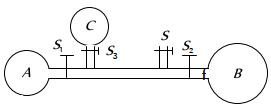
The adjoining diagram shows three soap bubbles $A, B$ and $C$ prepared by blowing the capillary tube fitted with stop cocks, $S, S$ and $S$. With stop cock $S$ closed and stop cocks $S, S$ and $S$ opened
Image
A convex lens has $9 \mathrm{~cm}$ focal length and a concave lens has $-18 \mathrm{~cm}$ focal length. The focal length of the combination in contact will be
The focal length of a combination of lenses formed with lenses having powers of $+2.50 D$ and $-3.75 D$ will be
The circular coil of a galvanometer has fifty turns. The coil has a radius of $1\ cm$. The coil is placed in a radial magnetic field of $0. 010\ T$. The torsion coefficent of the spring on which the coil hangs is $3 \times 10^{-7}\ N-m-rad^{-1}$. Determine the deviation of the galvanometer's hand if the current through the coil is $1.0\ mA$......$^o$
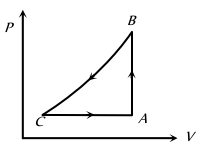
A sample of an ideal gas is taken through a cycle a shown in figure. It absorbs 50 / of energy during the process $A B$, no heat during $B C$, rejects $70 \mathrm{~J}$ during $C A .40 \mathrm{~J}$ of work is done on the gas during $B C$. Internal energy of gas at $A$ is 1500 /, the internal energy at $C$ would be
Image
A galvanometer of resistance $36 \Omega$ is changed into an ammeter by using a shunt of $4 \Omega$. The fraction $f$ of total current passing through the galvanometer is
Two springs have their force constant as $k_1$ and $k_2\left(k_1>k_2\right)$. When they are stretched by the same force
A car of mass $1000 \mathrm{~kg}$ accelerates uniformly from rest to a velocity of $54 \mathrm{~km} /$ hour in $5 \mathrm{~s}$. The average power of the engine during this period in watts is (neglect friction)