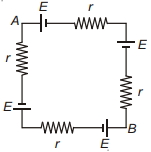
Potential difference across $A B$ in the network shown is .........
Easy
Download our app for free and get started
(a)
$i=\frac{E}{R}$
$V_A-E+i r-E+i r=V_B$
$V_A-E+E-E+E=V_B$
$V_A=V_B$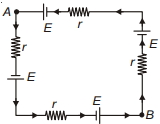

Download our appand get started for free
Experience the future of education. Simply download our apps or reach out to us for more information. Let's shape the future of learning together!No signup needed.*
Similar Questions
- 1In an experiment of potentiometer for measuring the internal resistance of primary cell a balancing length $\ell $ is obtained on the potentiometer wire when the cell is open circuit. Now the cell is short circuited by a resistance $R$. If $R$ is to be equal to the internal resistance of the cell the balancing length on the potentiometer wire will beView Solution
- 2A $100\, V$ voltmeter of internal resistance $20\,k\Omega $ in series with a high resistance $R$ is connected to a $110\, V$ line. The voltmeter reads $5\, V$, the value of $R$ is ................ $k \Omega $View Solution
- 3Two wires of same length and thickness having specific resistances $6\, \Omega \,cm$ and $3 \,\Omega\, cm$ respectively are connected in parallel. The effective resistivity is $\rho\, \Omega \,cm$. The value of $\rho$ to the nearest integer, is ..... .View Solution
- 4A potentiometer has uniform potential gradient. The specific resistance of the material of the potentiometer wire is $10^{-7} \, ohm-meter$ and the current passing through it is $0.1\, ampere$; cross-section of the wire is $10^{-6}\, m^2$. The potential gradient along the potentiometer wire isView Solution
- 5View SolutionWhich of the following quantities do not change when a resistor connected to a battery is heated due to the current?
- 6There is a current of $1.344\, amp$ in a copper wire whose area of cross-section normal to the length of the wire is $1\,m{m^2}$. If the number of free electrons per $c{m^3}$ is $8.4 \times {10^{22}}$, then the drift velocity would beView Solution
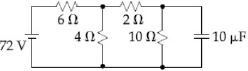
- 7Determine the charge on the capacitor in the following circuit ................ $\mu C$View Solution
- 8A current of $2\,A$ flows through a $2\,\Omega$ resistor when connected across a battery. The same battery supplies a current of $0.5\,\, A$ when connected across a $9 \,\,\Omega$ resistor. The internal resistance of the battery isView Solution
- 9View SolutionIf in the experiment of Wheatstone's bridge, the positions of cells and galvanometer are interchanged, then balance points will
- 10Resistance $n$, each of $r\; ohm$, when connected in parallel give an equivalentresistance of $R\; ohm$. If these resistances were connected in series, the combination would have a resistance in $ohms$, equal toView Solution