Question
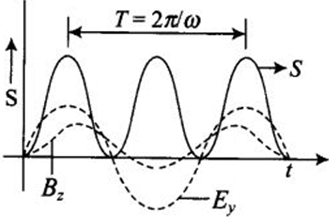
Poynting vectors S is defined as a vector whose magnitude is equal to the wave intensity and whose direction is along the direction of wave propogation. Mathematically, it is given by $\text{S}=\frac{1}{\mu_0}\text{E}\times\text{B}$. Show the nature of S vs t graph.
Answer

In an electromagnetic waves, let $\vec{\text{E}}$ be varying along y-axis, $\vec{\text{B}}$ is along z-axis and propagation of wave be along x-axis. Then $\vec{\text{E}}\times\vec{\text{B}}$ will tell the direction of propagation of energy flow in eletromagnetic wave, along x-axis.
Let $\vec{\text{E}}=\text{E}_0\sin(\omega\text{t}-\text{kx})\hat{\text{j}}$
$\vec{\text{B}}=\text{B}_0\sin(\omega\text{t}-\text{kx})\hat{\text{k}}$
$\text{S}=\frac{1}{\mu_0}(\vec{\text{E}}\times\vec{\text{B}})=\frac{1}{\mu_0}\text{E}_0\text{B}_0\sin(\omega\text{t}-\text{kx})(\hat{\text{j}}\times\hat{\text{k}})$
$\Rightarrow\ \text{S}=\frac{\text{E}_0\text{B}_0}{\mu_0}\sin^2(\omega\text{t}-\text{kx})\hat{\text{i}}\ \ (\text{As}\ \hat{\text{j}}\times\hat{\text{k}}=\hat{\text{i}})$
Since $\sin^2(\omega\text{t}-\text{kx})$ is never negative, $\vec{\text{S}}(\text{x},\text{t})$ always points in the positive X-direction, i.e, in the direction of wave propagation.
The variation of |S| with time T will be as given in the figure below:

Need a full question paper?

Generate a complete, print-ready paper with questions like this in minutes — across 16+ boards, with answer keys.

Start Generating Free

Similar questions

An electric bulb is designed to consume 55W when operated at 110 volts. It is connected to a 220V, 50Hz line through a choke coil in series. What should be the inductance of the coil for which the bulb gets correct voltage?
Calculate the work done in moving a test charge q0 from point A to point B against the repulsive force acting on it due to the other charge Q > 0 located at the origin.
Figure shows a convex spherical surface with centre of curvature $C$ separating the two media of refractive indices $\mu_1$ and $\mu_2$. Draw a ray diagram showing the formation of the image of a point object $O$ lying on the principal axis. Derive the relationship between the object and image distance in terms of refractive indices of the media and the radius of curvature $R$ of the surface.
Image
Half mole of an ideal gas $\Big(\gamma=\frac{5}{3}\Big)$ is taken through the cycle abcda, as shown in the figure. Take $\text{R}=\frac{25}{3}\text{JK}^{-1}\text{mol}^{-1}.$
  1. Find the temperature of the gas in the states $a, b, c$ and $d$.
  2. Find the amount of heat supplied in the processes $ab$ and $bc$.
  3. Find the amount of heat liberated in the processes $cd $ and $da.$
A charged particle is accelerated through a potential difference of $12\ kV$ and acquires a speed of $1.0 \times 10^6m s^{−1}.$ It is then injected perpendicularly into a magnetic field of strength $0.2T.$ Find the radius of the circle described by it.
Figure shows a potentiometer with a cell of $2.0V$ and internal resistance of $0.40\Omega$ maintaining a potential drop across the resistor wire $AB.$ A standard cell which maintains a constant emf of $1.02V ($for very moderate currents upto a few $mA)$ gives a balance point at $67.3\ cm$ length of the wire. To ensure very low currents drawn from the standard cell, a very high resistance of $600\ \text{k}\Omega$ is put in series with it, which is shorted close to the balance point. The standard cell is then replaced by a cell of unknown $emf$ and the balance point found similarly, turns out to be at $82.3\ cm$ length of the wire.
  1. What is the value of $\varepsilon?$
  2. What purpose does the high resistance of $600\ \text{k}\Omega$ have?
  3. Is the balance point affected by this high resistance?
  4. Is the balance point affected by the internal resistance of the driver cell?
  5. Would the method work in the above situation if the driver cell of the potentiometer had an $emf$ of $1.0V$ instead of $2.0V$?
  6. Would the circuit work well for determining extremely small $emf,$ say of the order of few $mV ($such as the typical $emf$ of a thermo couple$)$? If not, how would you modify the circuit?
Explain ac voltage applied on a series LCR circuit and give its analytical solution.
A particle of mass $1g$ and charge $2.5 \times 10^{-4}C$ is released from rest in an electric field of $1.2 \times 10^4NC^{-1}.$
  1. Find the electric force and the force of gravity acting on this particle. Can one of these forces be neglected in comparison with the other for approximate analysis?
  2. How long will it take for the particle to travel a distance of $40\ cm?$
  3. What will be the speed of the particle after travelling this distance?
  4. How much is the work done by the electric force on the particle during this period?
​​​​​​​
A point object is placed at a distance of $15\ cm$ from a convex lens. The image is formed on the other side at a distance of $30\ cm$ from the lens. When a concave lens is placed in contact with the convex lens, the image shifts away further by $30\ cm$. Calculate the focal lengths of the two lenses.
A group of hydrogen atoms are prepared in n = 4 states. List the wavelength that are emitted as the atoms make transitions and return to n = 2 states.