Question
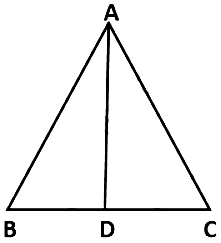
Prove that a $\triangle ABC$ is isosceles, if: altitude $AD$ bisects angles $BAC.$

Answer

In $\triangle A B C$, let the altitude $A D$ bisects $\angle B A C$. Then we have to prove that the $\triangle A B C$ is isosceles.

In triangles $\mathrm{ADB}$ and $\mathrm{ADC}$,
$\angle B A D=\angle C A D \ldots(A D$ is bisector of  $\angle B A C)$
$A D=A D \ldots  ($common$)$
$\angle A D B=\angle A D C \ldots .($ Each equal to  $90^{\circ})$
$\Rightarrow \triangle A D B \cong \triangle A D C \ldots ($by $\text{ASA}$ congruence criterion$)$
$\Rightarrow A B=A C \ldots  ($cpct$)$
Hence, $\triangle \mathrm{ABC}$ is an isosceles.

Need a full question paper?

Generate a complete, print-ready paper with questions like this in minutes — across 16+ boards, with answer keys.
Start Generating Free

Similar questions

Evaluate the following :$(5.45)^3 + (3.55)^3$
Given: $\cos A = \frac{5}{13}$Evaluate: $(i)\frac{\sin A -\cot A }{2 \tan A };(ii)\cot A +\frac{1}{\cos A }$
The height of a circular cylinder is $4.2\ cm.$ There times the sum of the areas of its two circular faces is twice the area of the curved surface. Find the volume of the cylinder correct to $1$ decimal place.
In a parallelogram $\text{ABCD, E}$ and $F$ are the midpoints of the sides $AB$ and $CD$ respectively. The line segments $AF$ and $BF$ meet the line segments $DE$ and $CE$ at points $G$ and $H$ respectively Prove that:$\text{EGFH}$ is a parallelogram.
Solve $x$ and $y$ if : $( \sqrt{32} )^x \div 2^{y + 1} = 1$ and $8^y - 16^{4 - x/2} = 0$
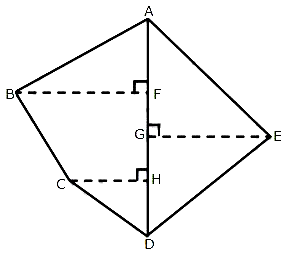
The following diagram shows a pentagonal field $\text{ABCDE}$ in which the lengths of $AF, FG, GH,$ and $HD$ are$ 50\ m, 40\ m, 15\ m$ and $25\ m$ respectively; and the lengths of perpendiculars $BF, CH$ and $EG$ are $50\ m, 25\ m$ and $60\ m$ respectively.Determine the area of the field.
Solve :$4 x+\frac{x-y}{8}=17,2 y+x-\frac{5 y+2}{3}=2$
If the numerator of a fraction is increased by $2$ and denominator is decreased by $1 $, it becomes $\frac{2}{3}$. If the numerator is increased by $1$ and denominator is increased by $2 $, it becomes $\frac{1}{3}$. Find the fraction.
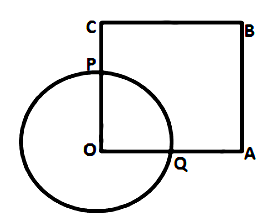
In the following figure, $\text{OABC}$ is a square. A circle is drawn with $O$ as centre which meets $OC$ at $P$ and $OA$ at $Q$.Prove that$:( i ) \triangle OPA \cong \triangle OQC;( ii ) \triangle BPC \cong \triangle BQA$
Solve:$\frac{a}{x}-\frac{b}{y}=0, \frac{a b^2}{x}+\frac{a^2 b}{y}=a^2+b^2$