Question
Prove that after a direct elastic collision between two balls of equal mass, their velocities mutually interchange.

Answer

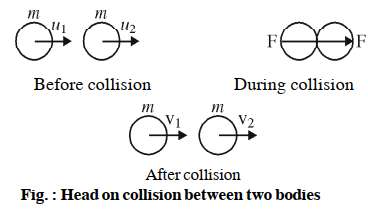
Suppose two balls of equal mass $m$ are moving in the same direction with velocities $u_1$ and $u_2$ respectively. Both the balls are moving in a same straight line before and after the collision and their collision is perfectly elastic. Let the velocities of the balls becomes $v_1$ and $v_2$ respectively after the collision.
Image
Momentum and kinetic energy are conserved in elastic collisions, hence from the low of conservation of momentum,
Total momentum before collison $=$ Total momentum after collision
$\begin{aligned}
m u_1+m u_2 & =m v_1+m v_2 \\
u_1+u_2 & =v_1+v_2 \\
\left(u_1-v_1\right) & =\left(v_2-u_2\right) \ \ldots(1)
\end{aligned}$
From the law of conservation of kinetic energy, Kinetic energy before Collision $=$ kinetic energy after collision
$\begin{aligned}
\frac{1}{2} m u_1^2+\frac{1}{2} m u_2^2 & =\frac{1}{2} m v_1^2+\frac{1}{2} m v_2^2 \\
\left(u_1^2-v_1^2\right) & =\left(v_2^2-u_2^2\right) \ \ldots(2)
\end{aligned}$
By dividing equation (2) by (1),
$\begin{aligned}
\frac{\left(u_1^2-v_1^2\right)}{\left(u_1-v_1\right)} & =\frac{\left(v_2^2-u_2^2\right)}{\left(v_2-u_2\right)} \\
\frac{\left(u_1+v_1\right)\left(u_1-v_1\right)}{\left(u_1-v_1\right)} & =\frac{\left(v_2+u_2\right)\left(v_2-u_2\right)}{\left(v_2-u_2\right)} \\
u_1+v_1 & =v_2+u_2 \\
u_1-u_2 & =-\left(v_1-v_2\right) \ \ldots(3) \\
\Delta u & =-\Delta v
\end{aligned}$
Therefore, the relative speed of coming closer before the collision and the relative speed of moving away after the collision are equal.
On adding equation (1) and (3),
$\begin{aligned}
2 u_1 & =2 v_2 \\
\therefore u_1 & =v_2 \ \ldots(4)
\end{aligned}$
On subtracting equations (1) and (3)
$\begin{aligned}
2 u_2 & =2 v_1 \\
u_2 & =v_1 \ \ldots(5)
\end{aligned}$
Hence from equations (4) and (5) it is clear that after elastic collision between two moving balls of equal mass, their velocities mutually change.

Need a full question paper?

Generate a complete, print-ready paper with questions like this in minutes — across 16+ boards, with answer keys.
Start Generating Free

Similar questions

A hemispherical portion of the surface of a solid glass sphere $(\mu=1.5)$ of radius r is silvered to make the inner side reflecting. An object is placed on the axis of the hemisphere at a distance 3r from the centre of the sphere. The light from the object is refracted at the unsilvered part, then reflected from the silvered part and again refracted at the unsilvered part. Locate the final image formed.
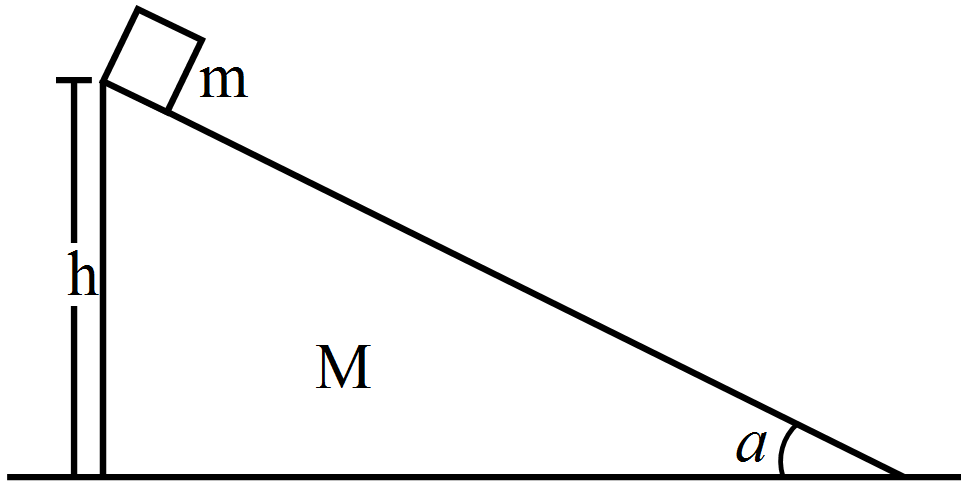
A block of mass m is placed on a triangular block of mass M, which in turn is placed on a horizontal surface as shown in figure. Assuming frictionless surfaces find the velocity of the triangular block when the smaller block reaches the bottom end.
Two bodies of masses $10kg$ and $20kg$ respectively kept on a smooth, horizontal surface are tied to the ends of a light string. A horizontal force $F = 600N$ is applied to (i) A, (ii) B along the direction of string. What is the tension in the string in each case?
Find the expression for the position of the center of mass of the system of two particles.
Draw velocity$-$time graph of uniformly accelerated motion in one dimension. From the velocity time graph of uniform accelerated motion, deduce the equations of motion in distance and time.
Consider the situation of the previous problem. The man has to reach the other shore at the point directly opposite to his starting point. If he reaches the other shore somewhere else, he has to walk down to this point. Find the minimum distance that he has to walk.
Explain by making a labelled diagram of two dimensional collision or oblique collision.
The nearest star to our solar system is $4.29$ light years away. How much is this distance in terms of parsecs? How much parallax would this star (named Alpha Centauri) show when viewed from two locations of the Earth six months apart in its orbit around the Sun?
If a liquid is flowing through a horizontal tube, write down the formula for the volume of the liquid flowing per second through it. Water is flowing through a horizontal tube of radius $2r$ and length $1m$ at a rate of $60L/s$, when connected to a pressure difference of h cm of water. Another tube of same length but radius is connected in series with this tube and the combination is connected to the same pressure head. Find out the pressure difference across each tube and the rate of flow of water through the combination.
Two identical balls A and B undergo a perfectly elastic two dimensional collision. Initially A is moving with a speed of $10ms^{-1}$ and B is at rest. Due to collision A is scattered through angle of $30°$. What are the speed of A and B after the collision?