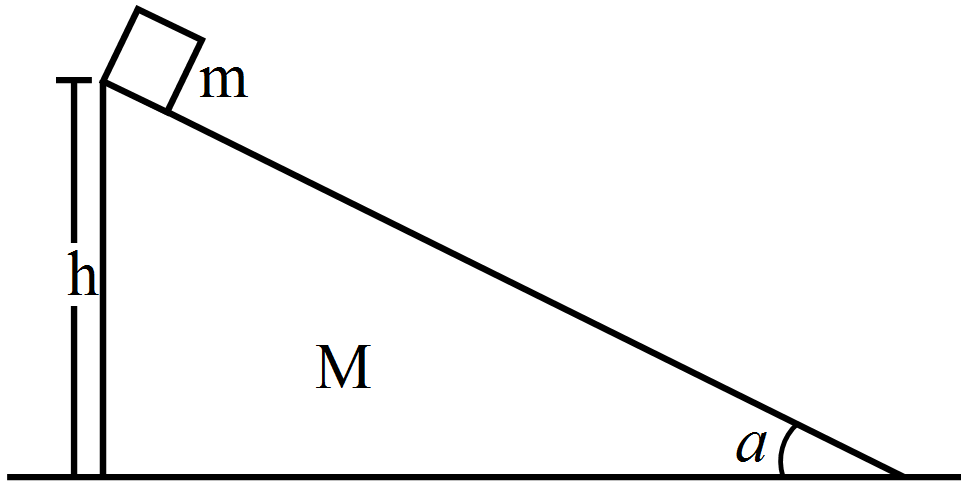
A block of mass m is placed on a triangular block of mass M, which in turn is placed on a horizontal surface as shown in figure. Assuming frictionless surfaces find the velocity of the triangular block when the smaller block reaches the bottom end.
Download our app for free and get started
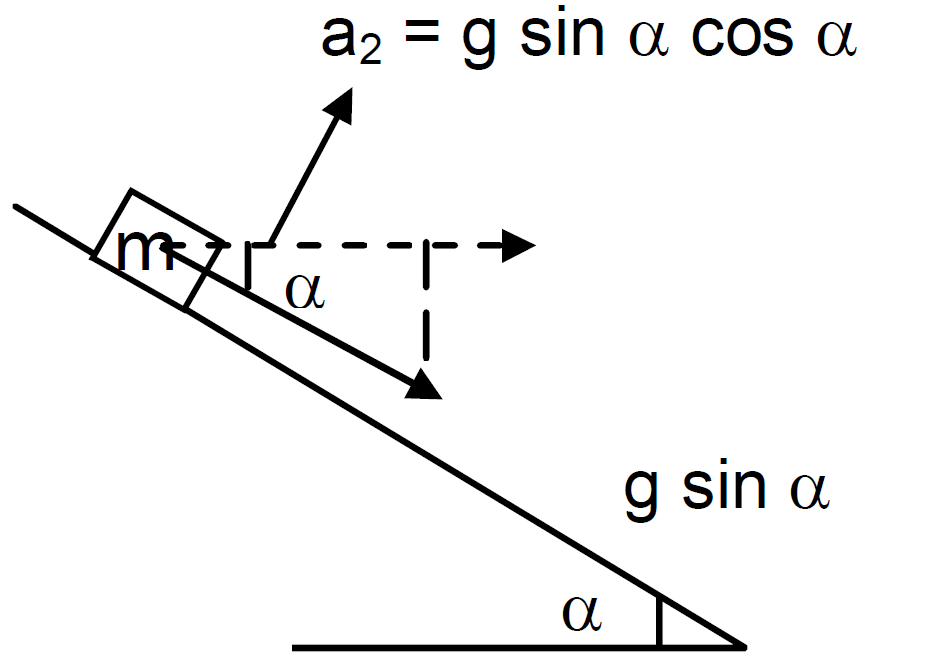
The block ‘m’ will slide down the inclined plane of mass M with acceleration $\text{a}_1\text{g}\sin\alpha$ (relative) to the inclined plane. The horizontal component of $a_1$ will be, $\text{a}_{\text{x}}=\text{g}\sin\alpha\cos\alpha,$ for which the block M will accelerate towards left. Let, the acceleration be $a_2$. According to the concept of centre of mass, (in the horizontal direction external force is zero).
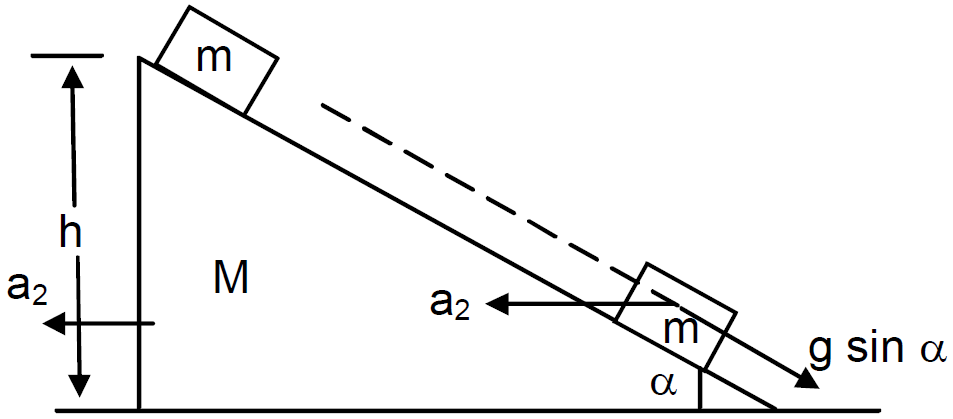
$ ma_x = (M + m)a_2$_ $\Rightarrow\text{a}_2=\frac{\text{ma}_{\text{x}}}{\text{M}+\text{m}}=\frac{\text{mg}\sin\alpha\cos\alpha}{\text{M}+\text{m}}\ \dots(1)$ So, the absolute (Resultant) acceleration of ‘m’ on the block ‘M’ along the direction of the incline will be, $\text{a}=\text{g}\sin\alpha-\text{a}_2\cos\alpha$
$=\text{g}\sin\alpha-\frac{\text{mg}\sin\alpha\cos^2\alpha}{\text{M}+\text{m}}$
$=\text{g}\sin\alpha\Big[1-\frac{\text{m}\cos^2\alpha}{\text{M}+\text{m}}\Big]$
$=\text{g}\sin\alpha\Big[\frac{\text{M}-\text{m}-\text{m}\cos^2\alpha}{\text{M}+\text{m}}\Big]$ So, $\text{a}=\text{g}\sin\alpha\Big[\frac{\text{M}+\text{m}\sin^2\alpha}{\text{M}+\text{m}}\Big]\ \dots(2)$ Let, the time taken by the block ‘m’ to reach the bottom end be ‘t’.
Now, $\text{S}=\text{ut}+\Big(\frac{1}{2}\Big)\text{at}^2$
$\Rightarrow\frac{\text{h}}{\sin\alpha}=\Big(\frac{1}2{}\Big)\text{at}^2$
$\Rightarrow\text{t}=\sqrt{\frac{2}{\text{a}\sin\alpha}}$ So, the velocity of the bigger block after time ‘t’ will be. $\text{V}_{\text{m}}=\text{u}+\text{a}_2\text{t}$
$=\frac{\text{mg}\sin\alpha\cos\alpha}{\text{M}+\text{m}}\sqrt{\frac{2}{\text{a}\sin\alpha}}$
$=\sqrt{\frac{\text{2m}^2\text{g}^2\text{h}\sin^2\alpha\cos^2\alpha}{(\text{M}+\text{m})^2\text{a}\sin\alpha}}$ Now, subtracting the value of a from equation (2) we get, $\text{V}_\text{m}=\bigg[\frac{\text{2m}^2\text{g}^2\text{h}\sin^2\alpha\cos^2\alpha}{(\text{M}+\text{m})^2\text{a}\sin\alpha}\times\frac{(\text{M}+\text{m})}{\text{g}\sin\alpha(\text{M}+\text{m}\sin^2 \alpha)}\bigg]^{\frac{1}{2}}$ or $\text{V}_{\text{m}}=\bigg[\frac{2\text{m}^2\text{g}^2\text{h}\cos^2\alpha}{(\text{M}+\text{m})(\text{M}+\text{m}\sin^2\alpha)}\bigg]^{\frac{1}{2}}$
$ ma_x = (M + m)a_2$_ $\Rightarrow\text{a}_2=\frac{\text{ma}_{\text{x}}}{\text{M}+\text{m}}=\frac{\text{mg}\sin\alpha\cos\alpha}{\text{M}+\text{m}}\ \dots(1)$ So, the absolute (Resultant) acceleration of ‘m’ on the block ‘M’ along the direction of the incline will be, $\text{a}=\text{g}\sin\alpha-\text{a}_2\cos\alpha$
$=\text{g}\sin\alpha-\frac{\text{mg}\sin\alpha\cos^2\alpha}{\text{M}+\text{m}}$
$=\text{g}\sin\alpha\Big[1-\frac{\text{m}\cos^2\alpha}{\text{M}+\text{m}}\Big]$
$=\text{g}\sin\alpha\Big[\frac{\text{M}-\text{m}-\text{m}\cos^2\alpha}{\text{M}+\text{m}}\Big]$ So, $\text{a}=\text{g}\sin\alpha\Big[\frac{\text{M}+\text{m}\sin^2\alpha}{\text{M}+\text{m}}\Big]\ \dots(2)$ Let, the time taken by the block ‘m’ to reach the bottom end be ‘t’.
Now, $\text{S}=\text{ut}+\Big(\frac{1}{2}\Big)\text{at}^2$
$\Rightarrow\frac{\text{h}}{\sin\alpha}=\Big(\frac{1}2{}\Big)\text{at}^2$
$\Rightarrow\text{t}=\sqrt{\frac{2}{\text{a}\sin\alpha}}$ So, the velocity of the bigger block after time ‘t’ will be. $\text{V}_{\text{m}}=\text{u}+\text{a}_2\text{t}$
$=\frac{\text{mg}\sin\alpha\cos\alpha}{\text{M}+\text{m}}\sqrt{\frac{2}{\text{a}\sin\alpha}}$
$=\sqrt{\frac{\text{2m}^2\text{g}^2\text{h}\sin^2\alpha\cos^2\alpha}{(\text{M}+\text{m})^2\text{a}\sin\alpha}}$ Now, subtracting the value of a from equation (2) we get, $\text{V}_\text{m}=\bigg[\frac{\text{2m}^2\text{g}^2\text{h}\sin^2\alpha\cos^2\alpha}{(\text{M}+\text{m})^2\text{a}\sin\alpha}\times\frac{(\text{M}+\text{m})}{\text{g}\sin\alpha(\text{M}+\text{m}\sin^2 \alpha)}\bigg]^{\frac{1}{2}}$ or $\text{V}_{\text{m}}=\bigg[\frac{2\text{m}^2\text{g}^2\text{h}\cos^2\alpha}{(\text{M}+\text{m})(\text{M}+\text{m}\sin^2\alpha)}\bigg]^{\frac{1}{2}}$

Download our appand get started for free
Experience the future of education. Simply download our apps or reach out to us for more information. Let's shape the future of learning together!No signup needed.*
Similar Questions
- 1Prove the result that the velocity v of translation of a rolling body (like a ring, disc, cylinder or sphere) at the bottom of an inclined plane of a height h is given by $\text{v}^2=\frac{2\text{gh}}{\Big(\frac{1+\text{k}^2}{\text{R}^2}\Big)}$ using dynamical consideration (i.e. by consideration of forces and torques).View Solution
Note: k is the radius of gyration of the body about its symmetry axis, and R is the radius of the body. The body starts from rest at the top of the plane. - 2From a uniform circular disc of diameter d, a circular hole of diameter $\frac{\text{d}}{6}$ and having its centre at a distance of $\frac{\text{d}}{4}$ from the centre of the disc is scooped out. Find the centre of mass of the remaining portion.View Solution
- 3Separation of Motion of a system of particles into motion of the centre of mass and motion about the centre of mass: Show $\text{p}=\text{p}'_\text{i}+\text{m}_\text{i}\text{V}$ where $p_i$ is the momentum of the ith particle (of mass $m_i$ ) and $p′_i = m_iv′_i.$ Note: $v′_i$ is the velocity of the ith particle relative to the centre of mass. Also, prove using the definition of the centre of mass.View Solution
- 4Separation of Motion of a system of particles into motion of the centre of mass and motion about the centre of mass: Show $\text{L}=\text{L}'+\text{R}\times\text{MV}$ where $\text{L}'=\sum\text{r}'_\text{i}\times\text{p}'_\text{i}$ is the angular momentum of the system about the centre of mass with velocities taken relative to the centre of mass. Remember $\text{r}'_\text{i}=\text{r}_\text{i}-\text{R},$ rest of the notation is the standard notation used in the chapter.View Solution
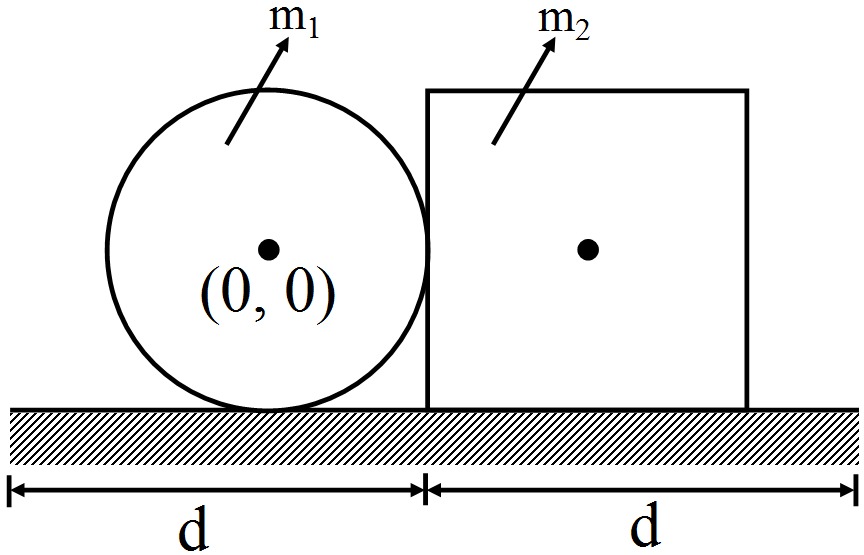
Note: $\text{L}'$ and $\text{MR}\times\text{V}$ can be said to be angular momenta, respectively, about and of the centre of mass of the system of particles. - 5View SolutionA square plate of edge d and a circular disc of diameter d are placed touching each other at the midpoint of an edge of the plate as shown in figure. Locate the centre of mass of the combination, assuming same mass per unit area for the two plates.
- 63 A man stands on a rotating platform, with his arms stretched horizontally holding a 5kg weight in each hand. The angular speed of the platform is 30 revolutions per minute. The man then brings his arms close to his body with the distance of each weight from the axis changing from 90cm to 20cm. The moment of inertia of the man together with the platform may be taken to be constant and equal to $7.6kgm^2$.View Solution
- What is his new angular speed? (Neglect friction).
- Is kinetic energy conserved in the process? If not, from where does the change come about?
- 7View SolutionCalculate the total torque acting on the body shown in figure about the point O.
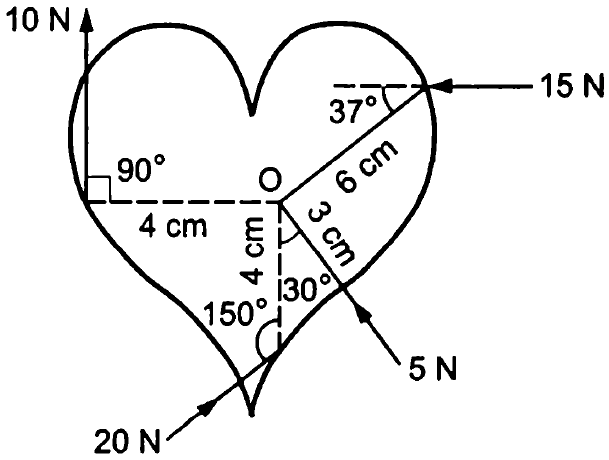
- 8View SolutionA ball is whirled in a circle by attaching it to a fixed point with a string. Is there an angular rotation of the ball about its centre? If yes, is this angular velocity equal to the angular velocity of the ball about the fixed point?
- 9Find the centre of mass of a uniform $L-$shaped lamina $($a thin flat plate$)$ with dimensions as shown. The mass of the lamina is $3 \ kg.$View Solution
- 10View SolutionShow that a(b × c) is equal in magnitude to the volume of the parallelepiped formed on the three vectors a, b and c.