Questions

3 Marks Question

Take a timed test

4 questions · self-marked practice — reveal the answer and mark yourself.

Question 13 Marks
In an ideal spring the law $\vec{F}=-k \vec{x}$ is followed. Here $k$ is the spring constant. Calculate the work done by the spring in stretching it to a distance $x$ from its equilibrium position by integral method and graphical method
Answer
Integration method :
$\begin{array}{l}
\text { Work } \quad w=\int_0^x \overrightarrow{F} \cdot \overrightarrow{d x} \\
\because \quad \vec{F}=-k \vec{x} \\
\therefore \quad w=\int_0^x-k \vec{x} \cdot \overrightarrow{d x} \\
w=-k \int_0^x x d x=-k\left[\frac{x^2}{2}\right]_0^x \\
=-k \frac{x^2}{2}=-\frac{1}{2} k x^2
\end{array}$
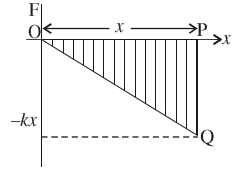
Graphical method : If a graph is drawn between the increase in spring length $x$ and the force F , then a straight line is obtained as shown in figure. Work done by restoring force :
Image
$\begin{aligned}
w & =\text { area of } \Delta OPQ \\
w & =\frac{1}{2} \times OP \times PQ \\
& =\frac{1}{2} x \times(-k x) \\
& =-\frac{1}{2} k x^2
\end{aligned}$
Hence, the value of work obtained by both methods is same.
View full question & answer
Question 23 Marks
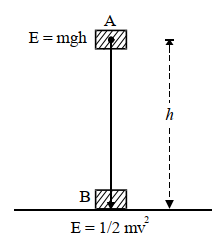
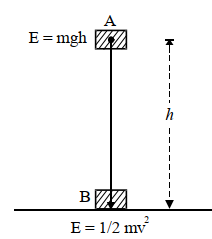
Prove that as the object moves towards the ground from some height, its potential energy decreases and kinetic energy increases by the same amount.
View full question & answer
Question 33 Marks
Write the main characteristics of potential energy
Answer
 (i) Potential energy is a scalar function of position.
(ii) The negative value of the derivative of potential energy with respect to position determines the force $\overrightarrow{F}=-\frac{d}{d t} U_{(x)}$
(iii) The value of potential energy depends on the frame of reference.
(iv) The concept of potential energy is defined only for internal conservative forces and not for non-conservative forces.
(v) Change in potential energy continous during the motion of a rigid object because the distance between its particles doesn't change even when external force is applied to the motion of a rigid object.
View full question & answer
Question 43 Marks
What is work and also give examples of the following :(i) Zero work(ii) Positive work(iii) Negative work
Answer
Suppose a constant force F is acting on an object of mass $m$ due to which the displacement of the
object in the positive $x$-direction is $\overrightarrow{ S }$, as shown in the figure.

Image
Therefore the work done by a force is defined as 'the product of the magnitude of displacement and component of force along the direction of displacment. Therefore,
$
W=(F \cos \theta) s=\overrightarrow{F} \cdot \overrightarrow{S} \ \ldots(1)
$
(i) Zero work : It is clear from equation (1) that if the displacement of the object is zero then no matter how great is the magnitude of force, the work done by the object is zero. No work is considered completed if
(a) the displacement is zero
(b) force is zero
(c) force and displacement are perpendicular to each other. Since $\theta=\frac{\pi}{2}$ and $\cos \frac{\pi}{2}=0$ is always zero.
The centripetal force on an object moving in a circular path with constant speed is perpendicular to the displacement hence the work done by the centripetal force is zero.
(ii) Positive work : If $\theta \geq 0^{\circ}$ and $\theta<90^{\circ}$ then the value of $\cos \theta$ is positive. In such a situation the work is positive. For example, when a man pulls a roller, the value of work is positive.
(iii) Negative work: When $90^{\circ}<\theta \leq 180^{\circ}$ then the value of $\cos \theta$ is negative. Hence the work is negative.
For example, when a roller is pulled on a rough surface, the friction force and displacement are in opposite directions hence the work done by the friction force is negative.

View full question & answer