Question
Prove that gravitational potential difference is the work done in carrying a unit mass from one point to another.

Answer

Gravitational potential at A $=-\frac{\text{GM}}{\text{r}_{\text{a}}}$
Gravitational potential at B $=-\frac{\text{GM}}{\text{r}_{\text{b}}}$
Difference in potential $=-\text{GM}\Big(\frac{1}{\text{r}_{\text{b}}}-\frac{1}{\text{r}_{\text{a}}}\Big)$
Work done in carrying a units mass from A to B is,
$\text{W}=\int^\limits{\text{r}_{\text{b}}}_\limits{\text{r}_{\text{a}}}\frac{\text{GM}}{\text{x}^2}$
$\text{W}=-\text{GM}\Big|\frac{1}{\text{x}}\Big|^{\text{r}_{\text{b}}}_{\text{r}_{\text{a}}}=-\text{GM}\Big(\frac{1}{\text{r}_{\text{b}}}-\frac{1}{\text{r}_{\text{a}}}\Big)$
So, work done and gravitational potential difference are same.

Need a full question paper?

Generate a complete, print-ready paper with questions like this in minutes — across 16+ boards, with answer keys.
Start Generating Free

Similar questions

As you have learnt in the text, a geostationary satellite orbits the earth at a height of nearly 36,000km from the surface of the earth. What is the potential due to earth’s gravity at the site of this satellite? (Take the potential energy at infinity to be zero). Mass of the earth = 6.0 × 1024kg, radius = 6400km.
From parallax measurement, the sun is found to be at a distance of about 400 times the earth-moon distance. Estimate the ratio of sun-earth diameters.
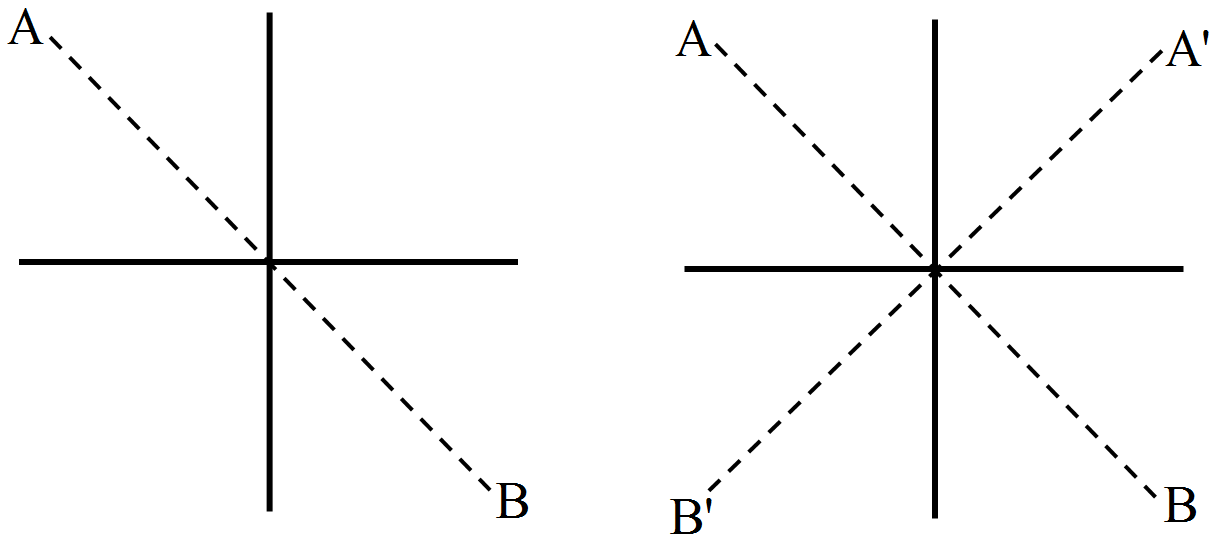
Two uniform thin identical rods, each of mass M and length L, are joined so as to form a cross as shown in Fig. What is the moment of inertia of the system about the bisector line AB?

Pressure decreases as one ascends the atmosphere. If the density of air is $\rho,$ what is the change in pressure dp over a differential height dh?
How many astronomical units (A.U.) make 1 parsec?
A person standing on a platform finds that a train moving with velocity 0.6c takes one second to pass by him. Find:
  1. The length of the train as seen by the person and.
  2. The rest length of the train.
A 10 kW drilling machine is used to drill a bore in a small aluminium block of mass 8.0 kg . How much is the rise in temperature of the block in 2.5 minutes, assuming $50 \%$ of power is used up in heating the machine itself or lost to the surroundings. Specific heat of aluminium $=0.91 J g ^{-1} K^{-1}$.
Show that there are two values of time for a projectile when it is at same height. Also show that the sum of these two times is equal to the time of flight.

OR

Prove the following relations by calculus method:

  1. $\text{s}=\text{ut}+\frac{1}{2}\text{at}^2$
  2. $\text{v}^2-\text{u}^2=2\text{as}$
Name a varying mass system. Derive an expression for velocity of propulsion of a rocket at any instant.
A radioactive isotope is being produced at a constant rate $\frac{\text{dN}}{\text{dt}}=\text{R}$ in an experiment. The isotope has a half-life $\text{t}_{\frac{1}2{}}.$ Show that after a time $\text{t}>>\text{t}_{\frac{1}{2}},$ the number of active nuclei will become constant. Find the value of this constant.