$\text{v}=\sqrt{(6.67\times10^{12})}$
v= (2.58 × 10⁶)m/s98 questions · self-marked practice — reveal the answer and mark yourself.
$\text{v}=\sqrt{(6.67\times10^{12})}$
v= (2.58 × 10⁶)m/s
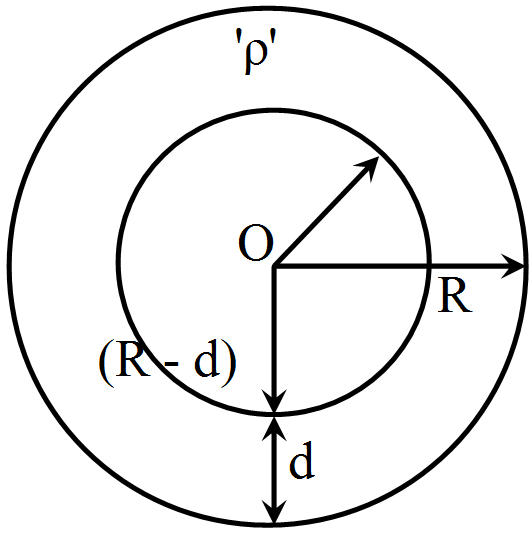
At a depth d, the gravitational force is due to the mass distributed in the sphere of radius (R - d). $\therefore$ The acceleration due to gravity at a depth d. $\text{g}'=\frac{\text{GM}'}{(\text{R}-\text{d})^2}=\text{G}\frac{4}{3}\frac{\pi(\text{R}-\text{d})^3\rho}{(\text{R}-\text{d})^2}$ $=\text{G}\frac{4}{3}\pi(\text{R}-\text{d})\text{r}$
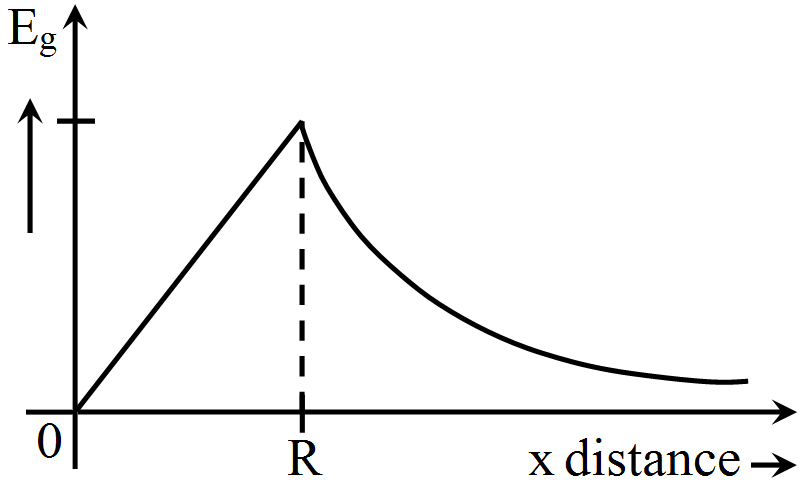
$\text{i.e.,}\text{g}'=\text{G}\frac{\text{R}^3\rho}{\text{R}^2}\frac{(\text{R}-\text{d})}{\text{R}}$ $=\text{g}\frac{(\text{R}-\text{d})}{\text{R}}=\text{g}\Big(1-\frac{\text{d}}{\text{R}}\Big)$ $\therefore$ reduces as we move from surface inwards and is zero at the centre.$\text{v}_\text{m}=\sqrt{\frac{2\text{G}\big(\frac{\text{M}}{9}\big)}{\frac{\text{R}}{2}}}$
$=\sqrt{\frac{4}{9}\frac{\text{GM}}{\text{R}}}=\frac{\sqrt{2}}{3}\times\text{v}_\text{e}$
$=\frac{1.414}{3}\times11.2\text{km s}^{-1}=5.279\text{km s}^{-1}$

$\text{g}'=\text{g}\Big(1-\frac{\text{R}}{2\text{R}}\Big)=\frac{\text{g}}{2}$
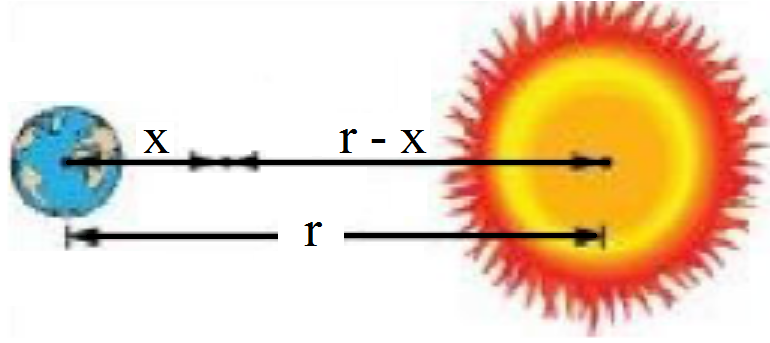
At height x,
$\text{g}'=\text{g}\Big(1-\frac{2\text{x}}{\text{R}}\Big)$
$\therefore\ \text{g}\Big(1-\frac{2\text{x}}{\text{R}}\Big)=\frac{\text{g}}{2}$
$\frac{1}{2}=\frac{2\text{x}}{\text{R}}$
$\Rightarrow\ \text{x}=\frac{\text{R}}{4}.$
$\text{T}=2\pi\sqrt{\frac{\text{r}}{\text{GM}}}$
$\therefore\text{larger}\ '\text{r}',\text{larger }\text{T}$
$\therefore$ Satellite B has longer period.
$\text{v}_{\text{o}}=\sqrt{\frac{\text{GM}}{\text{r}}},\text{lesser r,} \text{more }\text{v}_{\text{o}}$
$\therefore$ Satellite A has greater speed.
$\text{T}^2=\frac{4\pi^2}{\text{GM}_\text{m}}\text{R}^3$
$\text{M}_\text{m}=\frac{4\pi^2}{\text{G}}\times\frac{\text{R}^3}{\text{T}^2}$
$\text{M}_\text{m}=\frac{4\times(3.14)^2\times(9.4)^3\times10^{18}}{6.67\times10^{-11}\times(459\times60)^2}$
$=\frac{4\times(3.14)^2\times(9.4)^3\times10^{18}}{6.67\times(4.59\times6)^2\times10^{-5}}$
$=6.48\times10^{23}\text{kg}$
$\frac{\text{T}^2_\text{M}}{\text{T}^2_\text{E}}=\frac{\text{R}^3_\text{MS}}{\text{R}^3_\text{ES}}$
where RMS (RES) is the Mars (Earth) - Sun distance.
$\text{T}_\text{M}=\Big(\frac{\text{R}_\text{MS}}{\text{R}_\text{ES}}\Big)^\frac{3}{2}\times\text{T}_\text{E}$
$=(1.52)^\frac{3}{2}\times365=684\text{ days}$
Since $\text{T}^2\propto\text{r}^3,$ we have,
$\Big(\frac{2\pi\text{r}}{\text{v}}\Big)^2\propto\text{r}^3$
$\text{v}^2=4\pi^2\frac{\text{r}^2}{\text{r}^3}=\frac{4\pi^2}{\text{r}}$
$\frac{\text{mv}^2}{\text{r}}=\frac{4\text{m}\pi^2}{\text{r}^2}$
The centripetal force $\frac{\text{mv}^2}{\text{r}}$ is caused by M - earth on the planet of mass m.
Thus, $\text{F}\propto\frac{\text{Mm}}{\text{r}^2}$ It is the Newton's Universal Law of Gravitation.
$\text{v}=\sqrt{(6.67\times10^{12})}$
v= (2.58 × 10⁶)m/s$\frac{\text{mv}^2_0}{\text{R}+\text{h}}=\frac{\text{GMm}}{(\text{R}+\text{h})^2}$
$\text{v}_0^2=\frac{\text{GM}}{\text{R}+\text{h}}=\frac{\text{gR}^2}{(\text{R}+\text{h})}$
$\therefore\ \Big(\frac{1}{2}\text{v}_\text{e}\Big)^2=\frac{\text{gR}^2}{\text{R}+\text{h}}$ from eq. (i)
Now, R + h = 2R
h = R
Total energy $=-\frac{\text{GMm}}{2\text{R}}$
Let v be its velocity when it reaches the earth.
Hence the kinetic energy $=\frac{1}{2}\text{mv}^2$
Potential energy $=-\frac{\text{GMm}}{\text{R}}$
$\therefore\frac{1}{2}\text{mv}^2-\frac{\text{GMm}}{\text{R}}=-\frac{\text{GMm}}{2\text{R}}$
$\text{v}^2=2\text{GM}\Big(\frac{1}{\text{R}}-\frac{1}{2\text{R}}\Big)=\frac{2\text{gR}^2}{2\text{R}}$
$\Rightarrow\ \text{v}^2=\text{gR}$
$\text{v}=\sqrt{\text{gR}}$

$\Rightarrow\ \text{v}_0=\sqrt{\frac{\text{GM}}{\text{r}}}=\sqrt{\frac{\text{GM}}{(\text{R}+\text{h})}}$
But $\text{g}=\frac{\text{GM}}{\text{R}^2},$ hence GM = gR2$\therefore\ \text{v}_0=\sqrt{\frac{\text{gR}^2}{(\text{R}+\text{h})}}=\text{R}\sqrt{\frac{\text{g}}{(\text{R}+\text{h})}}.$

$=\text{GMm}\Big[-\frac{1}{\text{x}}\Big]^{2\text{R}}_{\text{R}}=-\frac{\text{GMm}}{\text{2R}}$
$\Rightarrow \frac{\text{M}_1}{\text{M}_2}=\frac{1}{10}$
and $\frac{\text{R}_1}{\text{R}_2}=\frac{2}{5}$$\frac{\text{d}_1}{\text{d}_2}=\bigg[\frac{\text{M}_1}{\frac{4}{3}\pi\text{R}_1^3}\bigg]\bigg[\frac{\frac{4}{3}\pi\text{R}^3_2}{\text{M}_2}\bigg]$
$\frac{\text{d}_1}{\text{d}_2}=\frac{\text{M}_1}{\text{M}_2}\Big[\frac{\text{R}_2}{\text{R}_1}\Big]^3$
$\frac{\text{d}_1}{\text{d}_2}=\Big[\frac{1}{10}\Big]\Big[\frac{5}{2}\Big]^3=\frac{25}{16}$
$\therefore\ \frac{\text{g}_1}{\text{g}_2}=\frac{\text{M}_1}{\text{M}_2}\Big[\frac{\text{R}_2}{\text{R}_1}\Big]^2$
$=\frac{1}{10}\Big[\frac{5}{2}\Big]^2=\frac{5}{8}$
$\Rightarrow\frac{\text{v}_1}{\text{v}_2}=\sqrt{\frac{\text{M}_1}{\text{M}_2}}\sqrt{\frac{\text{R}_2}{\text{R}_1}}=\sqrt{\frac{1}{10}\times\frac{5}{2}}=\frac{1}{2}$
$\Rightarrow\frac{\text{T}_1}{\text{T}_2}=\sqrt{\frac{\text{M}_2}{\text{M}_1}}\Big[\frac{\text{R}_1}{\text{R}_2}\Big]\Big[\sqrt{\frac{\text{R}_1}{\text{R}_2}}\Big]$
$=\sqrt{\frac{10}{1}}\Big[\frac{2}{5}\Big]\Big[\sqrt{\frac{2}{5}}\Big]=\frac{4}{5}$
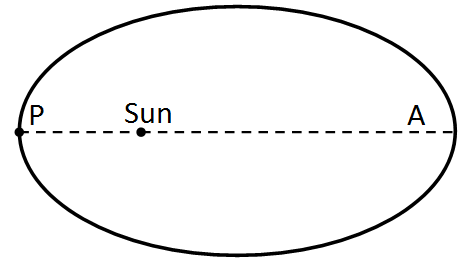
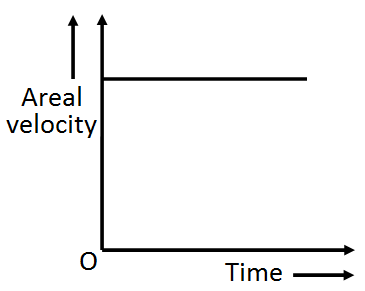
According to the second law of kepler’s the areal velocity of planet around the sun is constant.
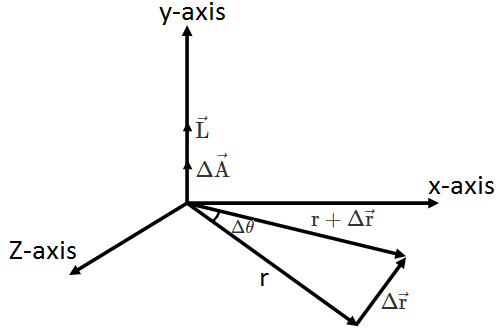
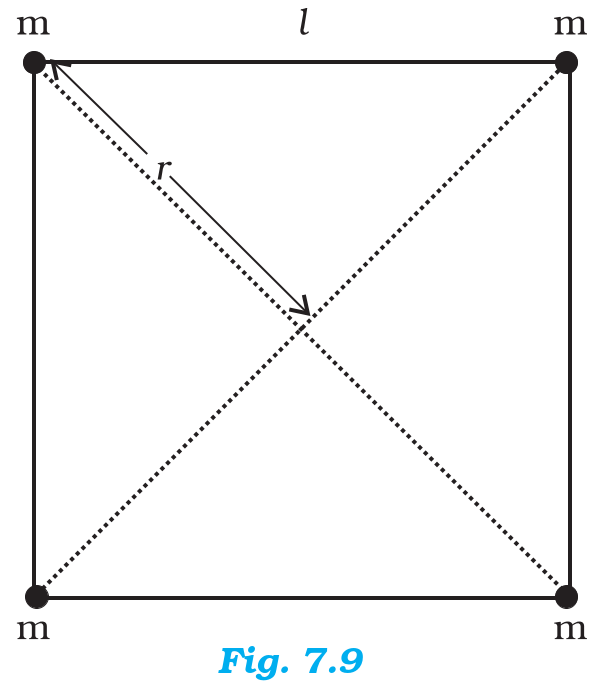
where, L is the angular momentum and M is the mass of the earth.Where r is measured from the centre of the earth. Total mechanical energy in the orbit is
$\text{E}=\text{G}\frac{\text{mM}}{2\text{r}}-\text{G}\frac{\text{Mm}}{\text{r}}$$=-\text{G}\frac{\text{mM}}{2\text{r}}$
$\text{r}=2\text{R}+\text{R}=3\text{R}$
$\text{E}=-\text{G}\frac{\text{mM}}{6\text{R}}$
The potential energy on the surface of the earth $=-\text{G}\frac{\text{mM}}{\text{R}}$ Minimum energy required $=-\frac{1}{6}\text{G}\frac{\text{mM}}{\text{R}}-\Big(-\text{G}\frac{\text{Mm}}{\text{R}}\Big)$ $=\frac{5}{6}\text{G}\frac{\text{mM}}{\text{R}}$ $=\frac{5}{6}\text{mg R}=\frac{5}{6}\times250\times9.8\times6.4\times10^6\text{J}$ $=1.3\times10^{10}\text{J}.$Taking $\text{T}_1=1\text{ year}$
$\text{T}^2_2=(1)^2\ (30)^3=27000$ or $\text{T}_2=\sqrt{27000}=164.3\text{ year}.$

$\text{g}=\text{G}.\frac{\text{M}}{\text{R}^2}\dots(\text{i})$
and on the height where h = R $\text{g}'=\text{G}.\frac{\text{M}}{(\text{R}+\text{R})^2}=\text{G}.\frac{\text{M}}{4\text{R}^2}\dots(\text{ii})$ Dividing (ii) by (i) we get $\frac{\text{g}'}{\text{g}}=\frac{\text{G}.\frac{\text{M}}{4\text{R}^2}}{\text{G}.\frac{\text{M}}{\text{R}^2}}$ $\therefore\ \frac{\text{g}'}{\text{g}}=\frac{1}{4}\Rightarrow\ \text{g}'=\frac{\text{g}}{4}$ Hence the weight of the body will reduce to one-fourth of its original weight on the surface of the earth.

$\text{v}=\Big[\frac{2\text{GM}'}{\text{R}'}\Big]^\frac{1}{2}$
Now,
$\text{M}'=95\text{M},\text{ R}'=9.5\text{R}$$\text{v}=\Big[\frac{2\times95\text{GM}}{9.5\text{R}}\Big]^\frac{1}{2}=3.16\times\sqrt{2\frac{\text{GM}}{\text{R}}}$
But
$\Big[\frac{2\text{GM}}{\text{R}}\Big]^\frac{1}{2}=11.2\text{km s}^{-1}$$\therefore\ \text{v}=3.16\times11.2=35.4\text{km s}^{-1}.$
$\therefore\frac{\text{g}_{\text{p}}}{\text{g}_{\text{e}}}=\frac{1}{2}$
The time period of a simple pendulum is given by $\text{T}_{\text{e}}=2\pi\sqrt{\frac{\text{l}}{\text{g}_{\text{e}}}}$ $\text{and }\text{T}_{\text{p}}=2\pi\sqrt{\frac{\text{l}}{\text{g}_{\text{p}}}}$ $\text{For }\text{T}_{\text{e}}=1\text{s},\text{T}_{\text{p}}=\sqrt{2}\text{s}.$$\text{v}_0=\sqrt{\frac{\text{GM}}{\text{r}}}=\text{R}\sqrt{\frac{\text{g}}{(\text{R}+\text{h})}}$ $\Big[\text{as g}=\frac{\text{GM}}{\text{R}^2}\text{ and r}=\text{R}+\text{h}\Big]$
In this problem,
$\text{v}_0=\frac{1}{2}\text{v}_\text{e}=\frac{1}{2}\sqrt{2\text{gR}}$
So, $\frac{\text{R}^2\text{g}}{\text{R}+\text{h}}=\frac{1}{2}\text{gR}$
i.e., h = R = 6400km
$0+\Big(-\frac{\text{GMm}}{\text{r}}\Big)=\frac{1}{2}\text{mv}^2+\Big(-\frac{\text{GMm}}{\text{R}}\Big)$
$\text{v}^2=2\text{GM}\Big[\frac{1}{\text{R}}-\frac{1}{2\text{R}}\Big]$ [as r = R + h = R + R = 2R]
$\text{v}=\sqrt{\frac{\text{GM}}{\text{R}}}=\sqrt{\text{gR}}=8\text{km/s}$
i.e.,
$\nu'=\nu\Big(1-\frac{\text{GM}}{\text{c}^2\text{R}}\Big)$where
$\nu'$ is the shifted frequency.Now,
$\lambda'=\lambda\Big(1+\frac{\text{GM}}{\text{c}^2\text{R}}\Big)$ if $\frac{\text{GM}}{\text{Rc}^2}<1$i.e.,
$\lambda'-\lambda=\frac{\lambda\text{GM}}{\text{c}^2\text{R}}=0.371\mathring{\text{A}}$relation $\text{g}\propto\frac{1}{\text{r}^2}$
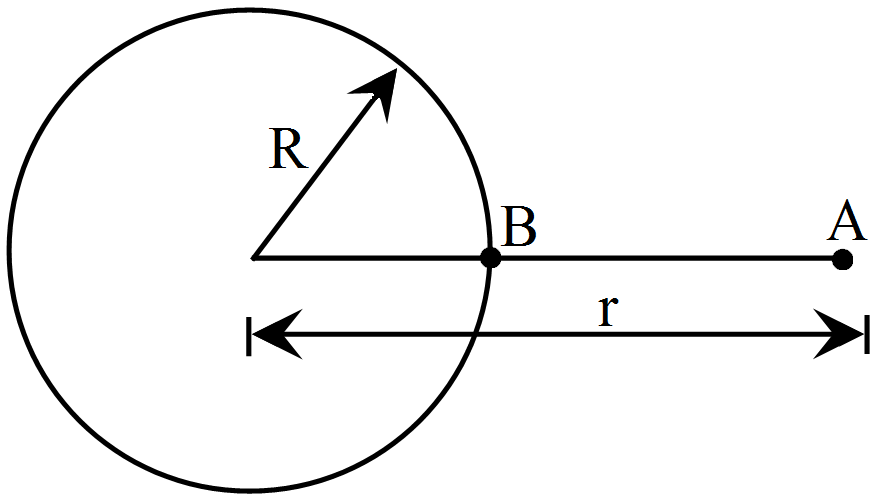
where $\text{r}=\text{R}+\text{h}$
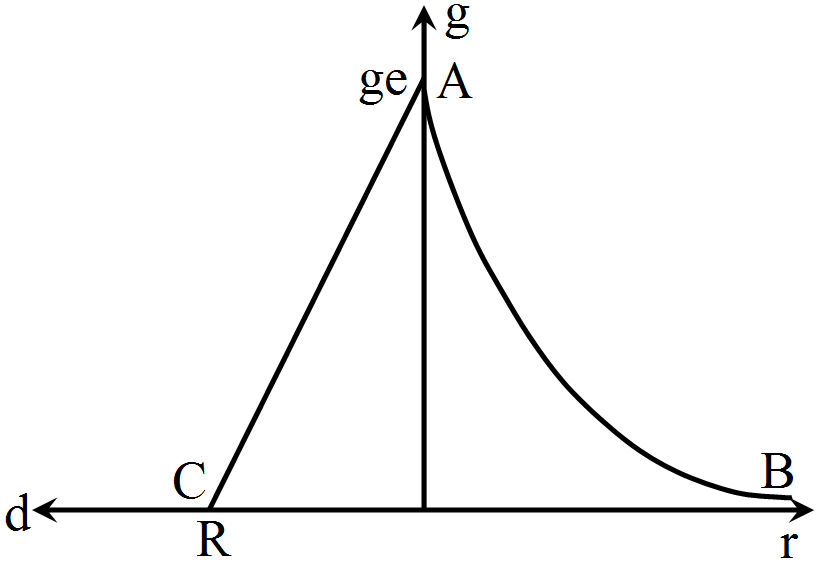
Thus, the variation of g and r is parabolic curve, i.e. part AB of the graph as shown in figure alongside.
$\text{g}' = \text{g}\Big(1 - \frac{\text{d}}{\text{R}}\Big)$
$\text{i.e. g}\propto(\text{R}-\text{d})$
Thus, the variation of 'g' and 'd' is a straight line, i.e. part AC of the graph.

$\text{g}=\frac{\text{GM}}{\text{R}^2}$
If mass is same, then $\text{g}\propto\frac{\text{I}}{\text{R}^2}$
$\therefore\frac{\text{g}_1}{\text{g}_2}=\frac{\text{R}^2_2}{\text{R}^2_1}=\frac{4}{1}$
$\therefore\frac{\text{g}_1}{\text{g}_2}=\frac{1}{2}$
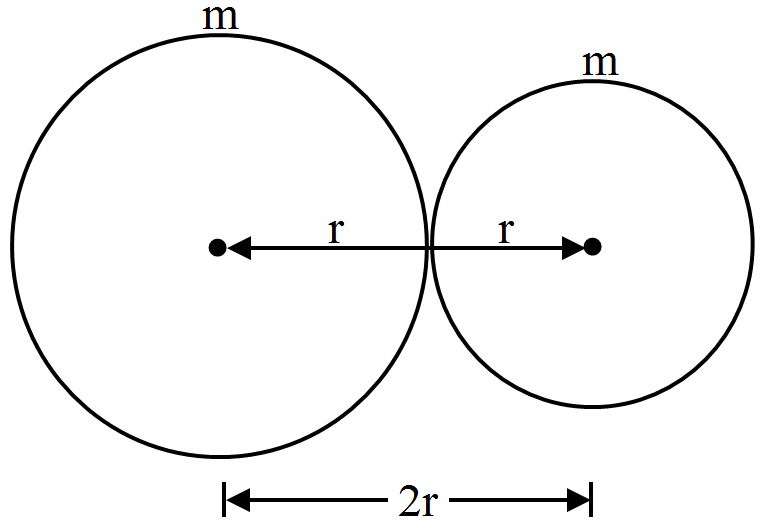
$\text{F}=\frac{\text{Gm}\times\text{m}}{(2\text{r})^2}=\frac{\text{Gm}^2}{4\text{r}^2}$
But, m = volume × density
$=\frac{4}{3}\pi\text{r}^3\rho$
$\therefore\ \text{F}=\frac{\text{G}\times\frac{16}{9}\pi^2\text{r}^6\rho^2}{4\text{r}^2}=\frac{4}{9}\pi^2\text{G}\rho^2\text{r}^4$
Since $\frac{4}{9}\pi^2\text{G}\rho^2=$ constant
$\therefore\ \text{F}\propto\text{r}^4.$