Question
Prove that in projectile motion, when bodies are projected at angle $\left(45^{\circ}+\phi\right)$ and $\left(45^{\circ}-\phi\right)$ from the horizontal, their horizontal range will be same.

Answer

 We know that by projecting an object at angle $\theta$,
$R=\frac{u^2 \sin 2 \theta}{g}$
But it is given that when object is projected at angle $(45+\phi)$ and $\left(45^{\circ}-\phi\right)$ from the horizontal, their ranges are same.$
\begin{aligned}
R_1 & =\frac{u^2 \sin 2\left(45^{\circ}+\phi\right)}{g} \\
R_1 & =\frac{u^2 \sin \left(90^{\circ}+2 \phi\right)}{g} \\
R_1 & =\frac{u^2 \cos 2 \phi}{g}......(1) \\
\text { Similarly, } \quad R_2 & =\frac{u^2 \sin 2\left(45^{\circ}-\phi\right)}{g} \\
R_2 & =\frac{u^2 \sin \left(90^{\circ}-2 \phi\right)}{g} \\
R_2 & =\frac{u^2 \cos 2 \phi}{g}.......(2)
\end{aligned}$
From equations (1) and (2), it is clear
$R_1=R_2$

Need a full question paper?

Generate a complete, print-ready paper with questions like this in minutes — across 16+ boards, with answer keys.
Start Generating Free

Similar questions

Two masses M and m are connected at the two ends of an inextensible, light string. The string passes over a smooth frictionless pulley. Calculate the acceleration of the masses and the tension in the string. M is heavier than m.
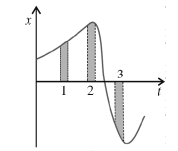
Figure gives the x – t plot of a particle in one dimensional motion. Three different equal intervals of time are shown. In which interval is the average speed greatest, and in which is it the least? Give the sign of average velocity for each interval.
Image
A ball is thrown vertically upwards. Draw its:
  1. Velocity-time curve.
  2. Acceleration-time curve.
Calculate the energy required to move an earth satellite of mass $10^3 kg$ from a circular orbit of radius 2 R to that of radius 3R. Given mass of the earth, $M=5.98 \times 10^{24} kg$ and radius of the earth, $R=6.37 \times 10^6 m$.
Suppose you have three resistors of $20\Omega,50\Omega$ and $100\Omega.$ What minimum and maximum resistance can you obtain from these resistors?
Find the work done in increasing the radius of a soap bubble from 4cm to 6cm. The value of surface tension for the soap solution is 30 dyne cm-1.
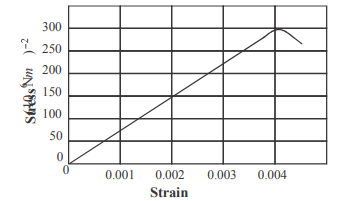
Figure shows the strain-stress curve for a given material. What are (a) Young’s modulus and (b) approximate yield strength for this material?
 Image
Which of the following functions of time represent (a) simple harmonic, (b) periodic but not simple harmonic, and (c) non-periodic motion? Give period for each case of periodic motion ($\omega$ is any positive constant):
$\cos\omega\text{t}+\cos3\omega\text{t}+\cos5\omega\text{t}$
A capacitor of capacitance C is given a charge Q. At t = 0, it is connected to an ideal battery of emf $\in$ through a resistance R. Find the charge on the capacitor at time t.
Give the location of the centre of mass of a:
  1. Sphere.
  2. Cylinder.
  3. Ring, and
  4. Cube, each of uniform mass density.
Does the centre of mass of a body necessarily lie inside the body?