Question
Prove that the altitudes of a triangle are concurrent.
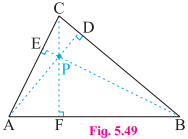
Now from (1) we have
$
\begin{aligned}
& \overline{A P} \perp \overline{B C} \quad \text { and } \overline{B P} \perp \overline{A C} \\
& \overline{A P} \perp \overline{B C}=0 \quad \text { and } \overline{B P} \perp \overline{A C}=0 \\
\therefore & (\bar{p}-\bar{a}) \cdot(\bar{c}-\bar{b})=0 \text { and }(\bar{p}-\bar{b}) \cdot(\bar{c}-\bar{a})=0 \\
\therefore & \bar{p} \cdot \bar{c}-\bar{p} \cdot \bar{b}-\bar{a} \cdot \bar{c}+\bar{a} \cdot \bar{b}=0 \\
& \bar{p} \cdot \bar{c}-\bar{p} \cdot \bar{a}-\bar{b} \cdot \bar{c}+\bar{b} \cdot \bar{a}=0
\end{aligned}
$
Therefore, subtracting equation (2) from equation (3), we get
$
\begin{array}{ll}
& -\bar{p} \cdot \bar{a}+\bar{p} \cdot \bar{b}-\bar{b} \cdot \bar{c}+\bar{a} \cdot \bar{c}=0 \quad(\text { Since } \bar{a} \cdot \bar{b}=\bar{b} \cdot \bar{a}) \\
\therefore \quad & \bar{p}(\bar{b}-\bar{a})-\bar{c}(\bar{b}-\bar{a})=0 \\
\therefore & (\bar{p}-\bar{c}) \cdot(\bar{b}-\bar{a})=0 \\
\therefore & \overline{C P} \cdot \overline{A B}=0 \\
\therefore & \overline{C P} \perp \overline{A B}
\end{array}
$
Hence the proof.
Generate a complete, print-ready paper with questions like this in minutes — across 16+ boards, with answer keys.
$y^2=2 x$ and $y=2 x$