Questions

Solve the Following Question.(5 Marks)

🎯

Test yourself on this topic

23 questions · timed · auto-graded

Question 15 Marks
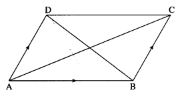
If A(3, 2, -1), B(-2, 2, -3), C(3, 5, -2), D(-2, 5, -4) then verify that the points are the vertices of a parallelogram and 2. find its area.
Answer
Let $\bar{a}, \vec{b}, \bar{c}, \bar{d}$ be the position vectors of $\mathrm{A}, \mathrm{B}, \mathrm{C}, \mathrm{D}$

respectively w.r.t. the origin $\mathrm{O}$.

Then $\bar{a}=3 \hat{i}+2 \hat{j}-\hat{k}, \bar{b}=-2 \hat{i}+2 \hat{j}-3 \hat{k}$,

$\bar{c}=3 \hat{i}+5 \hat{j}-2 \hat{k}, \bar{d}=-2 \hat{i}+5 \hat{j}-4 \hat{k}$

$\begin{aligned} \therefore \overline{\mathrm{AB}} & =\vec{b}-\bar{a}=(-2 \hat{i}+2 \hat{j}-3 \hat{k})-(3 \hat{i}+2 \hat{j}-\hat{k}) \\ & =-5 \hat{i}-2 \hat{k} \\ \overline{\mathrm{DC}} & =\bar{c}-\bar{d}=(3 \hat{i}+5 \hat{j}-2 \hat{k})-(-2 \hat{i}+5 \hat{j}-4 \hat{k}) \\ & =5 \hat{i}+2 \hat{k}=-(-5 \hat{i}-2 \hat{k})\end{aligned}$

$\therefore \overline{\mathrm{DC}}=-\overline{\mathrm{AB}}$

$\therefore \overline{\mathrm{DC}}$ is scalar multiple of $\overline{\mathrm{AB}}$

$\therefore \overline{\mathrm{DC}}$ is parallel to $\overline{\mathrm{AB}}$

Also, $|\overline{\mathrm{DC}}|=\sqrt{5^2+2^2}=\sqrt{25+4}=\sqrt{29}$

and $|\overline{\mathrm{AB}}|=\sqrt{(-5)^2+(-2)^2}=\sqrt{25+4}=\sqrt{29}$

$\begin{aligned} & \therefore|\overline{\mathrm{DC}}|=|\overline{\mathrm{AB}}| \\ & \therefore l(\mathrm{AB})=l(\mathrm{DC})\end{aligned}$

∴ opposite sides AB and DC of ABCD are parallel and equal. ∴ ABCD is a parallelogram.

$\begin{aligned} \overline{\mathrm{AB}} & =\bar{b}-\bar{a}=(-2 \hat{i}+2 \hat{j}-3 \hat{k})-(3 \hat{i}+2 \hat{j}-\hat{k}) \\ & =-5 \hat{i}-2 \hat{k} \\ \overline{\mathrm{AD}} & =\bar{d}-\bar{a}=(-2 \hat{i}+5 \hat{j}-4 \hat{k})-(3 \hat{i}+2 \hat{j}-\hat{k})\end{aligned}$

$=-5 \hat{i}+3 \hat{j}-3 \hat{k}$

$\therefore \overline{\mathrm{AB}} \times \overline{\mathrm{AD}}=\left|\begin{array}{ccc}\hat{i} & \hat{j} & \hat{k} \\ -5 & 0 & -2 \\ -5 & 3 & -3\end{array}\right|$

$\begin{aligned} & =(0+6) \hat{i}-(15-10) \hat{j}+(-15+0) \hat{k} \\ & =6 \hat{i}-5 \hat{j}-15 \hat{k}\end{aligned}$

$\therefore$ area of parallelogram $=|\overline{\mathrm{AB}} \times \overline{\mathrm{AD}}|$

$\begin{aligned} & =\sqrt{6^2+(-5)^2+(-15)^2}=\sqrt{36+25+225} \\ & =\sqrt{286} \text { sq units. }\end{aligned}$
View full question & answer
Question 25 Marks
If Q is the foot of the perpendicular from P(2, 4, 3) on the line joining the points A(1, 2, 4) and B(3, 4, 5), find coordinates of Q.
Answer
Let PQ be the perpendicular drawn from point P(2, 4, 3) to the line joining the points A(1, 2, 4) and B (3, 4, 5). Let Q divides AB internally in the ratio λ : 1

$\therefore \mathrm{Q} \equiv\left(\frac{3 \lambda+1}{\lambda+1}, \frac{44 \lambda+2}{\lambda+1}, \frac{5 \lambda+4}{\lambda+1}\right)$

.......(i)

Direction ratios of $\mathrm{PQ}$ are

$\frac{3 \lambda+1}{\lambda+1}-2, \frac{4 \lambda+2}{\lambda+1}-4, \frac{5 \lambda+4}{\lambda+1}-3$

i.e., $\frac{\lambda-1}{\lambda+1}, \frac{-2}{\lambda+1}, \frac{2 \lambda+1}{\lambda+1}$

Now, direction ratios of AB are, 3 – 1, 4 – 2, 5 – 4 i.e., 2, 2, 1.

Since $P Q$ is perpendicular to $A B$,

$2\left(\frac{\lambda-1}{\lambda+1}\right)+\frac{2(-2)}{\lambda+1}+1\left(\frac{2 \lambda+1}{\lambda+1}\right)=0$

$\therefore \frac{2 \lambda-2-4+2 \lambda+1}{\lambda+1}=0$

$\begin{aligned} & \therefore 4 \lambda-5=0 \\ & \therefore 4 \lambda=5 \\ & \therefore \lambda=\frac{5}{4} \\ & \text { Putting } \lambda=\frac{5}{4} \text { in (i). }\end{aligned}$

Coordinates of Q are,

$\begin{aligned} & \frac{3\left(\frac{5}{4}\right)+1}{\left(\frac{5}{4}\right)+1}=\frac{19}{19} \\ & \frac{\left(\frac{5}{4}\right)+2}{\left(\frac{5}{4}\right)+1}=\frac{28}{9}\end{aligned}$

$\begin{aligned} & \frac{5\left(\frac{5}{4}\right)+4}{\left(\frac{5}{4}\right)+1}=\frac{41}{9} \\ & \therefore Q \equiv\left(\frac{19}{9}, \frac{28}{9}, \frac{41}{9}\right)\end{aligned}$

View full question & answer
Question 35 Marks
Find the angle between the lines whose direction cosines are given by the equation 6mn – 2nl + 5lm = 0, 3l + m + 5n = 0
Answer
Given 6mn – 2nl + 5lm = o 3l + m +5n = 0. From (2), m = 3l – 5n Putting the value of m in equation (1), we get, ⇒ 6n(-3l – 5n) – 2nl + 5l(-3l – 5n) = 0 ⇒ -18nl- 30n – 2nl- 15l2 – 25nl = 0

$\begin{aligned} & \Rightarrow-30 n^2-45 n l-\left.15\right|^2=0 \\ & \Rightarrow 2 n^2+3 n l+\left.\right|^2=0 \\ & \Rightarrow 2 n^2+2 n l+n l+\left.\right|^2=0\end{aligned}$

⇒ (2n + l) (n + l) = 0 ∴ 2n + l = 0 OR n + l = 0 ∴ l = -2n OR l = -n ∴ l = -2n From (2), 3l + m + 5n = 0 ∴ -6n + m + 5n = 0 ∴ m = n i.e. (-2n, n, n) = (-2, 1, 1) ∴ l = -n ∴ -3n + m + 5n = 0 ∴ m = -2n i.e. (-n, -2n, n) = (1, 2, -1) (a1, b1, c1) = (-2, 1, 1) and (a2, b3, c3) = (1, 2, -1)

$\cos \theta=\left|\frac{a_1 a_2+b_1 b_2+c_1 c_2}{\sqrt{a_1^2+b_1^2+c_1^2} \cdot \sqrt{a_2^2+b^2-2+c_2^2}}\right|$

$=\left|\frac{(2)(1)+(-1)(2)+(-1)(-1)}{\sqrt{(2)^2+1^2+1^2} \cdot \sqrt{1^2+2^2+(1)^2}}\right|$

$=\left|\frac{2-2+1}{\sqrt{6} \cdot \sqrt{6}}\right|$

$=\left|-\frac{1}{6}\right|=\frac{1}{6}$

$\theta=\cos ^{-1}\left(\frac{1}{6}\right)$

View full question & answer
Question 45 Marks
Let $\bar{b}=4 \hat{i}+3 \hat{j}$ and $\bar{c}$ be two vectors perpendicular to each other in the $X Y$-plane. Find

vectors in the same plane having projection 1 and 2 along $\bar{b}$ and $\bar{c}_{\text {, respectively, are given Y }}$

Answer
$\begin{aligned} & \bar{b}=4 \hat{i}+3 \hat{j} \\ & \therefore|\bar{b}|=\sqrt{4^2+3^2}=\sqrt{16+9}=5\end{aligned}$

Let $\bar{c}=m \hat{i}+n \hat{j}$ be perpendicular to $\bar{b}$

Then $\bar{b} \cdot \bar{c}=0 \quad \therefore(4 \hat{i}+3 \hat{j}) \cdot(m \hat{i}+n \hat{j})=0$

$\therefore 4 m+3 n=0 \quad \therefore n=-\frac{4 m}{3}$

$\therefore \bar{c} m m \hat{i}-\frac{4 m}{3} \hat{j}=\frac{m}{3}(3 \hat{i}-4 \hat{j})$

$\therefore \bar{c}=p(3 \hat{i}-4 \hat{j}) \quad \ldots\left[p=\frac{m}{3}\right]$

$\therefore|\bar{c}|=p \sqrt{3^2+(-4)^2}=p \sqrt{9+16}=5 p$

Let $\bar{d}=x \hat{i}+y \hat{i}$ be the vector having projections 1 and 2

along $\bar{b}$ and $\bar{c}$.

$\therefore \frac{\bar{b} \cdot \bar{d}}{|\bar{b}|}=1$

$\therefore \frac{(4 \hat{i}+3 \hat{j})-(x \hat{i}+y \hat{j})}{5}=1$

$\therefore 4 x+3 y=5$

...(1)

Also, $\frac{\bar{c} \cdot \bar{d}}{|\bar{c}|}=2$

$\therefore \frac{(3 p \hat{i}-4 p \hat{j}) \cdot(x \hat{i}+y \hat{j})}{5 p}=2$

$\therefore 3 p x-4 p y=10 p$

$\therefore 3 x-4 y=10$

$\ldots(2)$

From (1), $3 y=5-4 x$

$\therefore y=\frac{5-4 x}{3}$

Substituting for $y$ in (2), we get

$\begin{aligned} & 3 x-4\left(\frac{5-4 x}{3}\right)=10 \\ & \therefore 9 x-20+16 x=30 \\ & \therefore 25 x=50 \quad \therefore x=2 \\ & y=\frac{5-4 x}{3}=\frac{5-4(2)}{3}=-1 \\ & \therefore \bar{d}=2 \hat{i}-\hat{j}\end{aligned}$

Hence, the required vector is $2 \hat{i}-\hat{j}$.

View full question & answer
Question 55 Marks
Find the acute angles between the curves at their points of intersection. $y=x^2, y=x^3$
Answer
The angle between the curves is same as the angle between their tangents at the points of

intersection. We find the points of intersection of $y=x^2 \ldots$ (1)

and $y=x^3 \ldots$ (2)

From (1) and (2)

$\begin{aligned} & x^3=x^2 \\ & \therefore x^3-x^2=0 \\ & \therefore x^2(x-1)=0 \\ & \therefore x=0 \text { or } x=1 \\ & \text { When } x=0, y=0 . \\ & \text { When } x=1, y=1 .\end{aligned}$

For $y=x^2, \frac{d y}{d x}=2 x$

For $y=x^3, \frac{d y}{d x}=3 x^2$

Angle at $\mathrm{O}=(0,0)$

Slope of tangent to $y=x^2$ at $O$

$=\left(\frac{d y}{d x}\right)_{\text {at } O(0,0)}=2 \times 0=0$

$\therefore$ equation of tangent to $y=x^2$ at $\mathrm{O}$ is $y=0$.

Slope of tangent to $y=x^3$ at $\mathrm{O}=\left(\frac{d y}{d x}\right)_{\text {at } \mathrm{O} 0,0)}=3 \times 0=0$

$\therefore$ equation of tangent to $y=x^3$ at $P$ is $y=0$.

∴ the tangents to both curves at (0, 0) are y = 0 ∴ angle between them is 0. Angle at P = (1, 1)

$\therefore$ equation of tangent to $y=x^3$ at $P$ is $y-1=3(x-1) y=3 x-2$

We have to find angle between y = 2x – 1 and y = 3x – 2 Lines through origin parallel to these tagents are y = 2x and y = 3x

$\therefore \frac{x}{1}=\frac{y}{2}$ and $\frac{z}{1}=\frac{y}{3}$

These lines lie in XY-plane. ∴ the direction ratios of these lines are 1, 2, 0 and 1, 3, 0. The angle θ between them is given by

$\cos \theta=\frac{(1)(1)+(2)(3)+(0)(0)}{\sqrt{1^2+2^2+0^2} \sqrt{1^2+3^2+0^2}}$

$=\frac{1+6+0}{\sqrt{5} \sqrt{10}}=\frac{7}{\sqrt{50}}=\frac{7}{5 \sqrt{2}}$

$\therefore \theta=\cos ^{-1}\left(\frac{7}{5 \sqrt{2}}\right)$

Hence, the required angles are 0 and $\cos ^{-1}\left(\frac{7}{5 \sqrt{2}}\right)$.

View full question & answer
Question 65 Marks
Find two unit vectors each of which makes equal angles with $\bar{u}, \bar{v}$ and $\bar{w}$.

$\bar{u}=2 \hat{i}+\hat{j}-2 \hat{k}, \bar{v}=\hat{i}+2 \hat{j}-2 \hat{k}$ and $\bar{W}=2 \hat{i}-2 \hat{j}+\hat{k}$

Answer
Let $\bar{r}=x \hat{i}+y \hat{j}+z \hat{k}$ be the unit vector which makes angle $\theta$

with each of the vectors

Then $|\bar{r}|=1$

Also, $\bar{u}=2 \hat{i}+\hat{j}-2 \hat{k}, \quad \bar{v}=\hat{i}+2 \hat{j}-2 \hat{k}, \quad \bar{w}=2 \hat{i}-2 \hat{j}+\hat{k}$

$|\bar{u}|=\sqrt{2^2+1^2+(-2)^2}=\sqrt{4+1+4}=\sqrt{9}=3$

$|\bar{v}|=\sqrt{1^2+2^2+(-2)^2}=\sqrt{1+4+4}=\sqrt{9}=3$

$|\bar{w}|=\sqrt{2^2+(-2)^2+1^2}=\sqrt{4+4+1}=\sqrt{9}=3$

Angle between $\bar{r}$ and $\bar{u}$ is $\theta$.

$\therefore \cos \theta=\frac{\bar{r} \cdot \bar{u}}{|\bar{r}||\bar{u}|}$

$=\frac{(x \hat{i}+y \hat{j}+z \hat{k}) \cdot(2 \hat{i}+\hat{j}-2 \hat{k})}{1 \times 3}$

$=\frac{2 x+y-2 z}{3}$

...(1)

Also, the angle between $\bar{r}$ and $\bar{v}$ and between $\bar{r}$ and $\bar{w}$ is $\theta$.

$\therefore \cos \theta=\frac{\bar{r} \cdot \bar{v}}{|\bar{r}||\bar{v}|}$

$=\frac{(x \hat{i}+y \hat{j}+z \hat{k}) \cdot(\vec{i}+2 \hat{j}-2 \hat{k})}{1 \times 3}$

$=\frac{x+y-2 z}{3}$

$\ldots$ (2)

and $\cos \theta=\frac{\bar{r} \cdot \bar{w}}{|\bar{r}||\bar{w}|}$

$=\frac{(x \hat{i}+y \hat{j}+z \hat{k}) \cdot(2 \hat{i}-2 \hat{j}+\hat{k})}{1 \times 3}$

$=\frac{2 x-2 y+z}{3}$

... (3)

From (1) and (2), we get

$\frac{2 x+y-2 z}{3}=\frac{x+2 y-2 z}{3}$

$\begin{aligned} & \therefore 2 x+y-2 z=x+2 y-2 z \\ & \therefore x=y\end{aligned}$

From $(2)$ and $(3)$, we get

$\frac{x+2 y-2 z}{3}=\frac{2 x-2 y+z}{3}$

$\therefore x+2 y-2 z=2 x-2 y+z$.

$\therefore 3 y=3 z$

$\ldots[\because x=y]$

$\begin{aligned} & \therefore y=z \\ & \therefore x=y=z \\ & \therefore \bar{r}=x \hat{i}+y \hat{j}+z \hat{k}=x \hat{i}+x \hat{j}+x \hat{k} \\ & \therefore|\bar{r}|=\sqrt{x^2+x^2+x^2}=1 \\ & \therefore x^2+x^2+x^2=1 \quad \therefore 3 x^2=1 \\ & \therefore x^2=\frac{1}{3} \quad \therefore x= \pm \frac{1}{\sqrt{3}}\end{aligned}$

$\begin{aligned} \therefore \bar{r} & = \pm \frac{1}{\sqrt{3}} \hat{i} \pm \frac{1}{\sqrt{3}} \hat{j} \pm \frac{1}{\sqrt{3}} \hat{k} \\ & = \pm \frac{1}{\sqrt{3}}(\hat{i}+\hat{j}+\hat{k})\end{aligned}$

Hence, the required unit vectors are $\pm \frac{1}{\sqrt{3}}(\hat{i}+\hat{j}+\hat{k})$.

View full question & answer
Question 75 Marks
Express the vector $\bar{a}=5 \hat{i}-2 \hat{j}+5 k$ as a sum of two vectors such that one is parallel to

the vector $\bar{b}=3 i+k$ and other is perpendicular to $\bar{b}$.

Answer
Let $\bar{a}=\bar{c}+\bar{d}$, where $\bar{c}$ is parallel to $\bar{b}$ and $\bar{d}$ is perpendicular to $\bar{b}$

Since, $\bar{c}$ is parallel to $\bar{b}, \bar{c}=m \bar{b}$, where $m$ is a scalar.

$\therefore \bar{c}=m(3 \hat{i}+\hat{k})$

i.e. $\bar{c}=3 m \hat{i}+m \hat{k}$

Let $\bar{d}=x \hat{i}+y \hat{j}+z \hat{k}$

Since, $\bar{d}$ is perpendicular to $\bar{b}=3 \hat{i}+\hat{k}, \bar{d} \cdot \bar{b}=0$

$\begin{aligned} & \therefore(x \hat{i}+y \hat{j}+z \hat{k}) \cdot(3 \hat{i}+\hat{k})=0 \\ & \therefore 3 x+z=0 \quad \therefore z=-3 x \\ & \therefore \bar{d}=x \hat{i}+y \hat{k}-3 x \hat{k}\end{aligned}$

Now, $\bar{a}=\bar{c}+\bar{d}$ gives

$\begin{aligned} \therefore 5 \hat{i}-2 \hat{j}+5 \hat{k} & =(3 m \hat{i}+m \hat{k})+(x \hat{i}+y \hat{j}-3 x \hat{k}) \\ & =(3 m+x) \hat{i}+y \hat{j}+(m-3 x) \hat{k}\end{aligned}$

By equality of vectors 3m + x = 5 … (1) y = -2 and m – 3x = 5 From (1) and (2) 3m + x = m – 3x ∴ 2m = -4x m ∴ m = -2x Substituting m = -2x in (1), we get ∴ -6x + x = 5 ∴ -5x = 5 ∴ x = -1 ∴ m = -2x = 2

$\therefore \bar{c}=6 \hat{i}+2 \hat{k}$ is parallel to $\hat{b}$ and

$\bar{d}=-\hat{i}-2 \hat{j}+3 \hat{k}$ is perpendicular to $\bar{b}$

Hence, $\bar{a}=\bar{c}+\bar{d}$, where $\bar{c}=6 \hat{i}+2 \hat{k}$ and $\bar{d}=-\hat{i}-2 \hat{j}+3 \hat{k}$.

View full question & answer
Question 85 Marks
If a parallelogram is constructed on the vectors $\bar{a}=3 \bar{p}-\bar{q}, \bar{b}=\bar{p}+3 \bar{q}$ and

$|\bar{p}|=|\bar{q}|=2$ and angle between $\bar{p}$ and $\bar{q}$ is $\frac{\pi}{3}$ show that the ratio of the lengths of the

sides is $\sqrt{7}: \sqrt{13}$

Answer
$|\bar{p}|=|\bar{q}|=2$ and angle between $\bar{p}$ and $\bar{q}$ is $\frac{\pi}{3}$.

$\therefore \bar{p} \cdot \bar{q}=|\bar{p} \|| \bar{q} \mid \cos \frac{\pi}{3}=2 \times 2 \times \frac{1}{2}=2$

Now, $\bar{a}=3 \bar{p}-\bar{q}$

$\therefore|\bar{a}|^2=|\overline{3 p}-\bar{q}|^2$

$\begin{aligned} & =(3 \bar{p}-\bar{q}) \cdot(3 p-\bar{q}) \\ & =3 \bar{p} \cdot(3 \bar{p}-\bar{q})-\bar{q} \cdot(3 p-\bar{q}) \\ & =9 \bar{p} \cdot \bar{p}-3 \bar{p} \cdot \bar{q}-3 \bar{q} \cdot \bar{p}+\bar{q} \cdot \bar{q}\end{aligned}$

$=9|\bar{p}|^2-6 \bar{p} \cdot \bar{q}+|\bar{q}|^2 \quad \ldots .[\because \bar{q} \cdot \bar{p}=\bar{p} \cdot \bar{q}]$

$=9 \times 4-6 \times 2+4 \quad \ldots[\because \bar{p} \cdot \bar{q}=2]$

$=28$

$\therefore|\bar{a}|=\sqrt{28}$

Also $\bar{b}=\bar{p}+3 \bar{q}$

$\therefore|\bar{b}|^2=|\bar{p}+3 \bar{q}|^2$

$\begin{aligned} & =(\bar{p}+3 \bar{q}) \cdot(\bar{p}+3 \bar{q}) \\ & =\bar{p} \cdot(\bar{p}+3 \bar{q})+3 \bar{q} \cdot(\bar{p}+3 \bar{q})\end{aligned}$

$=\bar{p} \cdot \bar{p}+3 \bar{p} \cdot \bar{q}+3 \bar{q} \cdot \bar{p}+9 q \cdot \bar{q} \quad \ldots[\because \bar{p} \cdot \bar{q}=\bar{q} \cdot \bar{p}]$

$=|\bar{p}|^2+3 \bar{p} \cdot \bar{q}+3 \bar{p} \cdot \bar{q}+9|\bar{q}|^2$

$=4+12+36 \quad \ldots[\because \bar{p} \cdot \bar{q}=2]$

$=52$

Ratio of lengths of the sides

$=\frac{|\bar{a}|}{|\bar{b}|}=\frac{\sqrt{28}}{\sqrt{52}}=\frac{2 \sqrt{7}}{2 \sqrt{13}}=\frac{\sqrt{7}}{\sqrt{13}}$

Hence, the ratio of the lengths of the sides is $\sqrt{7}: \sqrt{13}$.

View full question & answer
Question 95 Marks
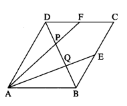
ABCD is a parallelogram E, F are the mid points of BC and CD respectively. AE, AF meet the diagonal BD at Q and P respectively. Show that P and Q trisect DB.
Answer

Image

Let $A, B, C, D, E, F, P, Q$ have

position vectors $\bar{a}, \bar{b}, \bar{c}, \bar{d}, \bar{e}, \bar{f}, \bar{p}$,

$\bar{q}$ respectively

$\because A B C D$ is a parallelogram

$\therefore \overline{A B}=\overline{D C}$

$\therefore \bar{b}-\bar{a}=\bar{c}-\bar{d}$

$\therefore \bar{c}=\bar{b}+\bar{d}-\bar{a}$

$\ldots$ (1)

$E$ is the midpoint of $B C$

$\therefore \bar{e}=\frac{\bar{b}+\bar{c}}{2} \quad \therefore 2 \bar{e}=\bar{b}+\bar{c}$

$\ldots(2)$

$\mathrm{F}$ is the mid-point of $\mathrm{CD}$

$\therefore \bar{f}=\frac{\bar{c}+\bar{d}}{2} \quad \therefore 2 \bar{f}=\bar{c}+\bar{d}$

$\ldots(3)$

$2 \bar{e}=\bar{b}+\bar{c} \quad \ldots[$ By (2)]

$=\bar{b}+(\bar{b}+\bar{d}-\bar{a}) \quad \ldots$ [By (1)]

$\begin{aligned} & \therefore 2 \bar{e}+\bar{a}=2 \bar{b}+\bar{d} \\ & \therefore \frac{2 \bar{e}+\bar{a}}{2+1}=\frac{2 \bar{b}+\bar{d}}{2+1}\end{aligned}$

LHS is the position vector of the point on AE and RHS is the position vector of the point on DB. But AE and DB meet at Q.

$\therefore \bar{q}=\frac{2 \bar{b}+\bar{d}}{2+1}$

$\therefore \mathrm{Q}$ divides $\mathrm{DB}$ in the ratio $2: 1$

$\ldots(4)$

$2 \bar{f}=\bar{c}+\bar{d} \quad \ldots[$ By (3)]

$=(\bar{b}+\bar{d}-\bar{a})+\bar{d}$

$\ldots[$ Вy $(1)]$

$\begin{aligned} & \therefore 2 \bar{f}+\bar{a}=2 \bar{d}+\bar{b} \\ & \therefore \frac{\bar{a}+2 \bar{f}}{1+2}=\frac{\bar{b}+2 \bar{d}}{1+2}\end{aligned}$

LHS is the position vector of the point on AF and RHS is the position vector of the point on DB.

But AF and DB meet at P.

$\therefore \bar{p}=\frac{\bar{b}+2 \bar{d}}{1+2}$

∴ P divides DB in the ratio 1 : 2 … (5) From (4) and (5), if follows that P and Q trisect DB.

View full question & answer
Question 105 Marks
Express the vector $\hat{i}+4 \hat{j}-4 \hat{k}$ as a linear combination of the vectors $2 \hat{i}-\hat{j}+3 \hat{k}$

$\hat{i}-2 \hat{j}+4 \hat{k}$ and $-\hat{i}+3 \hat{j}-5 \hat{k}$

Answer
$\begin{aligned} & \text { Let } \overline{\mathrm{a}}=2 \hat{\mathrm{i}}-\hat{\mathrm{j}}+3 \hat{k} \\ & \overline{\mathrm{b}}=\hat{\mathrm{i}}-2 \hat{\mathrm{j}}+4 \hat{k} \\ & \overline{\mathrm{c}}=-\hat{\mathrm{i}}+3 \hat{j}-5 \hat{k} \\ & \bar{p}=\hat{i}+4 \hat{j}-4 \hat{k}\end{aligned}$

Suppose $\bar{p}=x \bar{a}+y \bar{b}+z \bar{c}$.

Then, $\hat{\mathrm{i}}+4 \hat{\mathrm{j}}-4 \hat{\mathrm{k}}=x(2 \hat{\mathrm{i}}-\hat{\mathrm{j}}+3 \hat{\mathrm{k}})+y(\hat{\mathrm{i}}-2 \hat{\mathrm{j}}+4 \hat{k})+z(-\hat{\mathrm{i}}+3 \hat{\mathrm{j}}-5 \hat{\mathrm{k}})$

$\therefore \hat{\mathrm{i}}+4 \hat{j}-4 \hat{k}=(2 x+2 y-z) \hat{i}+(-x-2 y+3 z) \hat{j}+(3 x+4 y-5 z) \hat{k}$

By equality of vectors, $ \begin{aligned} & 2 x+2 y-z=1 \\ & -x-2 y+3 z=4 \\ & 3 x+4 y-5 z=-4 \end{aligned} $

We have to solve these equations by using Cramer’s Rule.

$D=\left|\begin{array}{ccc}2 & 2 & -1 \\ -1 & -2 & 3 \\ 3 & 4 & -5\end{array}\right|$

= 2(10 – 12) – 2(5 – 9) – 1(-4 + 6) = -4 + 8 – 2 = 2 ≠ 0

$D_x=\left|\begin{array}{ccc}1 & 2 & -1 \\ 4 & -2 & 3 \\ -4 & 4 & -5\end{array}\right|$

= 1(10 – 12) – 2(-20 + 12) – 1 (16 – 8) = -2 + 16 – 8 = 6

$D_y=\left|\begin{array}{ccc}2 & 1 & -1 \\ -1 & 4 & 3 \\ 3 & -4 & -5\end{array}\right|$

= 2(-20 + 12) – 1(5 – 9) – 1(4 – 12) = -16 – 4 – 8 = -28

$D_z=\left|\begin{array}{ccc}2 & 2 & 1 \\ -1 & -2 & 4 \\ 3 & 4 & -4\end{array}\right|$

= 2(8 – 16) – 2(4 – 12) + 1(-4 + 6) = -16 – 16 + 2 = -30

$\begin{aligned} & \therefore x=\frac{D_x}{D}=\frac{6}{2}=3 \\ & \therefore y=\frac{D_y}{D}=\frac{-28}{2}=-14 \\ & \therefore z=\frac{D_z}{D}=\frac{-30}{2}=-15 \\ & \therefore \bar{p}=3 \bar{a}-14 \bar{b}-3 \bar{c}\end{aligned}$

View full question & answer
Question 115 Marks
Two sides of a parallelogram are $3 \hat{i}+4 \hat{j}-5 \hat{k}$ and $-2 \hat{j}+7 \hat{k}$. Find the unit vectors parallel to the diagonals.
Answer

Image

Let $A B C D$ be a parallelogram with

$\overline{\mathrm{AB}}=3 \hat{i}+4 \hat{j}-5 \hat{k}$ and $\overline{\mathrm{BC}}=-2 \hat{j}+7 \hat{k}$

Then $\overline{\mathrm{AC}}=\overline{\mathrm{AB}}+\overline{\mathrm{BC}}=(3 \hat{i}+4 \hat{j}-5 \hat{k})+(-2 \hat{j}+7 \hat{k})$

$=3 \hat{i}+2 \vec{j}+2 \vec{k}$

$\therefore|\overline{\mathrm{AC}}|=\sqrt{3^2+2^2+2^2}=\sqrt{9+4+4}=\sqrt{17}$

$\therefore$ unit vector along $\overline{\mathrm{AC}}=\frac{\overline{\mathrm{AC}}}{|\overline{\mathrm{AC}}|}$

$=\frac{1}{\sqrt{17}}(3 \hat{i}+2 \hat{j}+2 \hat{k})$

Also, $\overline{\mathrm{BD}}=\overline{\mathrm{BA}}+\overline{\mathrm{AD}}=-\overline{\mathrm{AB}}+\overline{\mathrm{BC}}=\overline{\mathrm{BC}}-\overline{\mathrm{AB}}$

$\begin{aligned} & =(-2 \hat{j}+7 \hat{k})-(3 \hat{i}+4 \hat{j}-5 \hat{k}) \\ & =-3 \hat{i}-6 \hat{j}+12 \hat{k} \\ & =3(-\hat{i}-2 \hat{j}+4 \hat{k})\end{aligned}$

$\therefore|\overline{\mathrm{BD}}|=3 \sqrt{(-1)^2+(-2)^2+4^2}=3 \sqrt{1+4+16}=3 \sqrt{21}$

$\therefore$ unit vector along $\overline{\mathrm{BD}}=\frac{\overline{\mathrm{BD}}}{|\overline{\mathrm{BD}}|}$

$\begin{aligned} & =\frac{3(-\hat{i}-2 \hat{j}+4 \hat{k})}{3 \sqrt{21}} \\ & =\frac{1}{\sqrt{21}}(-\hat{i}-2 \hat{j}+4 \hat{k})\end{aligned}$

Hence, the unit vectors parallel to the diagonals are

$\frac{1}{\sqrt{17}}(3 \hat{i}+2 \hat{j}+2 \hat{k})$ and $\frac{1}{\sqrt{21}}(-\hat{i}-2 \hat{j}+4 \hat{k})$ respectively.

View full question & answer
Question 125 Marks
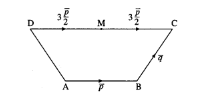
ABCD is a trapezium with AB parallel to DC and DC = 3AB. M is the mid-point of DC,

$\overline{A B}=\bar{p}$ and $\overline{B C}=\bar{q}$. Find in terms of $\bar{p}$ and $\bar{q}$.

(i) $\overline{A M}$

2. $\overline{B D}$

3. $\overline{M B}$

4. $\overline{D A}$

Answer

Image

$\mathrm{DC}$ is parallel to $\mathrm{AB}$ and $\mathrm{DC}=3 \mathrm{AB}$.

$\because \overline{\mathrm{AB}}=\bar{p} \quad \therefore \overline{\mathrm{DC}}=3 \bar{p}$

$\mathrm{M}$ is the midpoint of $\mathrm{DC}$

$\therefore \overline{\mathrm{DM}}=\overline{\mathrm{MC}}=\frac{1}{2} \overline{\mathrm{DC}}=\frac{3-}{2} \bar{p}_{\mathrm{M}}$

$\overline{\mathrm{AM}}=\overline{\mathrm{AB}}+\overline{\mathrm{BC}}+\overline{\mathrm{CM}}$

$=\overline{\mathrm{AB}}+\overline{\mathrm{BC}}-\overline{\mathrm{MC}}$

$=\bar{p}+\bar{q}-\frac{3 p}{2}$

$=-\frac{1-}{2^p}$

2. $\overline{\mathrm{BD}}=\overline{\mathrm{BC}}+\overline{\mathrm{CD}}=\overline{\mathrm{BC}}-\overline{\mathrm{DC}}=\bar{q}-3 \bar{p}$

3.$\overline{\mathrm{MB}}=\overline{\mathrm{MC}}+\overline{\mathrm{CB}}=\overline{\mathrm{MC}}-\overline{\mathrm{BC}}=\frac{3}{2} \bar{p}-\bar{q}$

4. $\begin{aligned} \overline{\mathrm{DA}} & =\overline{\mathrm{DC}}+\overline{\mathrm{CB}}+\overline{\mathrm{BA}}=\overline{\mathrm{DC}}-\overline{\mathrm{BC}}-\overline{\mathrm{AB}} \\ & =3 \bar{p}-\bar{q}-\bar{p}=2 \bar{p}-\bar{q}\end{aligned}$

View full question & answer
Question 135 Marks
Prove that the altitudes of a triangle are concurrent.
Answer
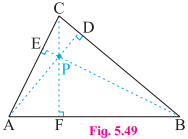
Let A, B and C be the vertices of a triangle
Let $\mathrm{AD}, \mathrm{BE}$ and $\mathrm{CF}$ be the altitudes of the triangle $\mathrm{ABC}$, therefore $\mathrm{AD} \perp \mathrm{BC}, \mathrm{BE} \perp \mathrm{AC}, \mathrm{CF} \perp \mathrm{AB}$.
Let $\bar{a}, \bar{b}, \bar{c}, \bar{d}, \bar{e}, \bar{f}$ be the position vectors of $A, B, C, D, E, F$ respectively. Let $\mathrm{P}$ be the point of intersection of the altitudes $A D$ and $B E$ with $\bar{p}$ as the position vector.
Therefore, $\overline{A P} \perp \overline{B C}, \overline{B P} \perp \overline{A C}$
To show that the altitudes $A D, B E$ and $C F$ are concurrent, it is sufficient to show that the altitude $C F$ passes through the point $P$. We will have to prove that $\overline{C F}$ and $\overline{C P}$ are collinear vectors. This can be achieved by showing $\overline{C P} \perp \overline{A B}$

Image
Now from (1) we have
$
\begin{aligned}
& \overline{A P} \perp \overline{B C} \quad \text { and } \overline{B P} \perp \overline{A C} \\
& \overline{A P} \perp \overline{B C}=0 \quad \text { and } \overline{B P} \perp \overline{A C}=0 \\
\therefore & (\bar{p}-\bar{a}) \cdot(\bar{c}-\bar{b})=0 \text { and }(\bar{p}-\bar{b}) \cdot(\bar{c}-\bar{a})=0 \\
\therefore & \bar{p} \cdot \bar{c}-\bar{p} \cdot \bar{b}-\bar{a} \cdot \bar{c}+\bar{a} \cdot \bar{b}=0 \\
& \bar{p} \cdot \bar{c}-\bar{p} \cdot \bar{a}-\bar{b} \cdot \bar{c}+\bar{b} \cdot \bar{a}=0
\end{aligned}
$
Therefore, subtracting equation (2) from equation (3), we get
$
\begin{array}{ll}
& -\bar{p} \cdot \bar{a}+\bar{p} \cdot \bar{b}-\bar{b} \cdot \bar{c}+\bar{a} \cdot \bar{c}=0 \quad(\text { Since } \bar{a} \cdot \bar{b}=\bar{b} \cdot \bar{a}) \\
\therefore \quad & \bar{p}(\bar{b}-\bar{a})-\bar{c}(\bar{b}-\bar{a})=0 \\
\therefore & (\bar{p}-\bar{c}) \cdot(\bar{b}-\bar{a})=0 \\
\therefore & \overline{C P} \cdot \overline{A B}=0 \\
\therefore & \overline{C P} \perp \overline{A B}
\end{array}
$
Hence the proof.

View full question & answer
Question 145 Marks
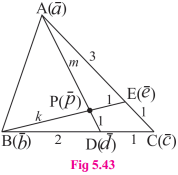
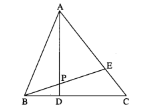
In a triangle ABC, D and E are points on BC and AC respectively, such that BD = 2 DC and AE = 3 EC. Let P be the point of intersection of AD and BE. Find BP/PF using vector methods.
Answer
Let $\bar{a}, \bar{b}, \bar{c}$ be the position vectors of A, B and C respectively with respect to some origin.
$\mathrm{D}$ divides $\mathrm{BC}$ in the ratio $2: 1$ and $\mathrm{E}$ divides $\mathrm{AC}$ in the ratio $3: 1$.
$
\therefore \bar{d}=\frac{\vec{b}+2 \vec{c}}{3} \bar{e}=\frac{\vec{a}+3 \vec{c}}{4} \text {. }
$
Let point of intersection $\mathrm{P}$ of $\mathrm{AD}$ and $\mathrm{BE}$ divides $\mathrm{BE}$ in the ratio $k: 1$ and $\mathrm{AD}$ in the ratio $m: 1$, then position
vectors of $\mathrm{P}$ in these two cases are $\frac{\vec{b}+k\left(\frac{\vec{a}+3 \vec{c}}{4}\right)}{k+1}$ and $\frac{\vec{a}+m\left(\frac{\vec{b}+2 \vec{c}}{3}\right)}{m+1}$ Fig 5.43
Equating the position vectors of $\mathrm{P}$ we get,
$
\begin{aligned}
& \frac{k}{4(k+1)} \bar{a}+\frac{1}{k+1} \bar{b}+\frac{3 k}{4(k+1)} \bar{c}=\frac{1}{m+1} \bar{a}+\frac{m}{3(m+1)} \bar{b}+\frac{2 m}{3(m+1)} \bar{c} \\
& \therefore \frac{k}{4(k+1)}=\frac{1}{m+1} \\
& \frac{1}{k+1}=\frac{m}{3(m+1)} \\
& \frac{3 k}{4(k+1)}=\frac{2 m}{3(m+1)}
\end{aligned}
$
Dividing (3) by (2) we get, $\frac{3 k}{4}=2$ i.e. $k=\frac{8}{3} \quad$ therefore $\frac{B P}{P F}=k: 1=8: 3$

Image

View full question & answer
Question 155 Marks
Prove that the angle bisectors of a triangle are concurrent.
Answer
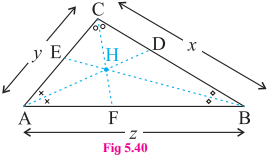
Let $\mathrm{A}, \mathrm{B}$ and $\mathrm{C}$ be vertices of a triangle. Let $\mathrm{AD}, \mathrm{BE}$ and $\mathrm{CF}$ be the angle bisectors of the triangle ABD. Let $\bar{a}, \bar{b}, \bar{c}, \bar{d}, \bar{e}$ and $\bar{f}$ be the position vectors of the points $\mathrm{A}, \mathrm{B}, \mathrm{C}, \mathrm{D}, \mathrm{E}$ and $\mathrm{F}$ respectively. Also $\mathrm{AB}=\mathrm{zBC}=\mathrm{xAC}=\mathrm{y}$. Now, the angle bisector $\mathrm{AD}$ meets the side $\mathrm{BC}$ at the point D. Therefore, the point $\mathrm{D}$ divides the line segment $\mathrm{BC}$ internally in the ratio $\mathrm{AB}: \mathrm{AC}$, that is $z: y$. Hence, by section formula for internal division, we have $\bar{d}=\frac{z \bar{c}+y \bar{b}}{z+y}$ Similarly, we get
$\bar{e}=\frac{x \bar{a}+z \bar{c}}{x+z}$ and $\quad \bar{f}=\frac{y \bar{b}+x \bar{a}}{y+x}$
As
$
\bar{d}=\frac{z \bar{c}+y \bar{b}}{z+y}
$
$\therefore \quad(z+y) \bar{d}=z \bar{c}+y \bar{b}$
i.e. $\quad(z+y) \bar{d}+x \bar{a}=x \bar{a}+y \bar{b}+z \bar{c}$
similarly
$(x+z) \bar{e}+y \bar{b}=x \bar{a}+y \bar{b}+\mathrm{z} \bar{c}$
and $\quad(x+y) \bar{f}+z \bar{c}=x \bar{a}+y \bar{b}+\mathrm{z} \bar{c}$
$\therefore \quad \frac{(z+y) \bar{d}+x \bar{a}}{x+y+z}=\frac{(x+z) \bar{e}+y \bar{b}}{x+y+z}=\frac{(x+y) \bar{f}+z \bar{c}}{x+y+z}=\frac{x \bar{a}+y \bar{b}+z \bar{c}}{x+y+z}=\bar{h}$ (say)
Then we have
$
\bar{h}=\frac{(y+z) \bar{d}+x \bar{a}}{(y+z)+x}=\frac{(x+z) \bar{e}+y \bar{b}}{(x+z)+y}=\frac{(x+y) \bar{f}+z \bar{c}}{(x+y)+z}
$
That is point $\mathrm{H}(\bar{h})$ divides $\mathrm{AD}$ in the ratio $(y+z): x, \mathrm{BE}$ in the ratio $(x+z): y$ and $\mathrm{CF}$ in the ratio $(x+y): z$.
This shows that the point $\mathrm{H}$ is the point of concurrence of the angle bisectors $\mathrm{AD}, \mathrm{BE}$ and $\mathrm{CF}$ of the triangle $\mathrm{ABC}$, Thus, the angle bisectors of a triangle are concurrent and $\mathrm{H}$ is called incentre of the triangle $\mathrm{ABC}$.

Image

View full question & answer
Question 165 Marks
Prove that the medians of a triangle are concurrent.
Answer
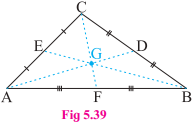
Let A, B and C be vertices of a triangle. Let D, E and F be the mid-points of the sides $\mathrm{BC}, \mathrm{AC}$ and $\mathrm{AB}$ respectively. Let $\bar{a}, \bar{b}, \bar{c}, \bar{d}, \bar{e}$ and $\bar{f}$ be position vectors of points $\mathrm{A}, \mathrm{B}$, $\mathrm{C}, \mathrm{D}, \mathrm{E}$ and $\mathrm{F}$ respectively.
Therefore, by mid-point formula,
$\therefore \bar{d}=\frac{\bar{b}+\bar{c}}{2}, \bar{e}=\frac{\bar{a}+\bar{c}}{2}$ and $\bar{f}=\frac{\bar{a}+\bar{b}}{2}$
$\therefore 2 \bar{d}=\bar{a}+\bar{c}, 2 \bar{e}=\bar{a}+\bar{c}$ and $2 \bar{f}=\bar{a}+\bar{b}$
$\therefore 2 \bar{d}+\bar{a}=\bar{a}+\bar{b}+\bar{c}$, similarly $2 \bar{e}+\bar{b}=2 \bar{f}+\bar{c}=\bar{a}+\bar{b}+\bar{c}$
$\therefore \frac{2 \bar{d}+\bar{a}}{3}=\frac{2 \bar{e}+\bar{b}}{3}=\frac{2 \bar{f}+\bar{c}}{3}=\frac{\bar{a}+\bar{b}+\bar{c}}{3}=\bar{g}$ (say)
Then we have $\bar{g}=\frac{\bar{a}+\bar{b}+\bar{c}}{3}=\frac{(2) \bar{d}+(1) \bar{a}}{2+1}=\frac{(2) \bar{e}+(1) \bar{b}}{2+1}=\frac{(2) \bar{f}+(1) \bar{c}}{2+1}$
If $\mathrm{G}$ is the point whose position vector is $\bar{g}$, then from the above equation it is clear that the point $\mathrm{G}$ lies on the medians $\mathrm{AD}, \mathrm{BE}, \mathrm{CF}$ and it divides each of the medians $\mathrm{AD}, \mathrm{BE}, \mathrm{CF}$ internally in the ratio $2: 1$.
Therefore, three medians are concurrent.

Image

View full question & answer
Question 175 Marks
Prove that the median of a trapezium is parallel to the parallel sides of the trapezium and its length is half the sum of parallel sides.
Answer
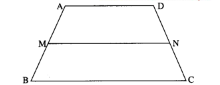
Let $\bar{a}_r \bar{b}, \bar{c}$ and $\bar{d}$ be respectively the position vectors of the vertices $\mathrm{A}, \mathrm{B}, \mathrm{C}$ and $\mathrm{D}$ of the

trapezium ABCD, with side AD || side BC.

Then the vectors $\overline{\mathrm{AD}}$ and $\overline{\mathrm{BC}}$ are parallel.

$\therefore$ there exists a scalar $k$

such that $\overline{\mathrm{AD}}=k \cdot \overline{\mathrm{BC}}$

$\therefore \overline{\mathrm{AD}}+\overline{\mathrm{BC}}=k \cdot \overline{\mathrm{BC}}+\overline{\mathrm{BC}}$

= (k + 1)BC …(1)

Image

Let $\bar{m}$ and $\bar{n}$ be the position vectors of the midpoints $\mathrm{M}$ and $\mathrm{N}$ of the non-parallel sides

AB and DC respectively. Then seg MN is the median of the trapezium. By the midpoint formula,

$\bar{m}=\frac{\bar{a}+\bar{b}}{2}$ and $\bar{n}=\frac{\bar{d}+\bar{c}}{2}$

$\therefore \overline{\mathrm{MN}}=\bar{n}-\bar{m}$

$=\left(\frac{\bar{d}+\bar{c}}{2}\right)-\left(\frac{\bar{a}+\bar{b}}{2}\right)$

$=\frac{1}{2}(\bar{d}+\bar{c}-\bar{a}-\bar{b})$

$=\frac{1}{2}[(\bar{d}-\bar{a})+(\bar{c}-\bar{b})]$

$=\frac{\overline{\mathrm{AD}}+\overline{\mathrm{BC}}}{2}$

$\ldots(2)$

$=\frac{(k+1) \overline{B C}}{2}$

$\ldots[B y(1)]$

Thus $\overline{\mathrm{MN}}$ is a scalar multiple of $\overline{\mathrm{BC}}$

$\therefore \overline{\mathrm{MN}}$ and $\overline{\mathrm{BC}}$ are parallel vectors

$\therefore \overline{\mathrm{MN}} \| \overline{\mathrm{BC}}$ where $\overline{\mathrm{BC}} \| \overline{\mathrm{AD}}$

∴ the median MN is parallel to the parallel sides AD and BC of the trapezium.

Now $\overline{\mathrm{AD}}$ and $\overline{\mathrm{BC}}$ are collinear

$\therefore|\overline{\mathrm{AD}}+\overline{\mathrm{BC}}|=|\overline{\mathrm{AD}}|+|\overline{\mathrm{BC}}|=\mathrm{AD}+\mathrm{BC}$

$\therefore$ from (2), we have

$\therefore \overline{\mathrm{MN}}=\frac{\overline{\mathrm{AD}}+\overline{\mathrm{BC}}}{2}$

$\therefore \mathrm{MN}=\frac{1}{2}(\mathrm{AD}+B C)$

View full question & answer
Question 185 Marks
Prove that a quadrilateral is a parallelogram if and only if its diagonals bisect each other.
Answer
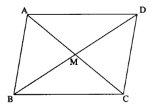
Let $\bar{a}_r \bar{b}, \bar{c}$ and $\bar{d}$ be respectively the position vectors of the vertices $\mathrm{A}, \mathrm{B}, C$ and $\mathrm{D}$ of the

parallelogram ABCD. Then AB = DC and side AB || side DC.

Image

$\begin{aligned} & \therefore \overline{\mathrm{AB}}=\overline{\mathrm{DC}} \\ & \therefore \bar{b}-\bar{a}=\bar{c}-\bar{d} \\ & \therefore \bar{a}+\bar{c}=\bar{b}+\bar{d} \\ & \therefore \frac{\bar{a}+\bar{c}}{2}=\frac{\bar{b}+\bar{d}}{2}\end{aligned}$

$\ldots$... (1)

The position vectors of the midpoints of the diagonals $\mathrm{AC}$ and $\mathrm{BD}$ are $(\bar{a}+\bar{c}) / 2$ and $(\bar{b}+$$\bar{d}) / 2$. By (1), they are equal.

∴ the midpoints of the diagonals AC and BD are the same.
This shows that the diagonals AC and BD bisect each other.

Conversely, suppose that the diagonals AC and BD
of □ ABCD bisect each other,
i. e. they have the same midpoint.
∴ the position vectors of these midpoints are equal.

$\begin{aligned} & \therefore \frac{\bar{a}+\bar{c}}{2}=\frac{\bar{b}+\bar{d}}{2} \therefore \bar{a}+\bar{c}=\bar{b}+\bar{d} \\ & \therefore \bar{b}-\bar{a}=\bar{c}-\bar{d} \therefore \overline{\mathrm{AB}}=\overline{\mathrm{DC}} \\ & \therefore \overline{\mathrm{AB}} \| \overline{\mathrm{DC}} \text { and }|\overline{\mathrm{AB}}|=|\overline{\mathrm{DC}}|\end{aligned}$

∴ side AB || side DC and AB = DC.
∴ □ ABCD is a parallelogram.

View full question & answer
Question 195 Marks
D and E divide sides BC and CA of a triangle ABC in the ratio 2 : 3 respectively. Find the position vector of the point of intersection of AD and BE and the ratio in which this point divides AD and BE.
Answer

Image

Let AD and BE intersect at P.

Let $\mathrm{A}, \mathrm{B}, \mathrm{C}, \mathrm{D}, \mathrm{E}, \mathrm{P}$ have position vectos $\bar{a}, \bar{b}, \bar{c}_t, \bar{d}, \bar{e}_{,} \bar{p}$ respectively.

D and E divide segments BC and CA internally in the ratio 2 : 3. By the section formula for internal division,

$\begin{aligned} & \bar{d}=\frac{2 \bar{c}+3 \bar{b}}{2+3} \\ & \therefore 5 \bar{d}=2 \bar{c}+3 \bar{b}\end{aligned}$

$\ldots(1)$

and $\bar{e}=\frac{2 \bar{a}+3 \bar{c}}{2+3}$

$\therefore 5 \vec{e}=2 a+3 \vec{c}$

$\cdots(2)$

From (1), $5 \bar{d}-3 \bar{b}=2 \bar{c} \quad \therefore 15 \bar{d}-9 \bar{b}=6 \bar{c}$

From (2), $5 \bar{e}-2 \bar{a}=3 \bar{c} \quad \therefore 10 \bar{e}-4 \bar{a}=6 \bar{c}$

Equating both values of $6 \bar{c}$, we get

$\begin{aligned} & 15 \bar{d}-9 \bar{b}=10 \bar{e}-4 \bar{a} \\ & \therefore 15 \bar{d}+4 \bar{a}=10 \bar{e}+9 \bar{b} \\ & \therefore \frac{15 \bar{d}+4 \bar{a}}{15+4}=\frac{10 \bar{e}+9 \bar{b}}{10+9}\end{aligned}$

LHS is the position vector of the point which divides segment AD internally in the ratio 15 : 4.
RHS is the position vector of the point which divides segment BE internally in the ratio 10 : 9.
But P is the point of intersection of AD and BE.
∴ P divides AD internally in the ratio 15 : 4 and P divides BE internally in the ratio 10 : 9.
Hence, the position vector of the point of interaction of

$\mathrm{AD}$ and $\mathrm{BE}$ is $\bar{p}=\frac{15 \bar{d}+4 \bar{a}}{19}=\frac{10 \bar{e}+9 \bar{b}}{19}$ and it divides $A D$ internally in the ratio $15: 4$ and $B E$

internally in the ratio 10 : 9.

View full question & answer
Question 205 Marks
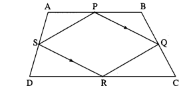
Prove that the line segments joining mid-point of adjacent sides of a quadrilateral form a parallelogram.
Answer
Let ABCD be a quadrilateral and P, Q, R, S be the midpoints of the sides AB, BC, CD and DA respectively.

Let $\bar{a}, \bar{b}, \bar{c}, \bar{d}, \bar{p}, \bar{q}, \bar{r}$ and $s$ be the position vectors of the points $A, B, C, D, P, Q, R$ and $S$ respectively. Since P, Q, R and S are the midpoints of the sides AB, BC, CD and DA respectively,

$\bar{p}=\frac{\bar{a}+\bar{b}}{2}, \bar{q}=\frac{\bar{b}+\bar{c}}{2}, \bar{r}=\frac{\bar{c}+\bar{d}}{2}$ and $\bar{s}=\frac{\bar{d}+\bar{a}}{2}$

Image

$\therefore \overline{\mathrm{PQ}}=\bar{q}-\bar{p}$

$=\left(\frac{\bar{b}+\bar{c}}{2}\right)-\left(\frac{\bar{a}+\bar{b}}{2}\right)$

$=\frac{1}{2}(\bar{b}+\bar{c}-\bar{a}-\bar{b})=\frac{1}{2}(\bar{c}-\bar{a})$

$\overline{\mathrm{SR}}=\bar{r}-\bar{s}$

$\begin{aligned} & =\left(\frac{\bar{c}+\bar{d}}{2}\right)-\left(\frac{\bar{d}+\bar{a}}{2}\right) \\ & =\frac{1}{2}(\bar{c}+\bar{d}-\bar{d}-\bar{a})=\frac{1}{2}(\bar{c}-\bar{a})\end{aligned}$

Similarly, $\overline{\mathrm{QR}} \mid \overline{\mathrm{PS}}$

$\therefore \overline{\mathrm{PQ}}=\overline{\mathrm{SR}} \quad \therefore \overline{\mathrm{PQ}} \| \overline{\mathrm{SR}}$

∴ □PQRS is a parallelogram.

View full question & answer
Question 215 Marks
If the points A(3, 0, p), B (-1, q, 3) and C(-3, 3, 0) are collinear, then find.

The ratio in which the point C divides the line segment AB.

The values of p and q.

Answer
1.Let $\bar{a}, \bar{b}$ and $\bar{c}$ be the position vectors of $\mathrm{A}, \mathrm{B}$ and $\mathrm{C}$ respectively.

Then $\bar{a}=3 \hat{i}+0 \cdot \hat{j}+p \hat{k}, \bar{b}=-\hat{i}+q \hat{j}+3 \hat{k}$ and $\bar{c}=-3 \hat{i}+3 \hat{j}+0 \hat{k}$.

As the points A, B, C are collinear, suppose the point C divides line segment AB in the ratio λ : 1.

∴ by the section formula,

$\bar{c}=\frac{\lambda \cdot \bar{b}+1 \cdot \bar{a}}{\lambda+1}$

$\begin{aligned} \therefore & -3 \hat{i}+3 \hat{j}+0 \cdot \hat{k} \\ = & \frac{\lambda(-\hat{i}+q \hat{j}+3 \hat{k})+(3 \hat{i}+0 \cdot \hat{j}+p \hat{k})}{\lambda+1}\end{aligned}$

$\begin{aligned} \therefore & (\lambda+1)(-3 \hat{i}+3 \hat{j}+0 \cdot \hat{k}) \\ & =(-\lambda \hat{i}+\lambda \hat{j}+3 \lambda \hat{k})+(3 \hat{i}+0 \hat{j}+p \hat{k}) \\ \therefore \quad & -3(\lambda+1) \hat{i}+3(\hat{\lambda}+1) \hat{j}+0 \hat{k} \\ & =(-\lambda+3) \hat{i}+\lambda 2 \hat{j}+(3 \lambda+p) \hat{k}\end{aligned}$

By equality of vectors, we have,
-3(λ + 1) = -λ + 3 … (1)
3(λ + 1 ) = λ q … (2)
0 = 3λ + p … (3)
From equation (1), -3λ – 3 = -λ + 3
∴ -2λ = 6 ∴ λ = -3
∴ C divides segment AB externally in the ratio 3 : 1.

2.Putting λ = -3 in equation (2), we get
3(-3 + 1) = -3q
∴ -6 = -3q ∴ q = 2
Also, putting λ = -3 in equation (3), we get
0 = -9 + p ∴ p = 9
Hence p = 9 and q = 2.

View full question & answer
Question 225 Marks
Find the position vector of point R which divides the line joining the points P and Q whose

position vectors are $2 \hat{i}-\hat{j}+3 \hat{k}$ and $-5 \hat{i}+2 \hat{j}-5 \hat{k}$ in the ratio $3: 2$

(1)internally

(2)externally

Answer
1.It is given that the points $\mathrm{P}$ and $\mathrm{Q}$ have position vectors $\bar{p}=2 \hat{i}-\hat{j}+3 \hat{k}$ and $\bar{p}=$

$-5 \hat{i}+2 \hat{j}-5 \hat{k}$ respectively.

If $\mathrm{R}(\bar{r})$ divides the line segment $\mathrm{PQ}$ internally in the ratio $3: 2$, by section formula for

internal division,

$\bar{r}=\frac{3 \bar{q}+2 \bar{p}}{3+2}=\frac{3(-5 \hat{i}+2 \hat{j}-5 \hat{k})+2(2 \hat{i}-\hat{j}+3 \hat{k})}{5}$

$=\frac{-11 \hat{i}+4 \hat{j}-9 \hat{k}}{5}=\frac{1}{5}(-11 \hat{i}+4 \hat{j}-9 \hat{k})$

$\therefore$ coordinates of $\mathrm{R}=\left(-\frac{11}{5}, \frac{4}{5},-\frac{9}{5}\right)$

Hence, the position vector of $R$ is $\frac{1}{5}(-11 \hat{i}+4 \hat{j}-9 \hat{k})$

and the coordinates of $\mathrm{R}$ are $\left(-\frac{11}{5}, \frac{4}{5},-\frac{9}{5}\right)$.

2.If $R(\bar{r})$ divides the line segment joining $P$ and $Q$ externally in the ratio $3: 2$, by section

formula for external division,

$\bar{r}=\frac{3 \bar{q}-2 \bar{p}}{3-2}=\frac{3(-5 \hat{i}+2 \hat{j}-5 \hat{k})-2(2 \hat{i}-\hat{j}+3 \hat{k})}{3-2}$

$=-19 \hat{i}+8 \hat{j}-21 \hat{k}$

∴ coordinates of R = (-19, 8, -21).

Hence, the position vector of $\mathrm{R}$ is $-19 \hat{i}+8 \hat{j}-21 \hat{k}$ and coordinates of $\mathrm{R}$ are $(-19,8,-21)$.

View full question & answer
Question 235 Marks
Express $-\hat{i}-3 \hat{j}+4 \hat{k}$ as linear combination of the vectors $2 \hat{i}+\hat{j}-4 \hat{k} 2 \hat{i}-\hat{j}+3 \hat{k}$and $3 \hat{i}+\hat{j}-2 \hat{k}$.
Answer
Let $\bar{a}=2 \hat{i}+\hat{j}-4 \hat{k}, \bar{b}=2 \hat{i}-\hat{j}+3 \hat{k}$,

$\bar{c}=3 \vec{i}+\hat{j}-2 \hat{k}$ and $\bar{p}=-\hat{i}-3 \hat{j}+4 \hat{k}$.

Suppose $\bar{p}=x \bar{a}+y \bar{b}+\bar{z}$.

Then, $-\hat{i}-3 \hat{j}+4 \hat{k}=x(2 \hat{i}+\hat{j}-4 \hat{k})+y(2 \hat{i}-\hat{j}+3 \hat{k})+$

$z(3 \hat{i}+\hat{j}-2 \hat{k})$

$\therefore-\hat{i}-3 \hat{j}+4 \hat{k}=(2 x+2 y+3 z) \hat{i}+(x-y+z) \hat{j}+$

$(-4 x+3 y-2 z) \hat{k}$

By equality of vectors,
2x + 2y + 3 = -1
x – y + z = -3
-4x + 3y – 2z = 4
We have to solve these equations by using Cramer’s Rule

$\begin{aligned} & D=\left|\begin{array}{rrr}2 & 2 & 3 \\ 1 & -1 & 1 \\ -4 & 3 & -2\end{array}\right| \\ & =2(2-3)-2(-2+4)+3(3-4) \\ & =-2-4-3=-9 \neq 0\end{aligned}$

$\begin{aligned} D_x & =\left|\begin{array}{rrr}-1 & 2 & 3 \\ -3 & -1 & 1 \\ 4 & 3 & -2\end{array}\right| \\ & =-1(2-3)-2(6-4)+3(-9+4) \\ & =1-4-15=-18\end{aligned}$

$\begin{aligned} D_y & =\left|\begin{array}{rrr}2 & -1 & 3 \\ 1 & -3 & 1 \\ -4 & 4 & -2\end{array}\right| \\ & =2(6-4)+1(-2+4)+3(4-12) \\ & =4+2-24=-18\end{aligned}$

$\begin{aligned} & D_z=\left|\begin{array}{rrr}2 & 2 & -1 \\ 1 & -1 & -3 \\ -4 & 3 & 4\end{array}\right| \\ & =2(-4+9)-2(4-12)-1(3-4) \\ & =10+16+1=27\end{aligned}$

$\begin{aligned} & \therefore x=\frac{D_y}{\mathrm{D}}=\frac{-18}{-9}=2 \\ & \therefore y=\frac{D_y}{D}=\frac{-18}{-9}=2 \\ & \therefore z=\frac{D_2}{\mathrm{D}}=\frac{27}{-9}=-3 \\ & \therefore \bar{p}=2 \bar{a}+2 \bar{b}-3 \bar{c} .\end{aligned}$

View full question & answer
Solve the Following Question.(5 Marks) - Maths STD 12 Science Questions - Vidyadip