Question
Prove that the angle bisectors of a triangle are concurrent.
Answer

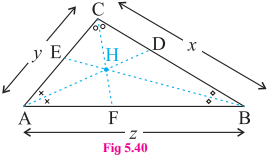
Let $\mathrm{A}, \mathrm{B}$ and $\mathrm{C}$ be vertices of a triangle. Let $\mathrm{AD}, \mathrm{BE}$ and $\mathrm{CF}$ be the angle bisectors of the triangle ABD. Let $\bar{a}, \bar{b}, \bar{c}, \bar{d}, \bar{e}$ and $\bar{f}$ be the position vectors of the points $\mathrm{A}, \mathrm{B}, \mathrm{C}, \mathrm{D}, \mathrm{E}$ and $\mathrm{F}$ respectively. Also $\mathrm{AB}=\mathrm{zBC}=\mathrm{xAC}=\mathrm{y}$. Now, the angle bisector $\mathrm{AD}$ meets the side $\mathrm{BC}$ at the point D. Therefore, the point $\mathrm{D}$ divides the line segment $\mathrm{BC}$ internally in the ratio $\mathrm{AB}: \mathrm{AC}$, that is $z: y$. Hence, by section formula for internal division, we have $\bar{d}=\frac{z \bar{c}+y \bar{b}}{z+y}$ Similarly, we get
$\bar{e}=\frac{x \bar{a}+z \bar{c}}{x+z}$ and $\quad \bar{f}=\frac{y \bar{b}+x \bar{a}}{y+x}$
As
$
\bar{d}=\frac{z \bar{c}+y \bar{b}}{z+y}
$
$\therefore \quad(z+y) \bar{d}=z \bar{c}+y \bar{b}$
i.e. $\quad(z+y) \bar{d}+x \bar{a}=x \bar{a}+y \bar{b}+z \bar{c}$
similarly
$(x+z) \bar{e}+y \bar{b}=x \bar{a}+y \bar{b}+\mathrm{z} \bar{c}$
and $\quad(x+y) \bar{f}+z \bar{c}=x \bar{a}+y \bar{b}+\mathrm{z} \bar{c}$
$\therefore \quad \frac{(z+y) \bar{d}+x \bar{a}}{x+y+z}=\frac{(x+z) \bar{e}+y \bar{b}}{x+y+z}=\frac{(x+y) \bar{f}+z \bar{c}}{x+y+z}=\frac{x \bar{a}+y \bar{b}+z \bar{c}}{x+y+z}=\bar{h}$ (say)
Then we have
$
\bar{h}=\frac{(y+z) \bar{d}+x \bar{a}}{(y+z)+x}=\frac{(x+z) \bar{e}+y \bar{b}}{(x+z)+y}=\frac{(x+y) \bar{f}+z \bar{c}}{(x+y)+z}
$
That is point $\mathrm{H}(\bar{h})$ divides $\mathrm{AD}$ in the ratio $(y+z): x, \mathrm{BE}$ in the ratio $(x+z): y$ and $\mathrm{CF}$ in the ratio $(x+y): z$.
This shows that the point $\mathrm{H}$ is the point of concurrence of the angle bisectors $\mathrm{AD}, \mathrm{BE}$ and $\mathrm{CF}$ of the triangle $\mathrm{ABC}$, Thus, the angle bisectors of a triangle are concurrent and $\mathrm{H}$ is called incentre of the triangle $\mathrm{ABC}$.

Image

Need a full question paper?

Generate a complete, print-ready paper with questions like this in minutes — across 16+ boards, with answer keys.

Start Generating Free

Similar questions

Find the maximum and minimum of the following functions:

$f(x)=\frac{\log x}{x}$

Evaluate the following integrals:
$\int\text{e}^{2\text{x}}(-\sin\text{x}+2\cos\text{x})\text{dx}$
Show that the points A(-1, 4, -3), B(3, 2, -5), C(-3, 8, -5) and D(-3, 2, 1) are coplanar.
If O is a point in space, ABC is a triangle and D, E, F are the mid-points of the sides BC, CA and AB respectively of the triangle, prove that $\overrightarrow{\text{OA}}+\overrightarrow{\text{OB}}+\overrightarrow{\text{OC}}=\overrightarrow{\text{OD}}+\overrightarrow{\text{OE}}+\overrightarrow{\text{OF}}$.
Find the vector equation of the following planes in non-parametric form.
$\vec{\text{r}}=(\lambda-2\mu)\hat{\text{i}}+(3-\mu)\hat{\text{j}}+(2\lambda+\mu)\hat{\text{k}}$
Evaluate the following integrals:$\int\frac{\text{x}^2+\text{x}-1}{\text{x}^2+\text{x}-6}\text{ dx}$
Evaluvate the following intregals
$\int\frac{2\text{x}+1}{\sqrt{\text{x}^2+4\text{x}+3}}\text{dx}$
Prove that:
$\begin{vmatrix}\text{a}+\text{b}&\text{b}+\text{c}&\text{c}+\text{a}\\\text{b}+\text{c}&\text{c}+\text{a}&\text{a}+\text{b}\\\text{c}+\text{a}&\text{a}+\text{b}&\text{b}+\text{c}\end{vmatrix}=2\begin{vmatrix}\text{a}&\text{b}&\text{c}\\\text{b}&\text{c}&\text{a}\\\text{c}&\text{a}&\text{b} \end{vmatrix}$
A firm manufactures two products, each of which must be processed through two departments, 1 and 2. The hourly requirements per unit for each product in each department, the weekly capacities in each department, selling price per unit, labour cost per unit, and raw material cost per unit are summarized as follows:
 
 
Product A
Product B
Weekly capacity
Department 1
3
2
130
Department 2
4
6
260
Selling price per unit
Rs. 25
Rs. 30
 
Labour cost per unit
Rs. 16
Rs. 20
 
Raw material cost per unit
Rs. 4
Rs. 4
 
The problem is to determine the number of units to produce each product so as to maximize total contribution to profit. Formulate this as a LPP.
Find the maximum and minimum value of 2x + y subject to the constraints:

$\text{x}+3\text{y}\geq6,\text{x}-3\text{y}\leq3,3\text{x}+4\text{y}\leq24,$ $-3\text{x}+2\text{y}\leq6,5\text{x}+\text{y}\geq5,\text{x},\text{y}\geq0$