Question
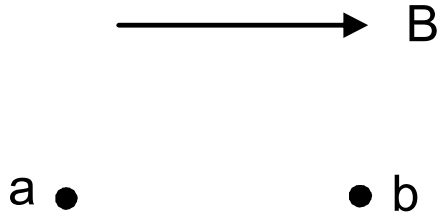
Prove that the force acting on a current-carrying wire, joining two fixed points a and b in a uniform magnetic field, is independent of the shape of the wire.
Answer


For force on a current carrying wire in an uniform magnetic field
We need, l → length of wire
i → Current
B → Magnitude of magnetic field
Since $\overrightarrow{\text{F}}=\text{i}\ell\text{B}$
Now, since the length of the wire is fixed from A to B, so force is independent of the shape of the wire.

Need a full question paper?

Generate a complete, print-ready paper with questions like this in minutes — across 16+ boards, with answer keys.

Start Generating Free

Similar questions

A convex lens of focal length 20 cm is placed coaxially with a convex mirror of radius of curvature 20 cm. The two are kept 15 cm apart. A point object is placed 40 cm in front of the convex lens. Find the position of the image formed by this combination. Draw the ray diagram showing the image formation.
Magnitudes of $\frac{1}{4 \pi \epsilon_0}$ and $\frac{\mu_0}{4 \pi}$ for vacuum are respectively $9 \times 10^9 N / m ^2$ and $10^{-7}$ weber/ampere respectively. Calculate the speed of electromagnetic wave in vacuum.
A person standing on a platform finds that a train moving with velocity 0.6c takes one second to pass by him. Find:
  1. The length of the train as seen by the person and.
  2. The rest length of the train.
Are matter waves electromagnetic?
An electron and a photon each have a wavelength of 1.00 nm. Find:
  1. Their momenta,
  2. The energy of the photon, and
  3. The kinetic energy of electron.
Two long strings A and B, each having linear mass density $1.2 \times 10^{-2}kg/m$, are stretched by different tensions 4.8N and 7.5N respectively and are kept parallel to each other with their left ends at $x = 0$. Wave pulses are produced on the strings at the left ends at t = 0 on string A and at t = 20ms on string B. When and where will the pulse on B overtake that on A?
  1. Draw a graph showing variation of photocurrent with anode potential for a particular intensity of incident radiation. Mark saturation current and stopping potential.
  2. By how much would the stopping potential for a given photosensitive surface go up if the frequency of the incidentradiations were to be increased from $4\times10^{15}\text{ }\text{Hz}\text{ }\text{to}8\text{ }\times10^{15}\text{ }\text{Hz}$?
A block of mass 250g is kept on a vertical spring of spring constant 100N/m fixed from below. The spring is now compressed to have a length 10cm shorter than its natural length and the system is released from this position. How high does the block rise? Take $g =10m/s^2.$
A source of ac voltage $ v= v_0 \sin\omega t$, is connected across a pure inductor of inductance L. Derive the expressions for the instantaneous current in the circuit. Show that average power dissipated in the circuit is zero.
Using Bohr's postulates, obtain the expression for the total energy of the electron in the stationary states of the hydrogen atom. Hence draw the energy level diagram showing how the line spectra corresponding to Balmer series occur due to transition between energy levels.