Question
Prove that there is a value of $(\text{c}\neq0)$ for which the system has infinitely many solutions. Find this value.
$6x + 3y = c - 3$
$12x + cy = c$

Answer

The given system of equations may be written as,
$6x + 3y - (c - 3) = 0$
$12x + cy - c = 0$
This is of the form
$a_1x + b_1y + c_1 = 0$
$a_2x + b_2y + c_2 = 0$
Where, $a_1 = 6, b_1 = 3, c_1 = -(c - 3)$
And, $a_2 = 12, b_2 = c, c_2 = -c$
For infinitely many solutions, we must have
$\frac{\text{a}_1}{\text{a}_2}=\frac{\text{b}_1}{\text{b}_2}=\frac{\text{c}_1}{\text{c}_2}$
$\Rightarrow\frac{6}{12}=\frac{3}{\text{c}}=\frac{-(\text{c}-3)}{-\text{c}}$
$\Rightarrow\frac{6}{12}=\frac{3}{\text{c}}$ and $$$\frac{3}{\text{c}}=\frac{\text{c}-3}{\text{c}}$
$\Rightarrow6\text{c}=12\times3$ and $3=(\text{c}-3)$
$\Rightarrow\text{c}=\frac{36}{6}$ and $\text{c}-3=3$
$\Rightarrow\text{c}=6$ and $\text{c}=6$
Now,
$\frac{\text{a}_1}{\text{a}_2}=\frac{6}{12}=\frac{1}{2}$
$\frac{\text{b}_1}{\text{b}_2}=\frac{3}{6}=\frac{1}{2}$
$\frac{\text{c}_1}{\text{c}_2}=\frac{-(6-3)}{-6}=\frac{1}{2}$
$\therefore\frac{\text{a}_1}{\text{a}_2}=\frac{\text{b}_1}{\text{b}_2}=\frac{\text{c}_1}{\text{c}_1}$
Clearly, for this value of c, we have $\frac{\text{a}_1}{\text{a}_2}=\frac{\text{b}_1}{\text{b}_2}=\frac{\text{c}_1}{\text{c}_2}$
Hence, the given system of equations has infinitely many solutions, if $c = 6.$

Need a full question paper?

Generate a complete, print-ready paper with questions like this in minutes — across 16+ boards, with answer keys.
Start Generating Free

Similar questions

Find the roots of the quadratic equations by using the quadratic formula in each of the following:
$\text{x}^2-3\sqrt{5}\text{x}+10=0.$
Find the value of k for which the following equation have real root:
$x^2 - 4kx + k = 0$
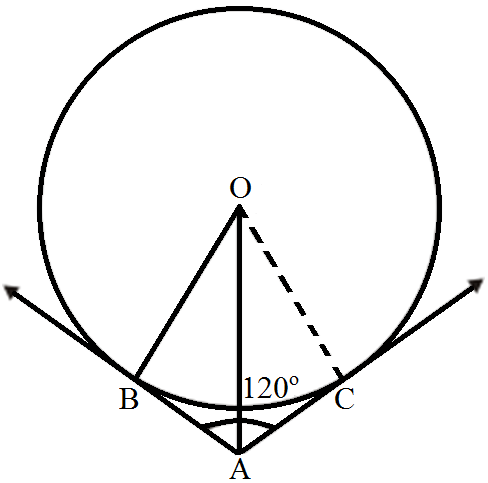
In the given figure, two tangents AB and AC are drawn to a circle with centre O such that $\angle\text{BAC}=120^{\circ}$. Prove that OA = 2AB.
Graphically, solve the following pair of equations:
$2 x+y=6$
$2 x-y+2=0$
Find the ratio of the areas of the two triangles formed by the lines representing these equations with the $x-$ axis and the lines with the $y-$ axis.
Draw the graphs of the equations $x-y+1=0$ and $3 x+2 y-12=0$. Write the co$-$ordinates of the vertices of the triangle formed by these lines and the $x -$axis and shade the corresponding triangular region.
A solid wooden toy is in the form of a hemisphere surmounted by a cone of same radius. The radius of hemisphere is $3.5 \ cm$ and the total wood used in the making of toy is $166 \frac{5}{6} \ cm^3$. Find the height of the toy. Also, find the cost of painting the hemispherical part of the toy at the rate of $Rs. 10\ \text { per } \ cm^2 \cdot\left[\text { Use } \pi=\frac{22}{7}\right]$
A toy is in the form of a cone mounted on a hemisphere with the same radius. The diameter of the base of the conical portion is 6cm and its height is 4cm. Determine the surface area of the toy. $(\text{Use}\ \pi=3.14)$
Very-Short-Answer Question:
Find the zeros of the polynomial $x^2 - 3x - m(m + 3).$
Find the zeros of the following quadratic polynomial and verify the relationship between the zeros and the coefficients:
$x^2 + 3x - 10$
Two arithmetic progression have the same common difference. The difference between their $100^{\text {th }}$ terms is 100 , What is the difference between their $1000^{\text {th }}$ terms?