Question
Prove that with constant angular speed a radius the perpendicular to the point of rotation of a person rotating in a circular path performs simple harmonic motion. Also find the equation of this motion.

Answer

SELF

Need a full question paper?

Generate a complete, print-ready paper with questions like this in minutes — across 16+ boards, with answer keys.
Start Generating Free

Similar questions

A thin prism of angle $6.0^\circ,\omega=0.07$ and $\mu_\text{y}=1.50$ is combined with another thin prism having $\omega=0.08$ and $\mu_\text{y}=1.60.$ The combination produces no deviation in the mean ray.
  1. Find the angle of the second prism.
  2. Find the net angular dispersion produced by the combination when a beam of white light passes through it.
  3. If the prisms are similarly directed, what will be the deviation in the mean ray
  4. Find the angular dispersion in the situation described in (c).
You are riding in an automobile of mass $3000\ kg$. Assuming that you are examining the oscillation characteristics of its suspension system. The suspension sags 15cm when the entire automobile is placed on it. Also, the amplitude of oscillation decreases by $50\%$ during one complete oscillation. Estimate the values of $(a)$ the spring constant $k$ and $(b)$ the damping constant b for the spring and shock absorber system of one wheel, assuming that each wheel supports $750\ kg.$
A steel rod $\left(Y=2.0 \times 10^{11} \mathrm{~N} \mathrm{~m}^{-2}\right.$, and $\left.\alpha=10^{-50} \mathrm{C}^{-1}\right)$ of length 1 m and area of cross-section 1 cm 2 is heated from $0^{\circ} \mathrm{C}$ to $200^{\circ} \mathrm{C}$, without being allowed to extend or bend. What is the tension produced in the rod?
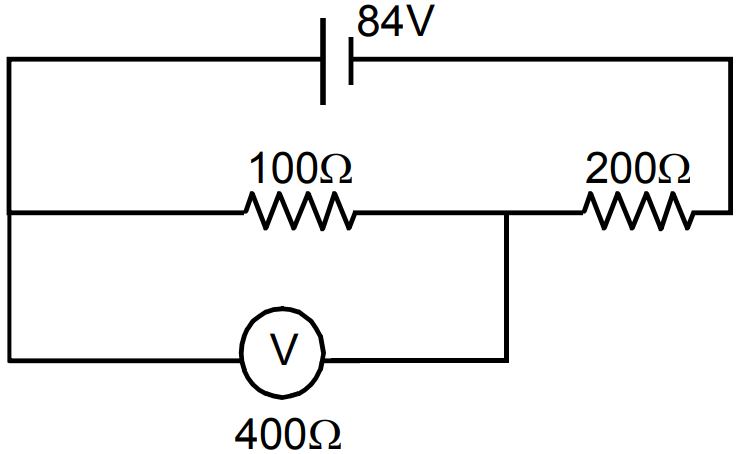
A voltmeter of resistance $400\Omega$ is used to measure the potential difference across the $100\Omega$ resistor in the circuit shown in the figure. (a) What will be the reading of the voltmeter? (b) What was the potential difference across $100\Omega$ before the voltmeter was connected?
What is meant by thermal radiation? What is the nature of thermal radiation? Explain.
Derive an expression for the moment of inertia of a thin uniform rod about an axis passing through its one end and perpendicular to its length. Also determine the radius of gyration about the same axis.
A boy standing on a stationary lift (open from above) throws a ball upwards with the maximum initial speed he can, equal to $49m s^{–1}$. How much time does the ball take to return to his hands? If the lift starts moving up with a uniform speed of $5m s^{-1}$ and the boy again throws the ball up with the maximum speed he can, how long does the ball take to return to his hands?
Prove that the total mechanical energy remains constant for a ball of mass m dropped from a towe of height h.
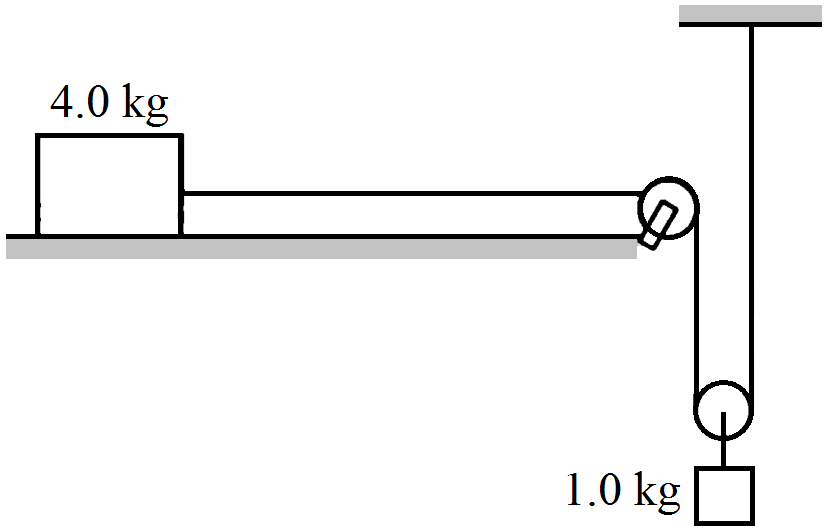
Consider the situation shown in figure. The system is released from rest and the block of mass $1.0kg$ is found to have a speed $0.3m/s$ after it has descended through a distance of $1m$. Find the coefficient of kinetic friction between the block and the table.
Find the components along the x, y, z axes of the angular momentum l of a particle, whose position vector is r with components x, y, z and momentum is p with components px, py and pz. Show that if the particle moves only in the x-y plane the angular momentum has only a z-component.