Question
What is meant by thermal radiation? What is the nature of thermal radiation? Explain.

Answer

SELF

Need a full question paper?

Generate a complete, print-ready paper with questions like this in minutes — across 16+ boards, with answer keys.

Start Generating Free

Similar questions

The $\text{K}_\beta$ X-rays from certain elements are given below. Draw a Moseley-type plot of $\sqrt{\text{v}}$ versus Z for $\text{K}_\beta$ radiation.
Element
Ne
P
Ca
Mn
Zn
Br
Energy (keV)
0.858
2.14
4.02
6.51
9.57
13.3
A thermally insulated, closed copper vessel contains water at $15^{\circ} C$. When the vessel is shaken vigorously for $15$ minutes, the temperature rises to $17^{\circ} C$. The .mass of the vessel is $100\ g$ and that of the water is $200\ g$ . The specific heat capacities of copper and water are $420 . kg ^{-1} K^{-1}$ and $4200\ Jkg ^{-1} K^{-1}$ respectively. Neglect any thermal expansion.
  1. How much heat is transferred to the liquid-vessel system?
  2. How much work has been done on this system?
  3. How much is the increase in internal energy of the system?
A quarterback, standing on his opponents 35-yard line, throws a football directly down field, releasing the ball at a height of 2.00 m above the ground with an initial velocity of $20.0 m / s$, directed $30.0^{\circ}$ above the horizontal.
i. How long does it take for the ball to cross the goal line, 32.0 m from the point of release?
ii. The ball is thrown too hard and so passes over the head of the intended receiver at the goal line. What is the ball's height above the ground as it crosses the goal line?
k transparent slabs are arranged one over another. The refractive indices of the slabs are $\mu_1,\mu_2,\mu_3, \ ...\mu_{\text{k}}$ and the thicknesses are $t_1, t_2, t_3, ... t_k$. An object is seen through this combination with nearly perpendicular light. Find the equivalent refractive index of the system which will allow the image to be formed at the same place.
A book with many printing errors contains four different formulas for the displacement $y$ of a particle undergoing a certain periodic motion:
  1. $\text{y}=\text{a}\sin2\pi\text{ t/T}$
  2. $\text{y}=\text{a}\sin \text{vt}$
  3. $\text{y}=(\text{a/T})\sin\text{t/a}$
  4. $\text{y}=(\text{a}\sqrt{2})(\sin2\pi\text{t/T}+\cos2\pi\text{t/T})$
$(a =$ maximum displacement of the particle, $v =$ speed of the particle. $T =$ time$-$period of motion$).$ Rule out the wrong formulas on dimensional grounds.
Steam at $120^{\circ} \mathrm{C}$ is continuously passed through a 50 cm long rubber tube of inner and outer radii 1.0 cm and 1.2 cm . The room temperature is $30^{\circ} \mathrm{C}$. Calculate the rate of heat flow through the walls of the tube. Thermal conductivity of rubber $=0.15 \mathrm{Js}^{-1} \mathrm{~m}^{-1^\circ} \mathrm{C}^{-1}$.
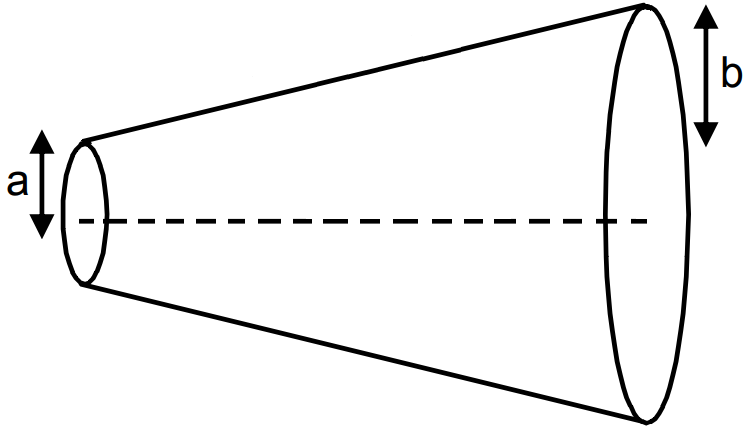
Figure. shows a conductor of length l with a circular cross-section. The radius of the cross-section varies linearly from a to b. The resistivity of the material is ρ. Assuming that b - a << l, find the resistance of the conductor.
Show that for a particle in linear S.H.M., the average kinetic energy over a period of oscillation is equal to the average potential energy over the same period. At what distance from the mean position is the kinetic energy in simple harmonic oscillator equal to potential energy?
Prove that the total speed of a particle in simple harmonic motion energy is directly proportional to the square of the particle's amplitude and the square of its frequency.
1 litre of an ideal gas $(\gamma=1.5)$ at $300K$ is suddenly compressed to half its original volume.
  1. Find the ratio of the final pressure to the initial pressure.
  2. If the original pressure is $100kPa$, find the work done by the gas in the process.
  3. What is the change in internal energy?
  4. What is the final temperature?
  5. The gas is now cooled to $300K$ keeping its pressure constant. Calculate the work done during the process.
  6. The gas is now expanded isothermally to achieve its original volume of $1$ litre. Calculate the work done by the gas.
  7. Calculate the total work done in the cycle.