Question
Prove the following trigonometric identities.
$\frac{\cos\text{A}}{1-\tan\text{A}}+\frac{\sin\text{A}}{1-\cot\text{A}}=\sin\text{A}+\cos\text{A}$
Answer

$\text{L.H.S}=\frac{\cos\text{A}}{1-\tan\text{A}}+\frac{\sin\text{A}}{\Big(1-\frac{1}{\tan\text{A}}\Big)}$
$=\frac{\cos\text{A}}{1-\tan\text{A}}-\frac{\sin\text{A}.\tan\text{A}}{1-\tan\text{A}}$
$\Rightarrow\ \frac{\cos\text{A}-\sin\text{A}\tan\text{A}}{(1-\tan\text{A})}$
$\Rightarrow\ \frac{\cos\text{A}-\sin\text{A}\times\frac{\sin\text{A}}{\cos\text{A}}}{1-\frac{\sin\text{A}}{\cos\text{A}}}$
$\Rightarrow\ \frac{\cos^2\text{A}-\sin^2\text{A}\cos\text{A}}{(\cos\text{A}-\sin\text{A})\cos\text{A}}$
$=\frac{(\cos\text{A}-\sin\text{A})(\cos\text{A}+\sin\text{A})}{\cos\text{A}-\sin\text{A}}$
$\Rightarrow\ \cos\text{A}+\sin\text{A}=\text{R.H.S}$
$\therefore \text{L.H.S}=\text{R.H.S}$

Need a full question paper?

Generate a complete, print-ready paper with questions like this in minutes — across 16+ boards, with answer keys.

Start Generating Free

Similar questions

In a quadrilateral $ABCD$, given that $\angle\text{A}+\angle\text{D}=90^\circ.$ Prove that $AC^2 + BD^2 = AD^2 + BC^2$.
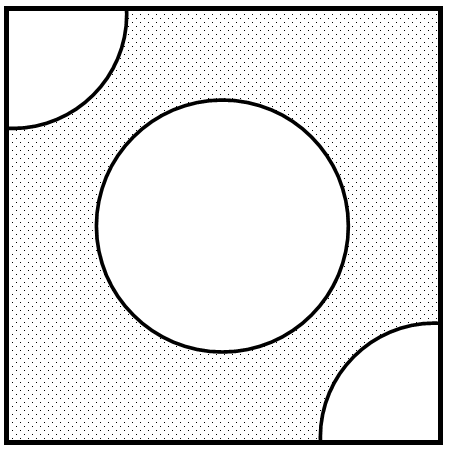
From each of the two opposite corners of a square of side $8\ cm$, a quadrant of a circle of radius $1.4\ cm$ is cut. Another circle of radius $4.2\ cm$ is also cut from the centre as shown in the following figure. Find the area of the remaining (Shaded) portion of the square.$\Big(\text{Use }\pi=\frac{22}{7}\Big)$

Solve the following quadratic equation:$x^2 + 6x - (a^2 + 2a - 8) = 0$
If $r_1$​​​​​​​ and $r_2​​​​​​​$​​​​​​​ denote the radii of the circular bases of the frustum of a cone such that $r_1 > r_2$​​​​​​​, then write the ratio of the height of the cone of which the frustum is a part to the height fo the frustum.
Solve the following simultaneous equation graphically.
x + y = 0; 2x – y = 9
Find the mean marks of the student from the following cumulative frequency distribution.
MarksBelow
10
Below
20
Below
30
Below
40
Below
50
Below
60
Below
70
Below
80
Below
90
No. of
students
5917294560707883
The sixth term of an A.P. is 5 times the $1^{\text {st }}$ term and the eleventh term exceeds twice the fifth term by 3. Find the $8^{\text {th }}$ term.
If $-4$ is a root of the quadratic equation $x^2 + 2x + 4p = 0$, find the value of $k$ for which the quadratic equation $x^2 + px(1 + 3k) + 7(3 + 2k) = 0$ has equal roots.
A bucket is frustum shaped. Its height is $28 \mathrm{~cm}$. Radii of circular faces are $12 \mathrm{~cm}$ and $15 \mathrm{~cm}$. Find the capacity of the bucket. $\left(\pi=\frac{22}{7}\right.$ )
Find the value of k for which the following systems of linear equations has an infinite number of solutions:
$5x + 2y = 2k,$
$2(k + 1)x + ky = (3k + 4).$