Question 13 Marks
Prove the following trigonometric identities.
$\frac{1+\cos\theta+\sin\theta}{1+\cos\theta-\sin\theta}=\frac{1+\sin\theta}{\cos\theta}$
AnswerWe have to prove the following identity-
$\frac{1+\cos\theta+\sin\theta}{1+\cos\theta-\sin\theta}=\frac{1+\sin\theta}{\cos\theta}$
Consider the L.H.S
$\text{L.H.S}=\frac{1+\cos\theta+\sin\theta}{1+\cos\theta-\sin\theta}$
$=\Big(\frac{1+\cos\theta+\sin\theta}{1+\cos\theta-\sin\theta}\Big)\Big(\frac{1+\cos\theta+\sin\theta}{1+\cos\theta+\sin\theta}\Big)$
$=\frac{(1+\cos\theta+\sin\theta)^2}{(1+\cos\theta)^2-\sin^2\theta}$
$=\frac{2+2(\cos\theta+\sin\theta+\sin\theta\cos\theta)}{2\cos^2\theta+2\cos\theta}$
$=\frac{2(1+\cos\theta)(1+\sin\theta)}{2\cos\theta(1+\cos\theta)}$
$=\frac{1+\sin\theta}{\cos\theta}=\text{R.H.S}$
$\therefore\ \text{L.H.S}=\text{R.H.S}$
View full question & answer→Question 23 Marks
If $\cos\text{A}=\frac{7}{25},$ find is the value of $\tan\text{A}+\cot\text{A}$.
Answer$\cos\text{A}=\frac{7}{25}$
$\sin\text{A}=\sqrt{1-\cos^2\text{A}}=\sqrt{1-\Big(\frac{7}{25}\Big)^2}$
$=\sqrt{1-\frac{49}{625}}=\sqrt{\frac{625-49}{625}}$
$=\sqrt{\frac{576}{625}}=\frac{24}{25}$
Now, $\tan\text{A}+\cot\text{A}=\frac{\sin\text{A}}{\cos\text{A}}+\frac{\cos\text{A}}{\sin\text{A}}$
$=\frac{\frac{24}{25}}{\frac{7}{25}}+\frac{\frac{7}{25}}{\frac{24}{25}}=\frac{24}{25}\times\frac{25}{7}+\frac{7}{25}\times\frac{25}{24}$
$=\frac{24}{7}+\frac{7}{24}$
$=\frac{576+49}{168}=\frac{625}{168}$
View full question & answer→Question 33 Marks
Prove the following trigonometric identities.
$\frac{\cot\text{A}+\tan\text{B}}{\cot\text{B}+\tan\text{A}}=\cot\text{A}\tan\text{B}$
AnswerWe have to prove $\frac{\cot\text{A}+\tan\text{B}}{\cot\text{B}+\tan\text{A}}=\cot\text{A}\tan\text{B}$
Now, $\frac{\cot\text{A}+\tan\text{B}}{\cot\text{B}+\tan\text{A}}=\frac{\cot\text{A}+\frac{1}{\cot\text{B}}}{\cot\text{B}+\frac{1}{\cot\text{A}}}$
$\text{L.H.S}=\frac{\cot\text{A}+\tan\text{B}}{\cot\text{B}+\tan\text{A}}$
$=\frac{\frac{\cot\text{A}\cot\text{B}+1}{\cot\text{B}}}{\frac{\cot\text{A}\cot\text{B}+1}{\cot\text{B}}}$
$=\frac{\cot\text{A}}{\cot\text{B}}$
$=\cot\text{A}\frac{1}{\cot\text{B}}$
$=\cot\text{A}\tan\text{B}=\text{R.H.S}$
$\therefore\ \text{L.H.S}=\text{R.H.S}$
View full question & answer→Question 43 Marks
If $\cot\theta=\frac{1}{\sqrt{3}},$ find the value of $\frac{1+\cos^2\theta}{2-\sin^2\theta}$.
AnswerGiven, $\cot\theta=\frac{1}{\sqrt3}$We have to find the value of the expression $\frac{1-\cos^2\theta}{2-\sin^2\theta}$
We know that, $1+\cot^2\theta=\text{cosec}^2\theta$ $\Rightarrow\text{cosec}^2\theta=1+\Big(\frac{1}{\sqrt3}\Big)^2$ $\Rightarrow\text{cosec}^2\theta=\frac{4}{3}$ Using the identity $\sin^2\theta+\cos^2\theta=1$, We have $\frac{1-\cos^2\theta}{2-\sin^2\theta}=\frac{\sin^2\theta}{2-\sin^2\theta}$ $=\frac{\frac{1}{\text{cosec}^2\theta}}{2-\frac{1}{\text{cosec}^2\theta}}$ $=\frac{1}{2\text{cosec}^2\theta}$ $$$=\frac{1}{2\times\frac{4}{3}-1}$ $=\frac{3}{5}$ Hence, the value of the given expression is $\frac{3}{5}$.
View full question & answer→Question 53 Marks
If $\text{cosec A}=\sqrt{2},$ find the value of $\frac{2\sin^2\text{A}+3\cot^2\text{A}}{4(\tan^2-\cos^2\text{A})}$.
AnswerWe know that $\cot\text{A}=\sqrt{\text{cosec}^2\text{A}-1}$
$=\sqrt{(2)^2-1}=\sqrt{2-1}$
$=-1$
$\tan\text{A}=\frac{1}{\text{cot}A}=\frac{1}{1}=1$
$\sin\text{A}=\frac{1}{\text{cosec}}\text{A}=\frac{1}{\sqrt{2}}\therefore\sin\text{A}=\frac{1}{\sqrt{2}}$
$\cos\text{A}=\sqrt{1-\sin^2\text{A}}$
$=\sqrt{1-\Big(\frac{1}{\sqrt{2}}\Big)^2}-\sqrt{\frac{1}{\sqrt{2}}}=\sqrt{\frac{1}{\sqrt{2}}}.$
On substituting we get
$\frac{2\Big[\frac{1}{\sqrt{2}}\Big]^3+3\big[1\big]^2}{4\Big[(1)-\big(\frac{1}{\sqrt{2}}\big)^2\Big]}=\frac{2=\frac{1}{2}+3}{4\Big[1-\frac{1}{2}\Big]}$
$\Rightarrow\frac{1+3}{4\times\frac{1}{2}}=\frac{4}{2}=2$
View full question & answer→Question 63 Marks
If $\text{cosec }\theta=2\text{x and }\cot\theta=\frac{2}{\text{x}},$ find is the value of $2\Big(\text{x}^2-\frac{1}{\text{x}^2}\Big)$.
Answer$\text{cosec }\theta=2\text{x and }\cot\theta=\frac{2}{\text{x}}$
$2\text{x}+\frac{2}{\text{x}}=\text{cosec }\theta+\cot\theta$
$2\Big(\text{x}+\frac{1}{\text{x}}\Big)=\text{cosec }\theta+\cot\theta$
$\Rightarrow\ \text{x}+\frac{1}{\text{x}}=\frac{1}{2}[\text{cosec }\theta+\cot\theta]$
$\text{and } \text{x}-\frac{1}{\text{x}}=\frac{1}{2}[\text{cosec }\theta-\cot\theta]$
Now, $2\Big(\text{x}^2-\frac{1}{\text{x}^2}\Big)=2\Big[\Big(\text{x}+\frac{1}{\text{x}}\Big)\Big(\text{x}-\frac{1}{\text{x}}\Big)\Big]$
$=2\Big[\frac{1}{2}(\text{cosec }\theta+\cot\theta)\times\frac{1}{2}(\text{cosec }\theta-\cot\theta)\Big]$
$=2\times\frac{1}{2}\times\frac{1}{2}\ [\text{cosec}^2\theta-\cot^2\theta]$
$=\frac{1}{2}\times1\ \{\because\ \text{cosec}^2\theta-\cot^2\theta=1\}$
$=\frac{1}{2}$
View full question & answer→Question 73 Marks
Prove the following trigonometric identities.
If $\cos\text{A}+\cos^2\text{A}=1,$ prove that $\sin^2\text{A}+\sin^4\text{A}=1.$
Answer$\cos\text{A}+\cos^2\text{A}=1$
$\cos\text{A}=1-\cos^2\text{A}$
$\cos\text{A}=\sin^2\text{A}$
$\text{L.H.S}=\sin^2\text{A}+\sin^4\text{A}$
$=\sin^2\text{A}+(\sin^2\text{A})^2$
$=\sin^2\text{A}+(\cos\text{A})^2$
$=\sin^2\text{A}+\cos^2\text{A}$
$=1=\text{R.H.S}$
$\therefore\ \text{L.H.S}=\text{R.H.S}$
View full question & answer→Question 83 Marks
Prove the following trigonometric identities.
$(1+\cot\text{A}-\text{cosec A})(1+\tan\text{A}+\sec\text{A})=2$
Answer$\text{L.H.S}=(1+\cot\text{A}-\text{cosec A})(1+\tan\text{A}+\sec\text{A})$
$=\Big(1+\frac{\cos\text{A}}{\sin\text{A}}-\frac{1}{\sin\text{A}}\Big)\Big(1+\frac{\sin\text{A}}{\cos\text{A}}+\frac{1}{\cos\text{A}}\Big)$
$=\Big(\frac{\sin\text{A}+\cos\text{A}-1}{\sin\text{A}}\Big)\Big(\frac{\cos\text{A}+\sin\text{A}+1}{\cos\text{A}}\Big)$
$=\frac{(\sin\text{A}+\cos\text{A})^2-1}{\sin\text{A}\cos\text{A}}$
$=\frac{1+2\sin\text{A}\cos\text{A}-1}{\sin\text{A}\cos\text{A}} \big[\because \sin^2\text{A}+\cos^2\text{A}=1\big]$
$=2=\text{R.H.S}$
$\therefore\ \text{L.H.S}=\text{R.H.S}$
View full question & answer→Question 93 Marks
Prove the following trigonometric identities.
$\frac{\cos\text{A cosec A}-\sin\text{A}\sec\text{A}}{\cos\text{A}+\sin\text{A}}=\text{cosec A}-\sec\text{A}$
AnswerWe have to prove $\frac{\cos\text{A cosec A}-\sin\text{A}\sec\text{A}}{\cos\text{A}+\sin\text{A}}=\text{cosec A}-\sec\text{A}$
So,
$\text{L.H.S}=\frac{\cos\text{A cosec A}-\sin\text{A}\sec\text{A}}{\cos\text{A}+\sin\text{A}}=\frac{\cos\text{A}\frac{1}{\sin\text{A}}-\sin\text{A}\frac{1}{\cos\text{A}}}{\cos\text{A}+\sin\text{A}}$
$=\frac{\frac{\cos^2\text{A}-\sin^2\text{A}}{\sin\text{A}\cos\text{A}}}{\cos\text{A}+\sin\text{A}}$
$=\frac{\cos^2\text{A}-\sin^2\text{A}}{\sin\text{A}\cos\text{A}(\cos\text{A}+\sin\text{A})}$
$=\frac{(\cos\text{A}-\sin\text{A})(\cos\text{A}+\sin\text{A})}{\sin\text{A}\cos\text{A}(\cos\text{A}+\sin\text{A})}$
$=\frac{\cos\text{A}-\sin\text{A}}{\sin\text{A}\cos\text{A}}$
$=\frac{\cos\text{A}}{\sin\text{A}\cos\text{A}}-\frac{\sin\text{A}}{\sin\text{A}\cos\text{A}}$
$=\frac{1}{\sin\text{A}}-\frac{1}{\cos\text{A}}$
$=\text{cosec A}-\sec\text{A}=\text{R.H.S}$
$\therefore\ \text{L.H.S}=\text{R.H.S}$
View full question & answer→Question 103 Marks
Prove the following trigonometric identities.
$\frac{\tan\text{A}}{(1+\tan^2\text{A})^2}+\frac{\cot\text{A}}{(1+\cot^2\text{A})}=\sin\text{A}\cos\text{A}$
AnswerWe have to prove $\frac{\tan\text{A}}{(1+\tan^2\text{A})^2}+\frac{\cot\text{A}}{(1+\cot^2\text{A})}=\sin\text{A}\cos\text{A}$
We know that, $\sin^2\text{A}+\cos^2\text{A}=1$
So,
$\text{L.H.S}=\frac{\tan\text{A}}{(1+\tan^2\text{A})^2}+\frac{\cot\text{A}}{(1+\cot^2\text{A})}$
$=\frac{\tan\text{A}}{(\sec^2\text{A})^2}+\frac{\cot\text{A}}{(\text{cosec}^2\text{A})^2}$
$=\frac{\tan\text{A}}{\sec^4\text{A}}+\frac{\cot\text{A}}{\text{cosec}^4\text{A}}$
$=\frac{\frac{\sin\text{A}}{\cos\text{A}}}{\frac{1}{\cos^4\text{A}}}+\frac{\frac{\cos\text{A}}{\sin\text{A}}}{\frac{1}{\sin^4\text{A}}}$
$=\frac{\sin\text{A}\cos^4\text{A}}{\cos\text{A}}+\frac{\cos\text{A}\sin^4\text{A}}{\sin\text{A}}$
$=\sin\text{A}\cos^3\text{A}+\cos\text{A}\sin^3\text{A}$
$=\sin\text{A}\cos\text{A}(\cos^2\text{A}+\sin^2\text{A})$
$=\sin\text{A}\cos\text{A}=\text{R.H.S}$
$\therefore\ \text{L.H.S}=\text{R.H.S}$
View full question & answer→Question 113 Marks
Prove the following trigonometric identities.
$\sqrt{\frac{1+\sin\theta}{1-\sin\theta}}+\sqrt{\frac{1-\sin\theta}{1+\sin\theta}}=2\sec\theta$
AnswerWe have
$\text{L.H.S}=\sqrt{\frac{1+\sin\theta}{1-\sin\theta}}+\sqrt{\frac{1-\sin\theta}{1+\sin\theta}}=\frac{\sqrt{1+\sin\theta}}{\sqrt{1-\sin\theta}}+\frac{\sqrt{1-\sin\theta}}{\sqrt{1+\sin\theta}}$
$=\frac{\sqrt{1+\sin\theta}\sqrt{1+\sin\theta}+\sqrt{1-\sin\theta}\sqrt{1-\sin\theta}}{\sqrt{1-\sin\theta}\sqrt{1+\sin\theta}}$
$=\frac{(\sqrt{1+\sin\theta})^2+(\sqrt{1-\sin\theta})^2}{\sqrt{(1-\sin\theta)(1+\sin\theta)}}$
$=\frac{1+\sin\theta+1-\sin\theta}{\sqrt{1-\sin^2\theta}}$
$=\frac{2}{\sqrt{\cos^2\theta}}$
$=\frac{2}{\cos\theta}$
$=2\sec\theta=\text{R.H.S}$
$\therefore\ \text{L.H.S}=\text{R.H.S}$
View full question & answer→Question 123 Marks
Prove the following trigonometric identities.
$(\text{sec}\text{A}-\tan\text{A})^2=\frac{1-\sin\text{A}}{1+\sin\text{A}}$
Answer$\text{L.H.S}=(\sec\text{A}-\tan\text{A})^2$
$\Rightarrow\ \Big[\frac{1}{\cos\text{A}}-\frac{\sin\text{A}}{\cos\text{A}}\Big]^2\Rightarrow\ \frac{(1-\sin\text{A})^2}{\cos^2\text{A}}$
$\Rightarrow\ \frac{(1-\sin\text{A})^2}{1-\sin^2\text{A}} \big[\because\ 1-\sin^2\text{A}=\cos^2\text{A}\big]$
$\Rightarrow\ \frac{(1-\sin\text{A})^2}{(1-\sin\text{A})(1+\sin\text{A})} \big[\because \text{a}^2-\text{b}^2=(\text{a}-\text{b})(\text{a}+\text{b})\big]$
$=\frac{1-\sin\text{A}}{1+\sin\text{A}}$
$\therefore \text{L.H.S}=\text{R.H.S}$
Hence proved.
View full question & answer→Question 133 Marks
Prove the following trigonometric identities.
$\cot\theta-\tan\theta=\frac{2\cos^2\theta-1}{\sin\theta\cos\theta}$
Answer$\text{R.H.S}=\frac{2\cos^2\theta-1}{\sin\theta\cos\theta}$
$=\frac{2\cos^2\theta-(\sin^2\theta+\cos^2\theta)}{\sin\theta\cos\theta}$
$=\frac{2\cos^2\theta-\sin^2\theta-\cos^2\theta}{\sin\theta\cos\theta} $
$=\frac{\cos^2\theta-\sin^2\theta}{\sin\theta\cos\theta}$
$=\frac{\cos^2\theta}{\sin\theta\times\cos\theta}-\frac{\sin^2\theta}{\sin\theta\times\cos\theta}$
$=\frac{\cos\theta}{\sin\theta}-\frac{\sin\theta}{\cos\theta}$
$=\cot\theta-\tan\theta=\text{L.H.S}$
$\therefore\ \text{L.H.S}=\text{R.H.S}$
View full question & answer→Question 143 Marks
Prove the following trigonometric identities.
$\frac{1+\tan^2\theta}{1+\cot^2\theta}=\Big(\frac{1-\tan\theta}{1-\cot\theta}\Big)^2=\tan^2\theta$
Answer$\text{L.H.S}\Rightarrow\ \frac{1+\tan^2\theta}{1+\cot^2\theta}=\frac{\sec^2\theta}{\text{cosec}^2\theta}$
$\big[\because \tan^2\theta+1=\sec^2\theta,\ 1+\cot^2\theta=\text{cosec}^2\theta\big]$
$=\frac{1}{\cos^2\theta\times1}\ \sin^2=\tan^2\theta$
$\Rightarrow\ \Big[\frac{1-\tan\theta}{1-\cot\theta}\Big]^2\Rightarrow\ \Bigg[\frac{1-\tan\theta}{1-\frac{1}{\tan\theta}}\Bigg]^2$
$\Rightarrow\ \Big[\frac{1-\tan\theta}{(1-\tan\theta)}\times\tan\theta\Big]^2=\tan^2\theta$
$\therefore\ \text{L.H.S}=\text{R.H.S}$
Hence proved.
View full question & answer→Question 153 Marks
If $\text{x}=\text{a}\sin\theta\text{ and y}=\text{b}\cos\theta,$ what is the value pf $b^2x^2 + a^2y^2$?
Answer$\text{x}=\text{a}\sin\theta,\text{y}=\text{b}\cos\theta$
$\frac{\text{x}}{\text{a}}=\sin\theta,\frac{\text{y}}{\text{b}}=\cos\theta$
Squaring and adding we get,
$\therefore\ \frac{\text{x}^2}{\text{a}^2}=\sin^2\theta,\frac{\text{y}^2}{\text{b}^2}=\cos^2\theta$
$\frac{\text{x}^2}{\text{a}^2}+\frac{\text{y}^2}{\text{b}^2}=\sin^2\theta+\cos^2\theta$
$\Rightarrow\ \frac{\text{x}^2}{\text{a}^2}+\frac{\text{y}^2}{\text{b}^2}=1$
$\Rightarrow\ \frac{\text{b}^2\text{x}^2+\text{a}^2\text{y}^2}{\text{a}^2\text{b}^2}=1\Rightarrow\ \text{b}^2\text{x}^2+\text{a}^2\text{y}^2=\text{a}^2\text{b}^2$
$\therefore\ \text{b}^2\text{x}^2+\text{a}^2\text{y}^2=\text{a}^2\text{b}^2$
View full question & answer→Question 163 Marks
Prove the following trigonometric identities.
$\sqrt{\frac{1+\cos\theta}{1-\cos\theta}}+\sqrt{\frac{1-\cos\theta}{1+\cos\theta}}=2\text{cosec }\theta$
AnswerWe have
$\text{L.H.S}=\sqrt{\frac{1+\cos\theta}{1-\cos\theta}}+\sqrt{\frac{1-\cos\theta}{1+\cos\theta}}=\frac{\sqrt{1+\cos\theta}}{\sqrt{1-\cos\theta}}+\frac{\sqrt{1-\cos\theta}}{\sqrt{1+\cos\theta}}$
$=\frac{\sqrt{1+\cos\theta}\sqrt{1+\cos\theta}+\sqrt{1-\cos\theta}\sqrt{1-\cos\theta}}{\sqrt{1-\cos\theta}\sqrt{1+\cos\theta}}$
$=\frac{(\sqrt{1+\cos\theta})^2+(\sqrt{1-\cos\theta})^2}{\sqrt{(1-\cos\theta)(1+\cos\theta)}}$
$=\frac{1+\cos\theta+1-\cos\theta}{\sqrt{1-\cos^2\theta}}$
$=\frac{2}{\sqrt{\sin^2\theta}}$
$=\frac{2}{\sin\theta}$
$=2\text{cosec }\theta=\text{R.H.S}$
$\therefore\ \text{L.H.S}=\text{R.H.S}$
View full question & answer→Question 173 Marks
If $\tan\theta=\frac{12}{5},$ find the value of $\frac{1+\sin\theta}{1-\sin\theta}$.
AnswerWe have, $\tan\theta=\frac{12}{5}$
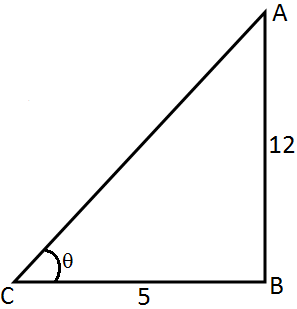
In $\triangle\text{ABC},$
$\text{AC}^2=\text{AB}^2+\text{BC}^2$
$\Rightarrow\ \text{AC}^2=(12)^2+(5)^2$
$\Rightarrow\ \text{AC}^2=144+25$
$\Rightarrow\ \text{AC}^2=169$
$\Rightarrow\ \text{AC}=13$
$\therefore\ \sin\theta=\frac{\text{AB}}{\text{AC}}=\frac{12}{13}$
Now, $\frac{1+\sin\theta}{1-\sin\theta}=\frac{1+\frac{12}{13}}{1-\frac{12}{13}}$
$=\frac{13+12}{13-12}$
$=25$ View full question & answer→Question 183 Marks
Prove the following trigonometric identities.
$\frac{(1+\sin\theta)^2+(1-\sin\theta)^2}{2\cos^2\theta}=\frac{1+\sin^2\theta}{1-\sin^2\theta}$
AnswerWe have to prove that, $\frac{(1+\sin\theta)^2+(1-\sin\theta)^2}{2\cos^2\theta}=\frac{1+\sin^2\theta}{1-\sin^2\theta}$
We know that, $\sin^2\theta+\cos^2\theta=1$
So,
$\text{L.H.S}=\frac{(1+\sin\theta)^2+(1-\sin\theta)^2}{2\cos^2\theta}=\frac{(1+2\sin\theta+\sin^2\theta)+(1-2\sin\theta+\sin^2\theta)}{2\cos^2\theta}$
$=\frac{1+2\sin\theta+\sin^2\theta+1-2\sin\theta+\sin^2\theta}{2\cos^2\theta}$
$=\frac{2+2\sin^2\theta}{2\cos^2\theta}$
$=\frac{2(1+\sin^2\theta)}{2(1-\sin^2\theta)}$
$=\frac{1+\sin^2\theta}{1-\sin^2\theta}=\text{R.H.S}$
$\therefore\ \text{L.H.S.}=\text{R.H.S}$
View full question & answer→Question 193 Marks
Prove the following trigonometric identities.
$\sqrt{\frac{\sec\theta-1}{\sec\theta+1}}+\sqrt{\frac{\sec\theta+1}{\sec\theta-1}}=2 \text{cosec }\theta$
AnswerWe have,
$\text{L.H.S}=\sqrt{\frac{\sec\theta-1}{\sec\theta+1}}+\sqrt{\frac{\sec\theta+1}{\sec\theta-1}}=\frac{\sqrt{\sec\theta-1}}{\sqrt{\sec\theta+1}}+\frac{\sqrt{\sec\theta+1}}{\sqrt{\sec\theta-1}}$
$=\frac{\sqrt{\sec\theta-1}\sqrt{\sec\theta-1}+\sqrt{\sec\theta+1}\sqrt{\sec\theta+1}}{\sqrt{\sec\theta+1}\sqrt{\sec\theta-1}}$
$=\frac{(\sqrt{\sec\theta-1})^2+(\sqrt{\sec\theta+1})^2}{\sqrt{(\sec\theta-1)(\sec\theta+1)}}$
$=\frac{\sec\theta-1+\sec\theta+1}{\sqrt{\sec^2\theta-1}}$
$=\frac{2\sec\theta}{\sqrt{\tan^2\theta}}$
$=\frac{2\sec\theta}{\tan\theta}$
$=\frac{2\frac{1}{\cos\theta}}{\frac{\sin\theta}{\cos\theta}}$
$=2\frac{1}{\sin\theta}$
$=2\text{cosec }\theta=\text{R.H.S}$
$\therefore\ \text{L.H.S}=\text{R.H.S}$
View full question & answer→Question 203 Marks
Prove the following trigonometric identities.
$\sec\text{A}(1-\sin\text{A})(\sec\text{A}+\tan\text{A})=1$
Answer$\text{L.H.S.}=\sec\text{A}(1-\sin\text{A})(\sec\text{A}+\tan\text{A})$
$=\frac{1}{\cos\text{A}}(1-\sin\text{A})\Big(\frac{1}{\cos\text{A}}+\frac{\sin\text{A}}{\cos\text{A}}\Big)$
$=\Big(\frac{1-\sin\text{A}}{\cos\text{A}}\Big)\Big(\frac{1+\sin\text{A}}{\cos\text{A}}\Big)$
$=\frac{1-\sin^2\text{A}}{\cos^2\text{A}}=\frac{\cos^2\text{A}}{\cos^2\text{A}}$
$=1=\text{R.H.S.}$
View full question & answer→Question 213 Marks
Prove the following trigonometric identities.
$\tan\theta-\cot\theta=\frac{2\sin^2\theta-1}{\sin\theta\cos\theta}$
Answer$\text{R.H.S}=\frac{2\sin^2\theta-1}{\sin\theta\times\cos\theta}$
$=\frac{2\sin^2\theta-(\sin^2\theta+\cos^2\theta)}{\sin\theta\times\cos\theta}$
$=\frac{\sin^2\theta-\cos^2\theta}{\sin\theta\cos\theta}$
$=\frac{\sin^2\theta}{\sin\theta\cos\theta}-\frac{\cos^2\theta}{\sin\theta\cos\theta}$
$=\frac{\sin\theta}{\cos\theta}-\frac{\cos\theta}{\sin\theta}$
$=\tan\theta-\cot\theta=\text{L.H.S}$
$\therefore\ \text{L.H.S}=\text{R.H.S}$
View full question & answer→Question 223 Marks
Prove the following trigonometric identities.
$\frac{\tan\text{A}+\tan\text{B}}{\cot\text{A}+\cot\text{B}}=\tan\text{A}\tan\text{B}$
Answer$\text{L.H.S}=\frac{\tan\text{A}+\tan\text{B}}{\cot\text{A}+\cot\text{B}}$
$=\frac{\frac{\sin\text{A}}{\cos\text{A}}+\frac{\sin\text{B}}{\cos\text{B}}}{\frac{\cos\text{A}}{\sin\text{A}}+\frac{\cos\text{B}}{\sin\text{B}}}$
$=\frac{\frac{\sin\text{A}\cos\text{B}+\cos\text{A}\sin\text{B}}{(\cos\text{A}\cos\text{B})}}{\frac{\cos\text{A}\sin\text{B}+\sin\text{A}\cos\text{B}}{\sin\text{A}\sin\text{B}}}$
$=\frac{\sin\text{A}\cos\text{B}+\cos\text{A}\sin\text{B}}{\cos\text{A}\cos\text{B}}\times\frac{\sin\text{A}\sin\text{B}}{\cos\text{A}\sin\text{B}+\cos\text{B}\sin\text{A}}$
$=\frac{\sin\text{A}\sin\text{B}}{\cos\text{A}\cos\text{B}}$
$=\tan\text{A}\cdot\tan\text{B}=\text{R.H.S}$
$\therefore\ \text{L.H.S}=\text{R.H.S}$
View full question & answer→Question 233 Marks
Prove the following trigonometric identities.
$\frac{1}{1+\sin\text{A}}+\frac{1}{1-\sin\text{A}}=2\sec^2\text{A}$
Answer$\text{L.H.S}=\frac{1-\sin\text{A}+1+\sin\text{A}}{(1+\sin\text{A})(1-\sin\text{A})}$
$\Rightarrow\ \frac{2}{1-\sin^2\text{A}} \big[\because (1+\sin\text{A})(1-\sin\text{A})=1-\sin^2\text{A}\big]$
$\Rightarrow\ \frac{2}{\cos^2\text{A}}\Rightarrow 2\sec^2\text{A} \big[\because 1-\sin\text{A}=\cos\text{A}\big]$
$\therefore\ \text{L.H.S}=\text{R.H.S}$
Hence proved
View full question & answer→Question 243 Marks
Prove the following trigonometric identities.
$\frac{\cos\text{A}}{1-\tan\text{A}}+\frac{\sin\text{A}}{1-\cot\text{A}}=\sin\text{A}+\cos\text{A}$
Answer$\text{L.H.S}=\frac{\cos\text{A}}{1-\tan\text{A}}+\frac{\sin\text{A}}{\Big(1-\frac{1}{\tan\text{A}}\Big)}$
$=\frac{\cos\text{A}}{1-\tan\text{A}}-\frac{\sin\text{A}.\tan\text{A}}{1-\tan\text{A}}$
$\Rightarrow\ \frac{\cos\text{A}-\sin\text{A}\tan\text{A}}{(1-\tan\text{A})}$
$\Rightarrow\ \frac{\cos\text{A}-\sin\text{A}\times\frac{\sin\text{A}}{\cos\text{A}}}{1-\frac{\sin\text{A}}{\cos\text{A}}}$
$\Rightarrow\ \frac{\cos^2\text{A}-\sin^2\text{A}\cos\text{A}}{(\cos\text{A}-\sin\text{A})\cos\text{A}}$
$=\frac{(\cos\text{A}-\sin\text{A})(\cos\text{A}+\sin\text{A})}{\cos\text{A}-\sin\text{A}}$
$\Rightarrow\ \cos\text{A}+\sin\text{A}=\text{R.H.S}$
$\therefore \text{L.H.S}=\text{R.H.S}$
View full question & answer→Question 253 Marks
Prove the following trigonometric identities.
$\frac{\cos\theta-\sin\theta+1}{\cos\theta+\sin\theta-1}=\text{cosec}\theta+\cot\theta$
Answer$\text{L.H.S}=\frac{\cos\theta-\sin\theta+1}{\cos\theta+\sin\theta-1}$
$=\frac{\frac{\cos\theta}{\sin\theta}-\frac{\sin\theta}{\sin\theta}+\frac{1}{\sin\theta}}{\frac{\cos\theta}{\sin\theta}+\frac{\sin\theta}{\sin\theta}-\frac{1}{\sin\theta}}$
$=\frac{\cot\theta-1+\text{cosec}\theta}{\cot\theta+1-\text{cosec}\theta}$
$=\frac{\cot\theta+\text{cosec}\theta-(\text{cosec}^2\theta-\cot^2\theta)}{(\cot\theta-\text{cosec}\theta+1)}$
$=\frac{\cot\theta+\text{cosec}\theta(1-\text{cosec}\theta+\cot\theta)}{(1-\text{cosec}\theta+\cot\theta)}$
$=\cot\theta+\text{cosec }\theta$
$=\text{R.H.S}$
$\therefore \text{L.H.S}=\text{R.H.S}$
View full question & answer→Question 263 Marks
Prove the following trigonometric identities.
$(\sec\text{A}+\tan\text{A}-1)(\sec\text{A}-\tan\text{A}+1)=2\tan\text{A}$
AnswerWe have to prove $(\sec\text{A}+\tan\text{A}-1)(\sec\text{A}-\tan\text{A}+1)=2\tan\text{A}$
We know that, $\sec^2\text{A}-\tan^2\text{A}=1$
So, we have
$\text{L.H.S}=(\sec\text{A}+\tan\text{A}-1)(\sec\text{A}-\tan\text{A}+1)$
$=\{\sec\text{A}+\tan\text{A}\}\{\sec\text{A}-(\tan\text{A}-1)\}$
$=\sec^2\text{A}-(\tan\text{A}-1)^2$
$=\sec^2\text{A}(\tan^2\text{A}-2\tan\text{A}+1)$
$=(\sec^2\text{A}-\tan^2\text{A})+2\tan\text{A}-1$
So, we have
$(\sec\text{A}+\tan\text{A}-1)(\sec\text{A}-\tan\text{A}+1)$
$=1 + 2\tan\text{A}-1$
$= 2\tan\text{A}=\text{R.H.S}$
$\therefore\ \text{L.H.S}=\text{R.H.S}$
View full question & answer→Question 273 Marks
If $5\text{x}=\sec\theta\text{ and }\frac{5}{\text{x}}=\tan\theta,$ find is the value of $5\Big(\text{x}^2-\frac{1}{\text{x}^2}\Big)$.
AnswerIf $5\text{x}=\sec\theta,\frac{5}{\text{x}}=\tan\theta$
$5\text{x}+\frac{5}{\text{x}}=\sec\theta+\tan\theta$
$5\Big(\text{x}+\frac{1}{\text{x}}\Big)=\sec\theta+\tan\theta$
$\text{x}+\frac{1}{\text{x}}=\frac{1}{5}(\sec\theta+\tan\theta)$
$\text{and }\text{x}-\frac{1}{\text{x}}=\frac{1}{5}(\sec\theta-\tan\theta)$
Now, $5\Big(\text{x}^2-\frac{1}{\text{x}^2}\Big)=5\Big(\text{x}+\frac{1}{\text{x}}\Big)\Big(\text{x}-\frac{1}{\text{x}}\Big)$
$=5\Big[\frac{1}{5}(\sec\theta+\tan\theta)(\sec\theta-\tan\theta)\Big]$
$=5\times\frac{1}{25}(\sec^2\theta-\tan^2\theta)$
$=\frac{1}{5}[1]\ (\because \ \sec^2\theta-\tan^2\theta=1)$
$=\frac{1}{5}$
View full question & answer→Question 283 Marks
Prove the following trigonometric identities.
$\Big(\tan\theta+\frac{1}{\cos\theta}\Big)^2+\Big(\tan\theta-\frac{1}{\cos\theta}\Big)^2=2\Big(\frac{1+\sin^2\theta}{1-\sin\theta}\Big)$
Answer$\text{L.H.S}=\Big(\tan\theta+\frac{1}{\cos\theta}\Big)^2+\Big(\tan\theta-\frac{1}{\cos\theta}\Big)^2$
$\Rightarrow\ (\tan\theta+\sec\theta)^2+(\tan\theta-\sec\theta)^2$
$=\tan^2\theta+\sec^2\theta+2\tan\theta\sec\theta+\tan^2\theta+\sec^2\theta-2\tan\theta\sec\theta$
$=2\tan^2\theta+2\sec^2\theta$
$=2\big[\tan^2\theta+\sec^2\theta\big]$
$=2\Big[\frac{\sin^2\theta}{\cos^2\theta}+\frac{1}{\cos^2\theta}\Big]$
$=2\Big(\frac{1+\sin^2\theta}{\cos^2\theta}\Big)=\text{R.H.S}$
$\therefore\ \text{L.H.S}=\text{R.H.S}$
View full question & answer→Question 293 Marks
If $\cot\theta=\sqrt{3},$ find the value of $\frac{\text{cosec}^2\theta+\cot^2\theta}{\text{cosec}^2\theta-\sec^2\theta}$.
AnswerWe have, $\cot\theta=\sqrt{3}$
In $\triangle\text{ABC},$
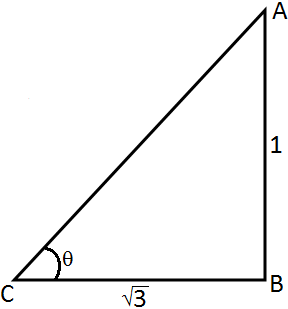
$\text{AC}^2=\text{AB}^2+\text{BC}^2$
$\Rightarrow\ \text{AC}^2=(1)^2+(\sqrt{3})^2$
$\Rightarrow\ \text{AC}^2=4$
$\Rightarrow\ \text{AC}=2$
$\therefore\ \text{cosec }\theta=\frac{\text{AC}}{\text{AB}}=2,\cot\theta=\frac{\text{BC}}{\text{AB}}=\sqrt{3},\sec\theta=\frac{\text{AC}}{\text{BC}}=\frac{2}{\sqrt{3}}$
Now, $\frac{\text{cosec}^2\theta+\cot^2\theta}{\text{cosec}^2\theta-\sec^2\theta}=\frac{(2)^3+(\sqrt{3})^2}{(2)^2-\Big(\frac{2}{\sqrt{3}}\Big)^2}$
$=\frac{4+3}{4-\frac{4}{3}}$
$=\frac{7}{\frac{12-4}{3}}$
$=\frac{21}{8}$ View full question & answer→Question 303 Marks
$\sqrt{\frac{1-\cos\text{A}}{1+\cos\text{A}}}+\sqrt{\frac{1+\cos\text{A}}{1-\cos\text{A}}}=2\text{cosec }\text{A}$
Answer$\text{L.H.S}=\sqrt{\frac{1-\cos\text{A}}{1+\cos\text{A}}}+\sqrt{\frac{1+\cos\text{A}}{1-\cos\text{A}}}$
$=\sqrt{\frac{(1-\cos\text{A})(1-\cos\text{A})}{(1+\cos\text{A})(1-\cos\text{A})}}+\sqrt{\frac{(1+\cos\text{A})(1+\cos\text{A})}{(1-\cos\text{A})(1+\cos\text{A})}}$
$=\sqrt{\frac{(1-\cos \text{A})^2}{1-\cos^2\text{A}}}+\sqrt{\frac{(1+\cos\text{A})^2}{1-\cos^2\text{A}}}$
$=\sqrt{\frac{(1-\cos \text{A})^2}{\sin^2\text{A}}}+\sqrt{\frac{(1+\cos\text{A})^2}{\sin^2\text{A}}}$
$\{\because 1-\cos^2\text{A}=\sin^2\text{A}\}$
$=\frac{1-\cos\text{A}}{\sin\text{A}}+\frac{1+\cos\text{A}}{\sin\text{A}}$
$=\frac{1-\cos\text{A}+1+\cos\text{A}}{\sin\text{A}}=\frac{2}{\sin\text{A}}$
$=2\text{cosec A}=\text{R.H.S}$
$\therefore\ \text{L.H.S}=\text{R.H.S}$
View full question & answer→Question 313 Marks
Prove the following trigonometric identities.
If $\text{x}=\text{a}\sec\theta+\text{b}\tan\theta\text{ and y}=\text{a}\tan\theta+\text{b}\sec\theta,$ prove that $x^2 - y^2 = a^2 - b^2$.
Answer$\text{L.H.S}=\text{x}^2-\text{y}^2$
$=(\text{a}\sec\theta+\text{b}\tan\theta)^2-(\text{a}\tan\theta+\text{b}\sec\theta)^2$
$=\text{a}^2\sec^2+\text{b}^2\tan^2\theta+2\text{ab}\sec\theta\tan\theta$
$=-\text{a}^2\tan^2\theta-\text{b}^2\sec\theta-2\text{ab}\sec\theta\tan\theta$
$=\text{a}^2-\sec^2\theta-\text{b}^2\sec^2+\text{b}^2\tan^2\theta-\text{a}^2\tan^2\theta$
$=\sec^2\theta(\text{a}^2-\text{b}^2)+\tan^2\theta(\text{b}^2-\text{a}^2)$
$=\sec^2\theta(\text{a}^2-\text{b}^2)-\tan^2\theta(\text{a}^2-\text{b}^2)$
$=(\text{a}^2-\text{b}^2)(\sec^2\theta-\tan^2\theta) \big[\because\ \sec^2\theta-\tan^2\theta=1\big]$
$=\text{a}^2-\text{b}^2=\text{R.H.S}$
$\therefore\ \text{L.H.S}=\text{R.H.S}$
View full question & answer→Question 323 Marks
If $3\cos\theta=1,$ find the value of $\frac{6\sin^2\theta+\tan^2\theta}{4\cos\theta}$.
AnswerGiven, $3\cos\theta=1$
We have to find the value of the expession $\frac{6\sin^2\theta+\tan^2\theta}{4\cos\theta}$
We have,
$3\cos\theta=1$
$\Rightarrow\ \cos\theta=\frac{1}{3}$
$\sin\theta=\sqrt{1-\cos^2\theta}=\sqrt{1-\Big(\frac{1}{3}\Big)^2}=\frac{\sqrt{8}}{3}$
$\tan\theta=\frac{\sin\theta}{\cos\theta}=\frac{\frac{\sqrt{8}}{3}}{\frac{1}{3}}=\sqrt{8}$
Therefore,
$\frac{6\sin^2\theta+\tan^2\theta}{4\cos\theta}=\frac{6\times\Big(\frac{\sqrt{8}}{3}\Big)^2+\big(\sqrt{8}\big)^2}{4\times\frac{1}{3}}$
$=10$
Hence, the value of the expression is 10.
View full question & answer→Question 333 Marks
If $\cos\theta=\frac{4}{5},$ find all other trigonometric rations of angle $\theta$.
AnswerWe have $\sin\theta=\sqrt{1-\cos^2\theta}=\sqrt{1-\Big(\frac{4}{5}\Big)^2}$
$=\sqrt{1-\frac{16}{25}}$
$=\sqrt{25-\frac{16}{25}}$
$=\sqrt{\frac{9}{25}}=\frac{3}{5}$
$\therefore\ \sin\theta=\frac{3}{5}$
$\tan\theta=\frac{\sin\theta}{\cos\theta}=\frac{\frac{3}{5}}{\frac{4}{5}}$
$=\frac{3}{4}\sec\theta=\frac{1}{\cos\theta}=\frac{1}{\frac{4}{5}}=\frac{5}{4}$
$\text{cosec}=\frac{1}{\sec\theta}=\frac{1}{\frac{3}{5}}$
$=\frac{5}{3}\cot\theta=\frac{1}{\tan\theta}=\frac{1}{\frac{3}{4}}=\frac{4}{3}$
View full question & answer→Question 343 Marks
Prove the following trigonometric identities.
If $\text{a }\cos^3\theta+3\text{a}\cos\theta\sin^2\theta=\text{m, a }\sin^3\theta+3\text{a}\cos^2\theta\sin\theta=\text{n},$ prove that $(\text{m}+\text{n})^\frac{2}{3}+(\text{m}-\text{n})^\frac{2}{3}=2\text{a}^\frac{2}{3}.$
AnswerGiven that,
$\text{a}\cos^3\theta+3\text{a}\cos\theta\sin^2\theta=\text{m},$
$\text{a}\sin^3\theta+3\text{a}\cos^2\theta\sin\theta=\text{n}$
We have to prove $(\text{m}+\text{n})^\frac{2}{3}+(\text{m}-\text{n})^\frac{2}{3}=2\text{a}^\frac{2}{3}$
Adding both the equations, we get
$\text{m}+\text{n}=\text{a}\cos^3\theta+3\text{a}\cos\theta\sin^2\theta+\text{a}\sin^3\theta+3\text{a}\cos^2\theta\sin\theta$
$=\text{a}(\cos^3\theta+3\cos^2\theta\sin\theta+3\cos\theta\sin^2+\sin^3\theta)$
$=\text{a}(\cos\theta+\sin\theta)^3$
Also.
$\text{m}-\text{n}=\text{a}\cos^3\theta+3\text{a}\cos\theta\sin^2\theta-(\text{a}\sin^3\theta+3\text{a}\cos^2\theta\sin\theta)$
$=\text{a}(\cos^3\theta-3\cos^2\theta\sin\theta+3\cos\theta\sin^2-\sin^3\theta)$
$=\text{a}(\cos\theta-\sin\theta)^3$
Therefore, we have
$\text{L.H.S}=(\text{m}+\text{n})^\frac{2}{3}+(\text{m}-\text{n})^\frac{2}{3}$
$=\text{a}^\frac{2}{3}(\cos\theta+\sin\theta)^2+\text{a}^\frac{2}{3}(\cos\theta-\sin\theta)^2$
$=\text{a}^\frac{2}{3}\{(\cos\theta+\sin\theta)^2+(\cos\theta-\sin\theta)^2\}$
$=\text{a}^\frac{2}{3}\{(\cos^2\theta+2\cos\theta\sin\theta+\sin^2\theta)+(\cos^2\theta-2\cos\theta\sin\theta+\sin^2\theta)\}$
$=\text{a}^\frac{2}{3}\{(\cos^2\theta+\sin^2\theta+2\cos\theta\sin\theta)+(\cos^2\theta+\sin^2\theta-2\cos\theta\sin\theta)\}$
$=\text{a}^\frac{2}{3}\{(1+2\cos\theta\sin\theta)+(1-2\cos\theta\sin\theta)\}$
$=\text{a}^\frac{2}{3}(1+2\cos\theta\sin\theta+1-2\cos\theta\sin\theta)$
$=2\text{a}^\frac{2}{3}=\text{R.H.S}$
$\therefore\ \text{L.H.S}=\text{R.H.S}$
View full question & answer→Question 353 Marks
Prove the following trigonometric identities.
$\frac{1+\sec\theta-\tan\theta}{1+\sec\theta+\tan\theta}=\frac{1-\sin\theta}{\cos\theta}$
AnswerCosider the L.H.S
$\text{L.H.S}=\frac{1+\sec\theta-\tan\theta}{1+\sec\theta+\tan\theta}$
$=\frac{(\sec\theta-\tan\theta)+1}{1+\sec\theta+\tan\theta}$
$=\frac{(\sec\theta-\tan\theta)+(\sec^2\theta-\tan^2\theta)}{1+\sec\theta+\tan\theta} \ (\sec^2\theta-\tan^2\theta=1)$
$=\frac{(\sec\theta-\tan\theta)(1+\sec\theta+\tan\theta)}{1+\sec\theta+\tan\theta}$
$=\sec\theta-\tan\theta$
$=\frac{1}{\cos\theta}-\frac{\sin\theta}{\cos\theta}$
$=\frac{1-\sin\theta}{\cos\theta}=\text{R.H.S}$
$\therefore\ \text{L.H.S}=\text{R.H.S}$
View full question & answer→Question 363 Marks
Prove the following trigonometric identities.
$\frac{\sin\theta-\cos\theta+1}{\sin\theta+\cos\theta-1}=\frac{1}{\sec\theta-\tan\theta}$
AnswerDivide Nr and Dr with $\cos\theta,$ we get
$\text{L.H.S}=\frac{\sin\theta-\cos\theta+1}{\sin\theta+\cos\theta-1}$
$\frac{\frac{\sin\theta-\cos\theta+1}{\cos\theta}}{\frac{\sin\theta\cos\theta-1}{\cos\theta}}=\frac{\tan\theta-1+\sec\theta}{\tan\theta+1-\sec\theta}$
$=\frac{1}{\frac{\sec\theta-\tan\theta}{\tan\theta-\sec\theta+1}}-1$
$=\frac{1-\sec\theta+\tan\theta}{1-\sec\theta+\tan\theta}\times\frac{1}{\sec\theta-\tan\theta}$
$=\frac{1}{\sec\theta-\tan\theta}=\text{R.H.S}$
$\therefore\ \text{L.H.S}=\text{R.H.S}$
View full question & answer→Question 373 Marks
Prove the following trigonometric identities.
$\frac{1}{\sec\text{A}+\tan\text{A}}-\frac{1}{\cos\text{A}}=\frac{1}{\cos\text{A}}-\frac{1}{\sec\text{A}-\tan\text{A}}$
Answer$\text{L.H.S}: \sec\text{A}-\tan\text{A}\Big[\therefore\ \frac{1}{\sec\text{A}+\tan\text{A}}=\sec\text{A}-\tan\text{A}\Big]$
$=-\tan\text{A}$
$\text{R.H.S}\frac{1}{\cos\text{A}}-\frac{1}{\sec\text{A}-\tan\text{A}}$
$\sec\text{A}-(\sec\text{A}+\tan\text{A})$
$\Big[\therefore\ \frac{1}{\sec\text{A}-\tan\text{A}}=\sec\text{A}+\tan\text{A}\Big]$
$=-\tan\text{A}$
$\therefore\ \text{L.H.S}=\text{R.H.S}$
View full question & answer→Question 383 Marks
Prove the following trigonometric identities.
$\frac{1+\cos\text{A}}{\sin\text{A}}=\frac{\sin\text{A}}{1-\cos\text{A}}$
AnswerWe need to prove $\frac{1+\cos\text{A}}{\sin\text{A}}=\frac{\sin\text{A}}{1-\cos\text{A}}$
Now, multiplying the numerator and denominator of L.H.S by $1-\cos\text{A}$, we get
$\frac{1+\cos\text{A}}{\sin\text{A}}=\frac{1+\cos\text{A}}{\sin\text{A}}\times\frac{1-\cos\text{A}}{1-\cos\text{A}}$
Further using the identity $a^2 - b^2 = (a + b)(a - b)$, we get
$\text{L.H.S}=\frac{1+\cos\text{A}}{\sin\text{A}}\times\frac{1-\cos\text{A}}{1-\cos\text{A}}=\frac{1-\cos^2\text{A}}{\sin\text{A}(1-\cos\text{A})}$
$=\frac{\sin^2\text{A}}{\sin\text{A}(1-\cos\text{A})} \ (\text{using} \sin^2\theta+\cos^2\theta=1)$
$=\frac{\sin\text{A}}{1-\cos\text{A}}=\text{R.H.S}$
$\therefore\ \text{L.H.S}=\text{R.H.S}$
View full question & answer→Question 393 Marks
Prove the following trigonometric identities.
If $\text{x}=\text{a}\cos^3\theta,\text{y}=\text{b}\sin^3\theta,$ prove that $\Big(\frac{\text{x}}{\text{a}}\Big)^\frac{2}{3}+\Big(\frac{\text{y}}{\text{b}}\Big)^\frac{2}{3}=1.$
Answer$\text{x}=\text{a}\cos^3\theta:\text{y}=\text{b}\sin^3\theta$
$\frac{\text{x}}{\text{a}}=\cos^3\theta:\frac{\text{y}}{\text{b}}=\sin^3\theta$
$\text{L.H.S}=\Big(\frac{\text{x}}{\text{a}}\Big)^\frac{2}{3}+\Big(\frac{\text{y}}{\text{a}}\Big)^\frac{2}{3}$
$=\big(\cos^3\theta\big)^\frac{2}{3}+\big(\sin^3\theta\big)^\frac{2}{3}$
$=\cos^2\theta+\sin^2\theta\ \big(\therefore \cos^2\theta+\sin^2\theta\big)$
$=1=\text{R.H.S}$
$\therefore\ \text{L.H.S}=\text{R.H.S}$
View full question & answer→Question 403 Marks
Prove the following trigonometric identities.
$\frac{1+\sin\theta}{\cos\theta}+\frac{\cos\theta}{1+\sin\theta}=2\sec\theta$
Answer$\text{L.H.S}=\frac{1+\sin\theta}{\cos\theta}+\frac{\cos\theta}{1+\sin\theta}$
$=\frac{(1+\sin\theta)^2+\cos^2\theta}{\cos\theta(1+\sin\theta)}$
$=\frac{1+\sin^2\theta+2\sin\theta+\cos^2\theta}{\cos\theta(1+\sin\theta)}$
$=\frac{1+(\sin^2\theta+\cos^2\theta)+2\sin\theta}{\cos\theta(1+\sin\theta)}$
$=\frac{1+1+2\sin\theta}{\cos\theta(1+\sin\theta)}$
$=\frac{2+2\sin\theta}{\cos\theta(1+\sin\theta)}$
$=\frac{2(1+\sin\theta)}{\cos\theta(1+\sin\theta)}$
$=\frac{2}{\cos\theta}$
$=2\sec\theta=\text{R.H.S}$
$\therefore\ \text{L.H.S}=\text{R.H.S}$
View full question & answer→Question 413 Marks
Prove the following trigonometric identities.
$\frac{\tan\text{A}}{1+\sec\text{A}}-\frac{\tan\text{A}}{1-\sec\text{A}}=2\text{cosec A}$
AnswerConsider the L.H.S.
$\text{L.H.S}=\frac{\tan\text{A}}{1+\sec\text{A}}-\frac{\tan\text{A}}{1-\sec\text{A}}$
$=\frac{\tan\text{A}(1-\sec\text{A})-\tan\text{A}(1+\sec\text{A})}{(1+\sec\text{A})(1-\sec\text{A})}$
$=\frac{\tan\text{A}-\tan\text{A}\sec\text{A}-\tan\text{A}-\tan\text{A}\sec\text{A}}{(1-\sec^2\text{A})}$
$=\frac{-2\tan\text{A}\sec\text{A}}{(1-\sec^2\text{A})}$
$=\frac{-2\tan\text{A}\sec\text{A}}{-\tan^2\text{A}}$
$=\frac{2\sec\text{A}}{\tan\text{A}}$
$=2\text{ cosec A}=\text{R.H.S}$
$\therefore\ \text{L.H.S}=\text{R.H.S}$
View full question & answer→Question 423 Marks
Prove the following trigonometric identities.
$\frac{(1+\tan^2\theta)\cot\theta}{\text{cosec}^2\theta}=\tan\theta$
AnswerWe need to prove $\frac{(1+\tan^2\theta)\cot\theta}{\text{cosec}^2\theta}=\tan\theta$
Solving the L.H.S, we get
$\text{L.H.S}=\frac{(1+\tan^2\theta)\cot\theta}{\text{cosec}^2\theta}=\frac{\sec^2\theta(\cot\theta)}{\text{cosec}^2\theta}$
Using $\sec\theta=\frac{1}{\cos\theta},\cot\theta=\frac{\cos\theta}{\sin\theta}\text{ and } \text{cosec}\theta=\frac{1}{\sin\theta}$, we get
$\frac{\sec^2\theta(\cot\theta)}{\text{cosec}^2\theta}=\frac{\frac{1}{\cos^2\theta}\Big(\frac{\cos\theta}{\sin\theta}\Big)}{\frac{1}{\sin^2\theta}}$
$=\frac{\frac{1}{\cos\theta\sin\theta}}{\frac{1}{\sin^2\theta}}$
$=\frac{\sin^2\theta}{\cos\theta\sin\theta}$
$=\frac{\sin\theta}{\cos\theta}$
$=\tan\theta=\text{R.H.S}$
$\therefore\ \text{L.H.S.}=\text{R.H.S}$
View full question & answer→Question 433 Marks
Prove the following trigonometric identities.
$\frac{\tan\theta}{1-\cot\theta}+\frac{\cot\theta}{1-\tan\theta}=1+\tan\theta+\cot\theta$
AnswerWe need to prove $\frac{\tan\theta}{1-\cot\theta}+\frac{\cot\theta}{1-\tan\theta}=1+\tan\theta+\cot\theta$
Now, using $\cot\theta=\frac{1}{\tan\theta}$ in the L.H.S, we get
$\text{L.H.S}=\frac{\tan\theta}{1-\cot\theta}+\frac{\cot\theta}{1-\tan\theta}=\frac{\tan\theta}{\Big(1-\frac{1}{\tan\theta}\Big)}+\frac{\Big(\frac{1}{\tan\theta}\Big)}{1-\tan\theta}$
$=\frac{\tan\theta}{\Big(\frac{\tan\theta-1}{\tan\theta}\Big)}+\frac{1}{\tan\theta(1-\tan\theta)}$
$=\Big(\frac{\tan\theta}{\tan\theta-1}\Big)(\tan\theta)+\frac{1}{\tan\theta(1-\tan\theta)}$
$=\frac{\tan^2\theta}{\tan\theta-1}-\frac{1}{\tan\theta(\tan\theta-1)}$
$=\frac{\tan^3\theta-1}{\tan\theta(\tan\theta-1)}$
Further using the identity $a^3 - b^3 = (a - b)(a^2 + ab + b^2)$, we get
$\frac{\tan^2\theta-1}{\tan\theta(\tan\theta-1)}=\frac{(\tan\theta-1)(\tan^2\theta+\tan\theta+1)}{\tan\theta(\tan\theta-1)}$
$=\frac{\tan^2\theta+\tan\theta+1}{\tan\theta}$
$=\frac{\tan^2\theta}{\tan\theta}+\frac{\tan\theta}{\tan\theta}+\frac{1}{\tan\theta}$
$=\tan\theta+1+\cot\theta$
Hence $\frac{\tan\theta}{1-\cot\theta}+\frac{\cot\theta}{1-\tan\theta}=1+\tan\theta+\cot\theta=\text{R.H.S}$
$\therefore\ \text{L.H.S.}=\text{R.H.S}$
View full question & answer→Question 443 Marks
Prove the following trigonometric identities.
$\frac{\sec\theta+1}{\sec\theta+1}=\Big(\frac{\sin\theta}{1+\cos\theta}\Big)^2$
AnswerWe have
$\text{L.H.S}=\frac{\sec\theta+1}{\sec\theta+1}=\frac{\frac{1}{\cos\theta}-1}{\frac{1}{\cos\theta}+1}$
$=\frac{\frac{1-\cos\theta}{\cos\theta}}{\frac{1+\cos\theta}{\cos\theta}}$
$=\frac{1-\cos\theta}{1+\cos\theta}$
Multiplying both the numerator and the denominator by $(1+\cos\theta),$ we get
$\frac{\sec\theta-1}{\sec\theta+1}=\frac{(1-\cos\theta)(1+\cos\theta)}{(1+\cos\theta)(1+\cos\theta)}$
$=\frac{(1-\cos^2\theta)}{(1+\cos\theta)^2}$
$=\frac{\sin^2\theta}{(1+\cos\theta)^2}$
$=\Big(\frac{\sin\theta}{1+\cos\theta}\Big)^2=\text{R.H.S}$
$\therefore \text{L.H.S}=\text{R.H.S}$
View full question & answer→Question 453 Marks
If $\text{cosec }\theta=\frac{13}{12},$ find the value of $\frac{2\sin\theta-3\cos\theta}{4\sin\theta-9\cos\theta}$.
AnswerGiven, $\text{cosec }\theta=\frac{13}{12}$
We have ot find the value of the expression $\frac{2\sin\theta-3\cos\theta}{4\sin\theta-9\cos\theta}$
$\text{cosec }\theta=\frac{13}{12}$
$\Rightarrow\ \sin\theta=\frac{1}{\text{cosec }\theta}=\frac{1}{\frac{13}{12}}=\frac{12}{13}$
$\cos\theta=\sqrt{1-\sin^2\theta}=\sqrt{1-\Big(\frac{12}{13}\Big)^2}=\frac{5}{13}$
Therefore,
$\frac{2\sin\theta-3\cos\theta}{4\sin\theta-9\cos\theta}=\frac{2\times\frac{12}{13}-3\times\frac{5}{13}}{4\times\frac{12}{13}-9\times\frac{5}{13}}$
$=3$
Hence, the value of the expression is 3.
View full question & answer→Question 463 Marks
Prove the following trigonometric identities.
$\sec^6\theta=\tan^6\theta+3\tan^2\theta\sec^2\theta+1$
AnswerWe know that $\sec^2\theta-\tan^2\theta=1$
Cubing on both sides
$\text{L.H.S}=(\sec^2\theta-\tan^2\theta)^3=1^3$
$\sec^6\theta-\tan^6\theta-3\sec^2\theta\tan^2\theta(\sec^2\theta-\tan^2\theta)=1$
$\tan^2\theta \big[\because (\text{a}-\text{b})^2=\text{a}^3-\text{b}^3-3\text{ab}(\text{a}-\text{b})\big]$
$\Rightarrow\ \sec^6\theta-\tan^6\theta-3\sec^2\theta\tan^2\theta=1$
$\Rightarrow\ \sec^6\theta=\tan^6\theta+1+3\tan^2\theta\sec^2\theta=\text{R.H.S}$
$\therefore\ \text{L.H.S.}=\text{R.H.S}$
View full question & answer→Question 473 Marks
If $\sqrt{3}\tan\theta=3\sin\theta,$ find the value of $\sin^2\theta-\cos^2\theta$.
AnswerWe have, $\sqrt{3}\tan\theta=3\sin\theta$
$\frac{\sin\theta}{\cos\theta}=\frac{3}{\sqrt{3}}\sin\theta$
$\cos\theta=\frac{1}{\sqrt{3}}$
Now, $\sin^2\theta-\cos^2\theta=1-\cos^2\theta-\cos^2\theta$
$=1-2\cos^2\theta$
$=1-2\Big(\frac{1}{\sqrt{3}}\Big)^2$
$=1-2\times\frac{1}{3}$
$=\frac{3-2}{3}$
$=\frac{1}{3}$
View full question & answer→Question 483 Marks
Prove the following trigonometric identities.
$\frac{\cos^2\theta}{\sin\theta}-\text{cosec}\theta+\sin\theta=0$
AnswerWe have to prove $\frac{\cos^2\theta}{\sin\theta}-\text{cosec}\theta+\sin\theta=0$
We know that, $\sin^2\theta+\cos^2\theta=1$
So,
$\text{L.H.S}=\frac{\cos^2\theta}{\sin\theta}-\text{cosec}\theta+\sin\theta$
$=\Big(\frac{\cos^2\theta}{\sin\theta}-\text{cosec}\theta\Big)+\sin\theta$
$=\Big(\frac{\cos^2\theta}{\sin\theta}-\frac{1}{\sin\theta}\Big)+\sin\theta$
$=\Big(\frac{\cos^2\theta-1}{\sin\theta}\Big)+\sin\theta$
$=\Big(\frac{-\sin^2\theta}{\sin\theta}\Big)+\sin\theta$
$=-\sin\theta+\sin\theta$
$=0=\text{R.H.S}$
$\therefore\ \text{L.H.S.}=\text{R.H.S}$
View full question & answer→Question 493 Marks
If $\tan\theta=\frac{1}{\sqrt{2}},$ find the value of $\frac{\text{cosec}^2\theta-\sec^2\theta}{\text{cosec}^2\theta+\cot^2\theta}.$
AnswerGiven, $\tan\theta=\frac{1}{\sqrt{2}}$
We have to find the value of the expression $\frac{\text{cosec}^2\theta-\sec^2\theta}{\text{cosec}^2\theta+\cot^2\theta}.$
We know that,
$1+\cot^2\theta=\text{cosec}^2\theta$
$\Rightarrow\ \text{cosec}^2\theta-\cot^2\theta=1$
Therefore, the given expression can be written as
$\frac{\text{cosec}^2\theta-\sec^2\theta}{\text{cosec}^2\theta+\cot^2\theta}=\frac{\text{cosec}^2\theta-\sec^2\theta}{1+\cot^2\theta+\cot^2\theta}$
$=\frac{\text{cosec}^2\theta-\sec^2\theta}{1+2\cot^2\theta}$
$\tan\theta=\frac{1}{\sqrt{2}}\Rightarrow\ \cot\theta=\sqrt{2}$
$\frac{\text{cosec}^2\theta-\sec^2\theta}{1+2\cot^2\theta}=\frac{1+\cot^2\theta-(1+\tan^2\theta)}{1+2\cot^2\theta}$
$(\text{since }\sec^2\theta=1+\tan^2\theta)$
$=\frac{\cot^2\theta-\tan^2\theta}{1+2\cot^2\theta}$
$=\frac{(\sqrt{2})^2-\Big(\frac{1}{\sqrt{2}}\Big)^2}{1+2\times(\sqrt{2})^2}$
$=\frac{3}{10}$
Hence, the value of the given expression is $\frac{3}{10}$.
View full question & answer→Question 503 Marks
Prove the following trigonometric identities.
$\sec^4\text{A}(1-\sin^4\text{A})-2\tan^2\text{A}=1$
Answer$\text{L.H.S}=\sec^4\text{A}(1-\sin^4\text{A})-2\tan^2\text{A}$
$=\sec^4\text{A}-\sec^4\text{A}\times\sin^4\text{A}-2\tan^2\text{A}$
$=\sec^4\text{A}-\frac{1}{\cos^4\text{A}}\times\sin^4\text{A}-2\tan^2\text{A}$
$=\sec^4\text{A}-\tan^4\text{A}-2\tan^2\text{A}$
$=(\sec^2\text{A})^2-\tan^4\text{A}-2\tan^2\text{A}$
$=(1+\tan^2\text{A})^2-\tan^4\text{A}-2\tan^2\text{A}\ \big[\because \sec^2\text{A}-\tan^2\text{A}=1\big]$
$=1+\tan^4\text{A}+2\tan^2\text{A}-\tan^4\text{A}-2\tan^2\text{A}$
$=1=\text{R.H.S}$
$\therefore\ \text{L.H.S}=\text{R.H.S}$
View full question & answer→