Question
Prove the following trigonometric identities.
If $\cos\text{A}+\cos^2\text{A}=1,$ prove that $\sin^2\text{A}+\sin^4\text{A}=1.$

Answer

$\cos\text{A}+\cos^2\text{A}=1$
$\cos\text{A}=1-\cos^2\text{A}$
$\cos\text{A}=\sin^2\text{A}$
$\text{L.H.S}=\sin^2\text{A}+\sin^4\text{A}$
$=\sin^2\text{A}+(\sin^2\text{A})^2$
$=\sin^2\text{A}+(\cos\text{A})^2$
$=\sin^2\text{A}+\cos^2\text{A}$
$=1=\text{R.H.S}$
$\therefore\ \text{L.H.S}=\text{R.H.S}$

Need a full question paper?

Generate a complete, print-ready paper with questions like this in minutes — across 16+ boards, with answer keys.
Start Generating Free

Similar questions

A solid is in the shape of a cone surmounted on a hemisphere, the radius of each of them is being 3.5cm and the total height of solid is 9.5cm. Find the volume of the solid.$\Big(\text{use}\ \pi=\frac{22}{7}\Big)$
Prove : $\left(\frac{1}{\cos \theta}+\frac{1}{\cot \theta}\right)=(\sec \theta-\tan \theta)=1$
A cone, a hemisphere and a cylinder stand on equal bases and have the same height. Show that their volumes are in the ratio 1 : 2 : 3.
If the coordinates of the mid-points of the sides of a triangle are $(3, 4) (4, 6)$ and $(5, 7)$, find its vertices.
Let ABCD be a square of side 2a. Find the coordinates of the vertices of this square when, The centre of the square is at the origin and coordinate axes are parallel to the sides AB and AD respectively.
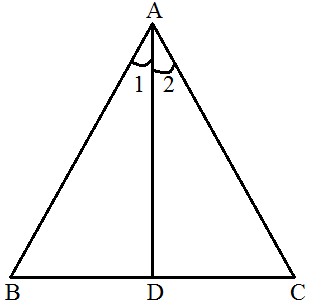
In fig. $\triangle\text{ABC}$ is a triangle such that $\frac{\text{AB}}{\text{AC}}=\frac{\text{BD}}{\text{DC}},\angle\text{B}=70^\circ,\angle\text{C}=50^\circ.$ Find the $\angle\text{BAD}.$
Ramkali would need Rs. 1800 for admission fee and books etc., for her daughter to start going to school from next year. She saved Rs. 50 in the first month of this year and increased her monthly saving by Rs. 20. After a year, how much money will she save? Will she be able to fulfil her dream of sending her daughter to school?
Four equal circles, each of radius a, touch each other. Show that the area between them is $\frac{6}{7}\text{a}^2$ $\Big(\text{Take }\pi=\frac{22}{7}\Big).$
Solve the following quadratic equation by completing the square method.
$5 x^2=4 x+7=0$
The roots of each of the following quadratic equation are real and equal, find k.
$3 y^2+k y+12=0$