Question
Provide the comparison (analogy) between Electro Statics and Magnetism.

Answer

Electro Statics Magnetism
1Permittivity of free space $($ vaccum $)-\varepsilon_0$1Permeability of free space (vacuum) $-\mu_0$
2Constant $\frac{1}{4 \pi \varepsilon_0}$2Constant $\frac{\mu_0}{4 \pi}$
3Electric Charge $q$3Pole Strength $q_m$
4Electric dipole moment
$p=2 a q$
Direction : $-q$ to $+q$
4Magnetic dipole moment
$m=2 l q_m$
Direction : S to N
5Electric Field ( $\vec{E}$ )5Magnetic Field ( $\vec{B}$ )
6Force acting between two stationary point charges
$F =\frac{1}{4 \pi \varepsilon_0} \cdot \frac{q_1 q_2}{r^2}$
6Magnetic force acting between two stationary magnetic poles,
$F =\frac{\mu_0}{4 \pi} \cdot \frac{q_{m_1} \cdot q_{m_2}}{r^2}$
7Electric field on the axis of an electric dipole
$E =\frac{1}{4 \pi \varepsilon_0} \cdot \frac{2 p}{r^3}$
7Magnetic field on the axis of a magnetic dipole
$B =\frac{\mu_0}{4 \pi} \cdot \frac{2 m}{r^3}$
8Electric field on the equatorial axis of electric dipole
$E =\frac{-1}{4 \pi \varepsilon_0} \cdot \frac{p}{r^3}$
8Magnetic field on the equatorial axis of a magnetic dipole
$B =\frac{-\mu_0}{4 \pi} \cdot \frac{m}{r^3}$
9Torque acting on an electric dipole in uniform electric field $\vec{\tau}=\vec{p} \times \overrightarrow{ E }$9Torque acting on a magnetic dipole in uniform magnetic field $\vec{\tau}=\vec{m} \times \overrightarrow{ B }$
10Potential energy of an electric dipole in uniform electric field
$\begin{aligned}
U & =-\vec{p} \cdot \overrightarrow{ E } \\
& =-p E \cos \theta
\end{aligned}$
10Potential energy of a magnetic dipole in uniform magnetic field
$\begin{aligned}
U & =-\vec{m} \cdot \overrightarrow{ B } \\
& =-m B \cos \theta
\end{aligned}$
11Work required to be done in moving an electric dipole from angle $\theta_1$ to $\theta_2$ in uniform electric field, $W =p E \left(\cos \theta_1-\cos \theta_2\right)$11Work required to be done in moving a magnetic dipole from angle $\theta_1$ to $\theta_2$ in uniform magnetic field, $W = mB \left(\cos \theta_1-\cos \theta_2\right)$

Need a full question paper?

Generate a complete, print-ready paper with questions like this in minutes — across 16+ boards, with answer keys.
Start Generating Free

Similar questions

The output of an OR gate is connected to both the inputs of a NAND gate. Draw the logic circuit of this combination of getes and write its truth table.
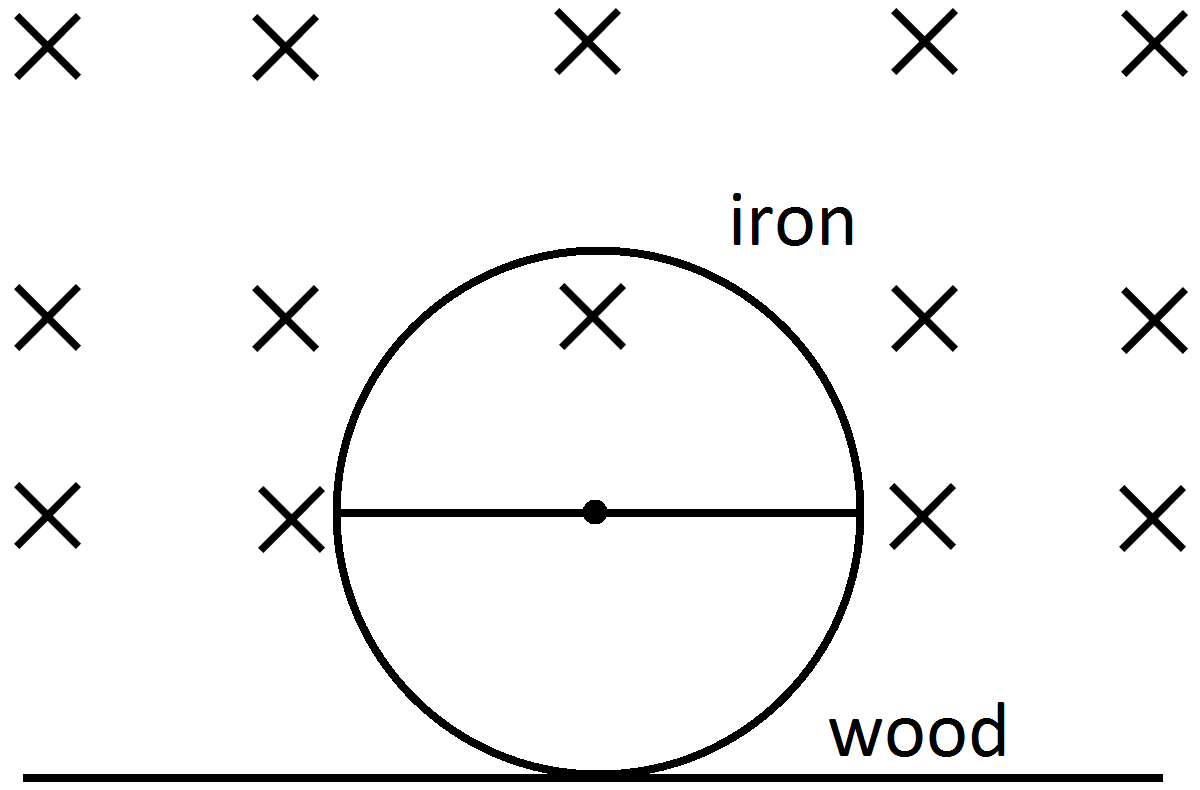
Figure shows a circular wheel of radius $10.0\ cm$ whose upper half, shown dark in the figure, is made of iron and the lower half of wood. The two junctions are joined by an iron rod. A uniform magnetic field $B$ of magnitude $2.00 \times 10^{-4} T$ exists in the space above the central line as suggested by the figure. The wheel is set into pure rolling on the horizontal surface. If it takes $2.00$ seconds for the iron part to come down and the wooden part to go up, find the average emf induced during this period.
A steel tube of length 1.00m is struck at one end. A Find the time gap between the two hearings. Use the person with his ear close to the other end hears the table in the text for speeds of sound in various sound of the blow twice, one travelling through the body substances. of the tube and the other through the air in the tube. Find the time gap between the two hearings. Use the table in the text for speeds of sound in various substances.
  1. Can two equipotential surfaces intersect each other? Give reasons.
  2. Two charges – q and +q are located at points A (0, 0, –a) and B (0, 0, +a) respectively. How much work is done in moving a test charge from point P (7, 0, 0) to Q (-3, 0, 0)?
The force acting on a particle moving along $X-$axis is $F = -k(x - u_0t)$ where $k$ is a positive constant. An observer moving at a constant velocity $v_0,$ along the $X-$axis looks at the particle. What kind of motion does he find for the particle?
Use the formula $\lambda_{ m } T =0.29 cm K$ to obtain the characteristic temperature ranges for different parts of the electromagnetic spectrum. What do the numbers that you obtain tell you?
An $\alpha$-particle and a proton are accelerated through the same potential difference. Find the ratio of their de Broglie wavelength.
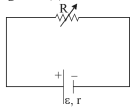
A variable resistor R, electromotive force and internal resistance $r$ are joined as shown in the given figure across the ends of the cell. Draw graph to show (i) terminal voltage and (ii) current $I$ as a function of $R$.
Image
Is there any lower limit to the electric force between two particles placed at a separation of 1cm ?
The phenomenon of diffraction is commonly seen in sound waves. But generally not in light waves, why?