Question 12 Marks
Explain Gauss's law for magnetism
Answer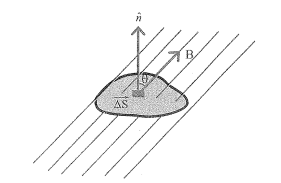
→As shown in the Fig., consider a surface ' S ' in a uniform magnetic field.
→To calculate the magnetic flux associated with the surface, imagine the surface ' S ' to be divided into many small area elements.
→Consider a small vector area element $\overrightarrow{\Delta S}$ from all such area elements.
→Magnetic flux passing through this area element.
$\Delta \phi_{ B }=\overrightarrow{ B } \cdot \overrightarrow{\Delta S }$
→Total magnetic flux associated with the surface S ,
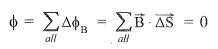
[That is because, for any enclosed surface, number of magnetic field lines leaving the surface is same as the number of field lines entering the surface. This means that the total positive flux is same as total negative fiux and hence the net magnetic flux is zero.]
In the eq. (1) 'all' stands for 'all area elements $\overrightarrow{\Delta S}$ '. This can be compared with the Gauss's law of electrostatics.
$\sum \overrightarrow{ E } \cdot \overrightarrow{\Delta S }=\frac{q}{\varepsilon_0}$
→From eq. (1), the Gauss's law for magnetism can be written as follows :
"The net magnetic flux through any closed surface is zero."
→Magnetic flux is a scalar quantity. SI unit of magnetic flux is :
$W b \text { (weber) }= T m^2$
View full question & answer→→As shown in the Fig., consider a surface ' S ' in a uniform magnetic field.
→To calculate the magnetic flux associated with the surface, imagine the surface ' S ' to be divided into many small area elements.
→Consider a small vector area element $\overrightarrow{\Delta S}$ from all such area elements.
→Magnetic flux passing through this area element.
$\Delta \phi_{ B }=\overrightarrow{ B } \cdot \overrightarrow{\Delta S }$
→Total magnetic flux associated with the surface S ,
[That is because, for any enclosed surface, number of magnetic field lines leaving the surface is same as the number of field lines entering the surface. This means that the total positive flux is same as total negative fiux and hence the net magnetic flux is zero.]
In the eq. (1) 'all' stands for 'all area elements $\overrightarrow{\Delta S}$ '. This can be compared with the Gauss's law of electrostatics.
$\sum \overrightarrow{ E } \cdot \overrightarrow{\Delta S }=\frac{q}{\varepsilon_0}$
→From eq. (1), the Gauss's law for magnetism can be written as follows :
"The net magnetic flux through any closed surface is zero."
→Magnetic flux is a scalar quantity. SI unit of magnetic flux is :
$W b \text { (weber) }= T m^2$