MCQ
[Pt(NH3)4][CuCl4] and [Cu(NH3)4][PtCl4] are known as:
- AIonisation isomers
- BCoordination isomers
- CLinkage isomers
- DPolymerisation isomers.
Explanation:
Different complex ions have the same molecular formula. Ligands are interchanged between the complex cation and complex anion. These type of complexes are called coordination isomers.
In [Pt(NH3)4][CuCl4], ammonia ligands are attached to Pt metal and chloride ligands are attached to Cu metal.
In [Cu(NH3)4][PtCl4], ammonia ligands are attached to Cu metal and chloride ligands are attached to Pt metal.
Generate a complete, print-ready paper with questions like this in minutes — across 16+ boards, with answer keys.
On addition of equal number of moles of a non-volatile solute $S$ in equal amount (in $kg$ ) of these solvents, the elevation of boiling point of solvent $X$ is three times that of solvent $Y$. Solute $S$ is known to undergo dimerization in these solvents. If the degree of dimerization is $0.7$ in solvent $Y$, the degree of dimerization in solvent $X$ is. . . . . . .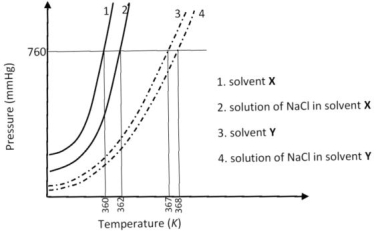
$\underset{({{C}_{2}}{{H}_{6}}O)}{\mathop{X}}\,\,\xrightarrow[573\,\,K]{Cu}$ $A$ $\xrightarrow[^{-}OH\,,\,\Delta ]{{{[Ag{{(N{{H}_{3}})}_{2}}]}^{+}}}$ Silver mirror
$A\,\xrightarrow{^{-}OH\,,\,\Delta }Y$
$A\,\xrightarrow{N{{H}_{2}}NHCON{{H}_{2}}}Z$
If the rate of formation of $B$ is set to be zero then the concentration of $B$ is given by :